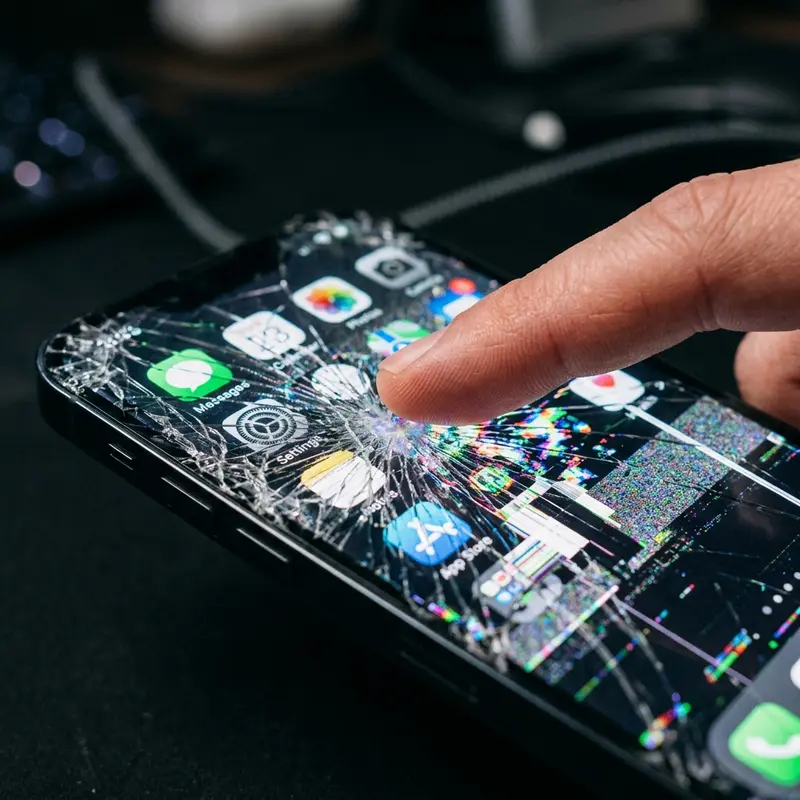
If your iPhone screen is unresponsive, clean it, force restart (Volume Up, Volume Down, then hold Power), or reinstall iOS via Recovery Mode.
A frozen or unresponsive touchscreen on an iPhone is one of the most frustrating experiences a user can face. Because iOS relies entirely on gesture inputs, a failure in the touch digitizer stack effectively locks you out of your device. Whether your screen is completely dead, registering phantom touches (ghost touching), or freezing intermittently, the root cause lies in a breakdown somewhere between the glass display assembly, the controller board, and the operating system's kernel driver level.
In this comprehensive, engineer-grade guide, we will analyze the biomechanics of iPhone touch failure, run a step-by-step diagnostic sequence to identify the culprit, provide advanced software fixes, and break down the repair options and costs for 2026.
Dica DomineTec: Always back up your data via iCloud or a computer before attempting hardware diagnostics or recovery restorations, as sudden hardware failures can sometimes result in data loss during troubleshooting.
Why Is Your iPhone Touchscreen Not Responding?
To understand why an iPhone screen stops responding, we must look at how modern capacitive displays function. The iPhone display assembly is not a single piece of glass, but a multi-layered sandwich consisting of the cover glass, an oleophobic coating, a capacitive digitizer grid, an OLED or LCD display panel, and a structural frame. When this stack or its controlling chips fail, input signals fail to reach the processor.
The Physics of Capacitive Touchscreens
Modern iPhones use mutual capacitance technology. The digitizer layer contains a grid of microscopic electrostatic sensors driven by transmitter and receiver lines. When your finger—which carries a natural electrical charge—touches the glass, it alters the local electrostatic field, drawing a minute amount of electrical current to the point of contact. This change in capacitance is detected by the touch controller IC (Integrated Circuit), which translates the analog coordinates into digital coordinates and transmits them to the CPU via high-speed SPI or I2C serial buses.
Any disruption to this electrostatic field (such as moisture, oil, static electricity, or non-conductive dirt) or physical damage to the copper grid lines will prevent the digitizer from registering the change in capacitance. Consequently, the CPU receives no coordinates, resulting in an unresponsive display.
Software-Level Bottlenecks and Touch Event Dropping
Sometimes, the hardware digitizer works perfectly, but the software fails to process the input. Within iOS, touch events are handled by the Backboardd daemon and the SpringBoard process. If the CPU is undergoing thermal throttling, running out of RAM, or dealing with a kernel panic caused by a corrupted application, the Main Thread responsible for the User Interface (UI) becomes blocked. When CPU utilization hits 100%, touch events queued by the digitizer driver are dropped, giving the illusion of hardware touch failure.
Hardware Failures: The Digitizer and the Logic Board
On the hardware side, the failure points are typically categorized into three areas:
- Digitizer Flex Cable Damage: The delicate ribbon cable connecting the display to the logic board can crack, tear, or become loose after a drop, interrupting the power or signal paths.
- Integrated Touch IC Failures: On modern iPhones, the Touch IC is directly integrated onto the display assembly itself, meaning physical screen damage is the primary cause of controller failure.
- Motherboard Board-Level Micro-cracks: Drops can fracture the micro-solder balls under the CPU or the connectors on the logic board, breaking the circuit path between the screen connector and the main processor.
Quick Diagnostic: Finding the Root Cause
Before spending money on repairs, you need to isolate whether your issue is caused by external interference, temporary software crashes, structural hardware damage, or deep logic board issues. Use the comparison diagnostic matrix below to locate your symptom.
| Symptom | Probable Cause | Severity | Quick Action |
|---|---|---|---|
| Entire screen frozen, buttons still click and show volume overlay | OS UI process freeze or driver hang | Low | Force restart the device |
| Intermittent touch loss, works when squeezing the top edges | Loose digitizer FPC connector or micro-fracture | Medium-High | Professional reseating or screen replacement |
| Specific horizontal or vertical strip of screen has a dead zone | Broken digitizer trace line (physical damage) | Medium | Replace the display panel assembly |
| Ghost touching (apps open on their own, screen clicks randomly) | Local capacitance distortion or damaged digitizer IC | Medium | Clean display, remove screen protector, replace screen if persistent |
Intermittent vs. Constant Unresponsiveness
If your screen responds fine most of the time but suddenly freezes for a few seconds before working again, it is likely a software daemon crashing and restarting. On the other hand, if the screen remains completely black or backlit but refuses to register any touch whatsoever from the moment of boot, the communication line between the display's integrated circuit and the CPU is physically compromised.
Localized Dead Zones vs. Full Screen Freeze
A localized dead zone—where a specific area (like the keyboard spacebar region or the top notification area) does not respond—is almost always a hardware digitizer issue. You can test this by opening the native Notes app, choosing the markup draw tool, and attempting to scribble all over the screen. If you find a clean, empty band where the brush strokes cannot draw, you have a physically broken sensor line inside the screen stack.
Fix 1 — Clean the Display and Remove Screen Protectors/Cases
Many users overlook how easily external physical factors can manipulate or block the electrical conductivity of their display's capacitive grid.
Understanding Oleophobic Coating Wear
Every iPhone comes from the factory with an oleophobic (oil-repellent) coating bonded to the glass surface. This coating repels natural skin oils and moisture, allowing your finger to glide smoothly. Over time, as this coating wears away due to friction and chemical exposure (like using isopropyl alcohol over 70% or window cleaner), oils can build up. This oil layer acts as a dielectric barrier, interfering with the capacitive sensors' ability to detect the tiny electrical drop from your finger. To clean your screen safely:
- Turn off your iPhone and unplug all cables.
- Use a dry, lint-free microfiber cloth.
- Wipe in gentle, circular motions to lift away grease and oil.
The Threat of Low-Quality Screen Protectors and Hydrogel Films
Tempered glass protectors and hydrogel films add an extra layer between your finger and the digitizer. Cheap screen protectors often lack precise dielectric properties, meaning they can restrict the electric field. Furthermore, if dust particles, air bubbles, or moisture become trapped under the protector during application, they can create micro-capacitance variances that register as continuous touches. This prevents the digitizer from registering new touches because it believes a contact is already held down. Peel off the screen protector and test the screen bare; this resolves touch issues in a surprising number of cases.
Electrostatic Discharges (ESD) and Case Pressure
Tight protective cases, especially those with built-in screen shields, can apply mechanical pressure to the edges of the display. This pressure can cause the glass to flex slightly, squeezing the digitizer layer against the screen panel, or trigger false edge-rejection algorithms in iOS. Remove the case entirely to see if touch functionality returns.
Dica DomineTec: Avoid using wet wipes with aggressive solvents, hand sanitizers, or abrasive materials like paper towels, which strip the protective oleophobic coating and can seep into the speaker grill, causing short circuits.
Fix 2 — Force Restart Your iPhone
When the screen is unresponsive, you cannot slide the on-screen power slider to turn off your phone. Therefore, you must use a hardware-level override to cut power to the memory controllers and force the processor to reboot.
The Hardware Reset Sequence for Modern iPhones
For the iPhone 8, iPhone SE (2nd & 3rd gen), iPhone X, XR, XS, 11, 12, 13, 14, 15, and 16 series, follow this precise sequence:
- Press and quickly release the Volume Up button.
- Press and quickly release the Volume Down button.
- Press and hold the Side (Power) button.
- Keep holding the side button even after the screen goes black, and only release it when the white Apple logo appears.
Make sure you execute these button presses in quick succession. If you hold the volume and side buttons simultaneously, you will trigger the emergency SOS screen instead of a force restart.
Resetting the Digitizer Interface Bus Power
A force restart does not just reboot the operating system; it triggers a hardware power cycle. This cuts the power line to the display's FPC connector, discharging the capacitors on the screen's logic board. Once the system reboots, the CPU restarts the I2C/SPI communication protocol with the touch controller, re-initializing the driver and resolving any software lockups that were ignoring touch inputs.
Fixes 3 and 4 — Storage Free-Up and Recovery Mode Reinstall
If the touch screen works briefly on startup but freezes shortly after, a system-level storage overflow or software corruption is likely the culprit.
Storage Saturation and the iOS Main Thread Starvation
When an iPhone reaches 99% or 100% of its storage capacity, the iOS file system (APFS) cannot write temporary cache files, swap space, or database logs. Under these conditions, background processes enter a loop of continuous crash-and-restart. Since the system is desperately trying to clear space and manage system logs, CPU utilization spikes. Because of this, the main system thread becomes starved, ignoring user interactions and digitizer data. To resolve this, connect your iPhone to a computer and check its storage capacity using Finder (macOS) or Apple Devices/iTunes (Windows). If it's full, you must delete media or apps to restore basic touch inputs.
Reinstalling iOS via Recovery Mode
If your screen is completely unresponsive due to system file corruption, a normal restore is impossible. In this scenario, you must place your iPhone into Recovery Mode and perform an operating system reinstall. Doing this refreshes the entire system folder structure while leaving your data intact. You must follow a guide to restore your iPhone without losing data to ensure you do not wipe your device accidentally.
To enter Recovery Mode:
- Connect your iPhone to your computer using a certified USB cable.
- Open Finder on macOS, or the Apple Devices app/iTunes on Windows.
- Perform the force restart sequence: press and release Volume Up, press and release Volume Down, then press and hold the Side button until the computer screen icon appears.
- On your computer, a popup will detect the iPhone in Recovery Mode. Select the Update option. This will download and reinstall the latest compatible iOS version without deleting your data.
Hardware Failures: Repair Costs and Options
If cleaning the screen, force restarting, and updating the OS fail to restore touch response, you are dealing with a physical hardware failure inside the device.
Screen Assembly Replacement: OEM vs. Third-Party Panels
Replacing the screen is the standard remedy when the digitizer layer is damaged. Original Equipment Manufacturer (OEM) screens offer correct color accuracy, high brightness, standard power draw, and full refresh rate capabilities. Aftermarket screens are cheaper but may display cooler color temperatures, draw more battery, and can exhibit micro-lags in touch registration due to lower-quality controller chips.
Logic Board and Touch IC Microsoldering
If a new screen assembly does not restore touch functionality, the problem lies on the logic board itself. In many cases, dropping the phone causes the microscopic solder joints under the Touch Controller IC or the FPC connector pins to crack. Repairing this requires a specialist technician using micro-soldering tools and a hot-air rework station to either reball the existing chip or replace it with a new one.
Repair Cost Breakdown by Model Class
The cost of repairing an unresponsive touchscreen depends heavily on the model of your iPhone and whether the damage is limited to the screen assembly or extends to the motherboard. Here is a realistic estimate of repair costs in 2026:
- Older/Budget Models (iPhone SE, iPhone 11, iPhone 12):
- Third-Party Screen Replacement: $80 - $120
- Apple Authorized Screen Replacement: $129 - $199
- Motherboard Touch IC Repair: $100 - $150
- Third-Party Screen Replacement: $150 - $220
- Apple Authorized Screen Replacement: $229 - $329
- Motherboard Touch IC Repair: $180 - $250
- Third-Party Screen Replacement: $220 - $300
- Apple Authorized Screen Replacement: $329 - $379
- Motherboard/Connector Micro-soldering: $250 - $350
Authorized vs. Independent Shops: Serialized Part Pairing & True Tone
Apple uses software locks on modern iPhones. If you replace the screen at an independent shop, iOS will detect that the screen's serial number does not match the motherboard's stored cryptographic keys. This will result in an "Important Display Message" warning, and you will lose the True Tone display feature. The technician must transfer the EEPROM data from the old screen to the new screen using a programmer tool to preserve True Tone, or use Apple's self-service repair system. If you ever need to perform other administrative tasks like to unlock your iPhone when forgot password, having an authentic screen ensures that recovery tools run smoothly.
FAQ (Frequently Asked Questions)
Why does my screen freeze randomly and work again later?
Random freezing that resolves itself is usually a software-level issue where the iOS UI thread is blocked by an overloaded CPU or memory leak. It can also be caused by temperature extremes: if the iPhone gets too hot, it automatically throttles the processor speed. However, if the issue happens when you flex or tap the phone, it is likely a loose internal display cable or a cracked solder joint that occasionally makes contact.
Can an iOS update cause the touch screen to fail?
Yes, an iOS update can cause touchscreen issues in two main ways. First, if the update process gets interrupted, it can corrupt the system drivers responsible for handling touch inputs. Second, if your iPhone has a previously replaced, non-genuine screen, a new iOS update might lock out the display controller chip because of new firmware security validations. In this case, performing a system update or replacing the screen with a compatible panel is required.
What is the 'Touch Disease' and does it affect newer iPhones?
'Touch Disease' was a structural flaw that affected the iPhone 6 and 6 Plus. Due to structural bending, the solder balls under the Touch IC chip on the motherboard would crack, causing a gray flickering bar and loss of touch input. Newer iPhones (iPhone X and newer) are not affected by this specific issue because Apple relocated the touch controllers directly onto the display assembly and structurally reinforced the frames.
Is it worth replacing only the cracked glass if the touch screen still works?
While some specialized repair shops offer "glass-only" replacements, it is generally not recommended for modern iPhones. Separating the cracked glass from the delicate display panel and digitizer layer requires specialized industrial machinery. If not done perfectly, it can ruin the screen entirely, cause pressure spots, or damage the digitizer, leading to touchscreen failure shortly after. Replacing the entire integrated screen assembly is much safer and more reliable.