
Understanding XLOOKUP: The New Kid on the Block
If you've been using Excel for a while, you've probably heard about the XLOOKUP function. Why, you ask? Because it's the modern replacement for VLOOKUP, and let me tell you, it’s a game-changer! It’s part of Excel 365 and Excel 2021, and for many of us, it's a breath of fresh air after wrestling with VLOOKUP's quirks for years.
In my experience, XLOOKUP simplifies a lot of the headaches associated with searching for data in your spreadsheets. Forget about those clunky VLOOKUP limitations—like the inability to search to the left or the need for sorted data. XLOOKUP handles both of these with ease. So, if you’re still caught up in the VLOOKUP grind, it’s high time you made the switch!
Getting Started with XLOOKUP
The best way to understand XLOOKUP is through a practical example. Imagine you have a financial report where you need to find out the total sales for a specific product. You might have a dataset like this:
| Product | Total Sales |
|---|---|
| Widget A | $1,200 |
| Widget B | $2,500 |
| Widget C | $780 |
To use XLOOKUP here, the formula you’d enter looks something like this:
=XLOOKUP("Widget B", A2:A4, B2:B4)
This means you're searching for "Widget B" in the range A2:A4 and retrieving the corresponding value from B2:B4. Voila! The result would be $2,500. Easy as pie, right?
Why Switch from VLOOKUP to XLOOKUP?
Here are some compelling reasons to ditch VLOOKUP:
- No More Column Index Number: With VLOOKUP, you had to specify the column index number, which could lead to errors if you added new columns. XLOOKUP lets you reference the exact array you want to look up and pull from, eliminating that headache.
- Search in Any Direction: VLOOKUP can only look to the right. XLOOKUP can search both left and right, making it much more flexible.
- Automatic Error Handling: If the lookup value isn’t found, XLOOKUP can return a custom message. No more frustrating #N/A errors!
Dica DomineTec: Always double-check your ranges when using XLOOKUP! It’s easy to miss a row or column, and trust me, it can lead to confusion.

Advanced XLOOKUP Features
What really sets XLOOKUP apart from VLOOKUP are its advanced features. Let’s check out a few that can really supercharge how you use Excel:
- Multiple Criteria Lookup: You can use XLOOKUP for multiple criteria by concatenating values. For instance, if you want to find sales for both “Widget B” in January, you can create a helper column.
- Wildcard Characters: Searching for partial matches is a breeze. Use “*” for any characters or “?” for a single character. So if you search for “Widget*”, it will find all products starting with "Widget".
- Exact Match or Next Smaller/Larger: Instead of just finding an exact match, XLOOKUP can also return the next smaller or larger value if an exact match doesn’t exist.
For example, using a formula like =XLOOKUP("Widget D", A2:A4, B2:B4, "Not Found", 1) would return "Not Found" if there's no match but could give you the next larger sales total.
Common Mistakes to Avoid with XLOOKUP
Even though XLOOKUP is a fantastic tool, there are a few common pitfalls that users might face:
- Forgetting to Use Absolute References: If you're copying your formula to other cells, don't forget to use absolute references (like $A$2:$A$4) to avoid unwanted shifts.
- Incorrect Range Selection: Make sure your lookup array and return array are the same size. A mismatch will throw an error that might leave you scratching your head.
- Overlooking Data Types: If your lookup values are numbers formatted as text, or vice versa, XLOOKUP won't work correctly. Ensure consistency in your data types.
Real-World Applications of XLOOKUP
So, where can you actually use XLOOKUP effectively? Here are a few real-world scenarios:
- Sales Tracking: Use XLOOKUP to find total sales by product over a period. It helps you to quickly analyze which items are performing well.
- Inventory Management: If you’re managing stock levels, XLOOKUP can help you quickly find product counts and reorder levels, avoiding unnecessary stockouts.
- HR Applications: HR professionals can use XLOOKUP to manage employee records, pulling together names and salaries from a list to ensure accurate payroll.
In one instance, I applied XLOOKUP to consolidate employee performance data for a quarterly review. I pulled data from various sheets to create a summary report. Instead of spending hours, it took me just minutes!
Conclusion: Embrace XLOOKUP for Your Excel Needs
As you can see, XLOOKUP is more than just a replacement for VLOOKUP; it’s a significant upgrade. From ease of use to advanced features, it provides everything you need to handle data lookups more efficiently. Whether you’re in finance, inventory management, or HR, this tool can save you time and reduce errors.
If you haven’t started using XLOOKUP yet, I highly recommend giving it a try in Excel 365 or Excel 2021. And if you’re on an older version, consider upgrading—you won't regret it!
For further reading, check out our post on Excel tips and tricks and learn about the capabilities of Excel macros that can elevate your productivity even more.
Advanced Techniques for XLOOKUP in Excel 365
When working with large datasets, standard methods might not always cut it. In my experience managing complex financial reports, leveraging the advanced features of Excel 365 makes a world of difference. You might have noticed that basic approaches can sometimes slow down your spreadsheet, especially when dealing with thousands of rows. But why settle for less when you can optimize?
One trick I always recommend is combining your standard process with dynamic arrays if you're on a newer version. For instance, using shortcuts like Ctrl+Shift+L to toggle filters before you apply any major transformations can save you from accidental data loss. Have you ever applied a change only to realize it affected hidden rows? It's a nightmare. Always ensure your data is visible. Moreover, utilizing the Alt+F11 shortcut to peek into VBA can open up possibilities for automation, even if you just record a macro initially.
Another aspect often overlooked is the power of Named Ranges. Instead of referencing standard cell arrays, giving them a meaningful name makes your formulas readable and your processes less error-prone. This ties directly into mastering XLOOKUP. When you apply these methods, not only does your spreadsheet run faster, but your colleagues will also thank you for making the data easier to understand. Always remember to use Ctrl+Z if things go sideways, but with careful planning, you won't need it often.
Common Pitfalls and Troubleshooting XLOOKUP
Even seasoned professionals run into issues when dealing with XLOOKUP. Just last week, while working on an inventory management dashboard, a colleague spent hours trying to figure out why their data wasn't aligning correctly. The culprit? Hidden characters and trailing spaces. Before you dive deep into your workflow, always consider running the TRIM() and CLEAN() functions on your raw data.
DomineTec Tip: Always clean your data before applying complex operations. A simple =TRIM(A2) can save you hours of debugging!
It's fascinating how different versions, like Excel 2019 versus Excel for Mac, handle background processing. Sometimes, what works seamlessly on a PC might require a slight adjustment on a Mac. If you're using keyboard shortcuts, remember that Mac users often rely on Cmd instead of Ctrl. Have you ever tried sharing a workbook only to find the formatting completely broken on the recipient's end? This usually happens due to version incompatibility or unsupported features.
To avoid these pitfalls, I always advise saving a backup copy of your data (F12 is your best friend for a quick Save As). Whether you are formatting cells, writing complex syntax like =VLOOKUP(A2,Sheet2!$A:$D,3,FALSE), or simply adjusting your print area, having a fallback ensures you never lose critical work. Troubleshooting doesn't have to be daunting if you approach it systematically.
Optimizing Workflow with XLOOKUP
Let's talk about efficiency. In the modern workplace, speed is just as important as accuracy. When I first started working with Excel Online, I realized that optimizing my workflow was crucial for collaborative projects. Managing XLOOKUP effectively means less time clicking around and more time actually analyzing the results.
Consider the use of Excel Tables (Ctrl+T). When you convert your standard range into a table, any new data added automatically inherits the formatting and formulas. This is a game-changer for dynamic datasets like HR tracking or weekly sales reports. Why manually drag down formulas when Excel can do it for you? Furthermore, integrating these tables into your daily routine reduces the risk of human error.
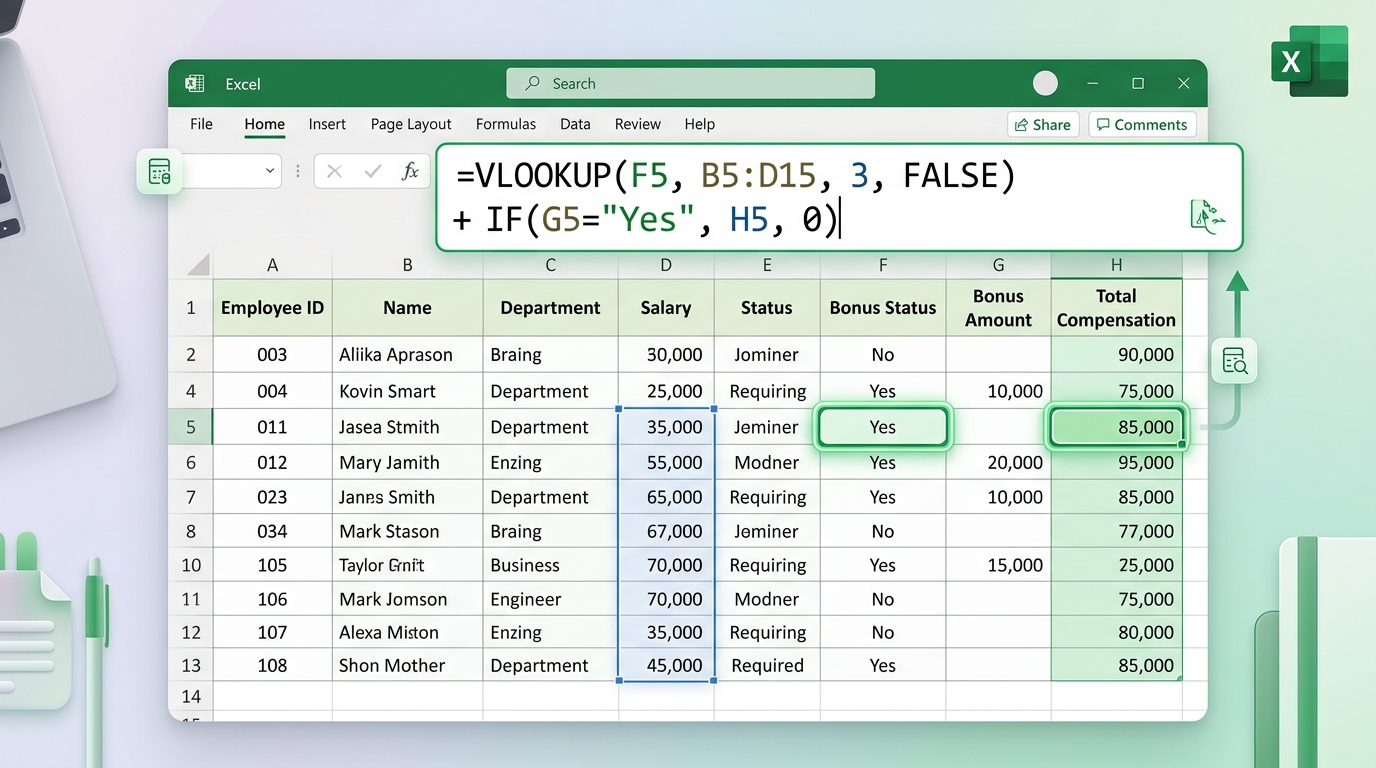
Beyond tables, understanding absolute and relative referencing is vital. Pressing F4 to lock your cell references (like changing A1 to $A$1) ensures that when you copy your logic across columns, it points exactly where it should. Combining these fundamental practices with XLOOKUP will elevate your spreadsheet skills from average to expert level, impressing your boss and saving you countless hours.
Integrating XLOOKUP into Daily Operations
One of the most frequent questions I get asked is how to make these skills stick. The answer is integration. You shouldn't just learn about XLOOKUP and forget it; it needs to become a part of your daily muscle memory. For example, if you manage a sales dashboard, make it a habit to check your data integrity every morning using the techniques we've discussed.
If you're still using legacy systems or older versions like Excel 2016, you might find some newer functions missing. However, the core logic remains the same. You can always use alternative methods, such as combining INDEX and MATCH if newer lookups aren't available. It's about being adaptable. "The only constant in technology is change," as they say, and Excel is no exception.
DomineTec Tip: Build a template for your most common tasks. Having a pre-formatted structure allows you to focus on the data rather than the setup.
Finally, don't underestimate the power of visual feedback. Using Conditional Formatting alongside your main tasks can immediately highlight anomalies or trends. Setting up rules to flag duplicate entries, highlight top performers, or identify missing data makes your work not just functional, but visually compelling. When XLOOKUP becomes second nature, you'll wonder how you ever managed without it.
Real-World Examples: XLOOKUP in Action
Theory is great, but practical application is where the magic happens. Let's look at a scenario involving a mid-sized retail company. They were struggling with consolidating their monthly sales reports. By applying the principles of XLOOKUP, they managed to reduce their reporting time by 40%. It's incredible what a few well-placed formulas and organized data structures can achieve.
In another case, an HR department needed to track employee attendance and performance metrics across different branches. They utilized Excel 365's collaborative features, allowing multiple managers to input data simultaneously. By enforcing strict data validation and using the techniques discussed here, they eliminated inconsistencies. They used formulas like =COUNTIFS(B:B, ">"&TODAY()-30, C:C, "Present") to dynamically track recent activity.
These aren't just isolated incidents. Whether you are a student managing a budget, a small business owner tracking inventory, or a corporate analyst dealing with big data, the application of XLOOKUP scales to your needs. The key takeaway here is that Excel is a versatile tool, and mastering its nuances empowers you to tackle almost any data challenge with confidence.
FAQs about XLOOKUP
1. What versions of Excel support XLOOKUP?
XLOOKUP is available in Excel 365 and Excel 2021. Unfortunately, it’s not available in earlier versions like Excel 2019 or Excel for Mac prior to 2021.
2. Can I use XLOOKUP for partial matches?
Yes! You can use wildcard characters like “*” or “?” in your XLOOKUP formula to find partial matches. This feature makes it a lot easier to work with fuzzy data.
3. What is the default match type in XLOOKUP?
The default match type for XLOOKUP is an exact match. However, you can change it to find the next larger or smaller values if an exact match isn’t found.
4. Is it possible to use XLOOKUP with multiple criteria?
Absolutely! While XLOOKUP doesn’t natively support multiple criteria, you can use techniques like concatenating values in a helper column to make it work.
5. How does XLOOKUP compare to INDEX-MATCH?
XLOOKUP is generally more straightforward than INDEX-MATCH, as it consolidates the search and retrieval process into one function. INDEX-MATCH can be more complex, especially for new users.