How to Install and Use ControlNet in Stable Diffusion WebUI

Learn how to install ControlNet in Stable Diffusion Automatic1111 WebUI to enhance your image generation capabilities using pose control and depth vectors.
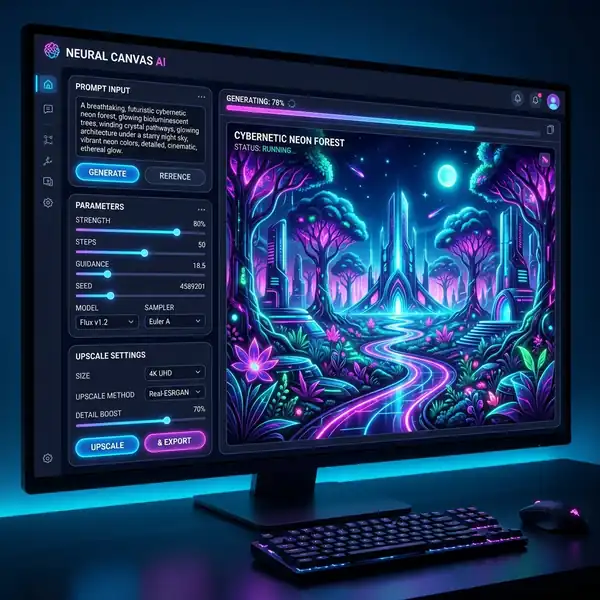
Introduction to ControlNet: Moving Beyond Basic Prompt Limitations
DomineTec Tip: Enable multi-controlnet in your settings to chain OpenPose and Canny together for perfect character creations. If you're building a content workflow, check best Leonardo AI models for realism.
ControlNet is an advanced extension designed for the Stable Diffusion Automatic1111 WebUI that enhances the model's ability to generate images based on user-defined structures. Traditional text prompts can often lead to ambiguous interpretations by the model, resulting in outputs that may not align with the user's intent. ControlNet addresses this limitation by allowing users to control various aspects of image generation, such as human poses, line art, and depth vectors, using explicit guidance. Essentially, ControlNet serves as a bridge between abstract textual prompts and the visual outputs, enabling more precise and desirable results.
Step-by-Step: Installing ControlNet on Automatic1111 WebUI Using Extensions Tab
| ControlNet Model | Core Purpose | Best Use Case |
|---|---|---|
| OpenPose | Extracts bone and pose coordinates from a reference figure | Enforcing precise actions and character stances |
| Canny | Extracts clean wireframe outlines (hard edges) | Redraw logos or keep graphic layouts intact |
To begin utilizing ControlNet, you need to install it as an extension within the Stable Diffusion Automatic1111 WebUI. Follow these detailed steps to ensure a proper installation:
Prerequisites
- Ensure you have the latest version of Stable Diffusion Automatic1111 WebUI running on your system.
- Verify that your system meets the necessary hardware and software requirements for running Stable Diffusion and ControlNet.
- Have Git installed on your machine, as it will be used to clone the ControlNet repository.
Installation Process
-
Launch your terminal or command prompt.
-
Navigate to the directory where your Stable Diffusion WebUI is installed. This is typically where the webui-user.bat or webui.sh file is located.
For example:
cd path/to/your/stable-diffusion-webui
-
Use the following Git command to clone the ControlNet repository into your extensions folder:
git clone https://github.com/Mikubill/sd-webui-controlnet.git extensions/sd-webui-controlnet
-
Once cloned, navigate to the ControlNet directory:
cd extensions/sd-webui-controlnet
-
Install the required dependencies by running the following command:
pip install -r requirements.txt
-
After installation, go back to your root Stable Diffusion directory:
cd ../../
-
Launch the WebUI by running:
python app.py
or for Windows users:
webui-user.bat
Once the WebUI is running, navigate to the Extensions tab in the interface to verify that ControlNet is successfully listed and enabled.
Downloading and Placing ControlNet Model Weight Files (.pth) Inside the Correct Directory
After successfully installing the ControlNet extension, the next step is to download the ControlNet model weight files, which are essential for the functionality of the extension. These files contain the pretrained weights necessary for the various models that ControlNet utilizes.
Finding and Downloading ControlNet Weights
-
Visit the official GitHub page for ControlNet or a trusted repository where the model weights are hosted. Typically, the weights can be found in releases or under specific model files.
-
Download the desired ControlNet model weights, which usually come in a .pth file format. Common models include:
- controlv11psd15_openpose.pth
- controlv11psd15_canny.pth
- controlv11psd15_depth.pth
Once downloaded, locate the models directory within your Stable Diffusion installation. This is typically located at:
path/to/your/stable-diffusion-webui/models/controlnet
If the controlnet folder does not exist, create it. Place all downloaded .pth files into this folder.
Verifying Model Weights
To ensure that the model weights are recognized by the ControlNet extension, restart the Stable Diffusion WebUI. You can check the logs in the terminal or command prompt to confirm that the weights have been loaded successfully. If there are any errors, re-download the weights and ensure they are placed in the correct directory.

Core Modules Decoded: OpenPose, Canny, Scribble, and Depth Mapping
ControlNet offers several core modules that allow you to guide the image generation process with different types of input. Understanding these modules is essential for effectively utilizing ControlNet's capabilities.
OpenPose
OpenPose is a popular method for detecting human poses in images. It generates a skeletal representation of the human figure, which can be used to guide the model in generating accurate human figures in the output.
- How it works: OpenPose uses a convolutional neural network to predict body key points, which represent specific joints in the human body. The output is a set of coordinates that can be fed into the image generation model.
- Applications: Use OpenPose when you want to maintain accurate human poses in your generated images, making it particularly useful for character design or illustrations.
Canny
The Canny module applies an edge detection algorithm to input images. This method is particularly useful for generating line art or outlines that can serve as a guiding structure for the image generation process.
- How it works: The Canny edge detection algorithm identifies strong gradients in the image, marking the edges. These edges can then be interpreted by the model to generate detailed outputs based on the given outlines.
- Applications: Use the Canny module when you want to create stylized images or illustrations based on simple outlines or sketches.
Scribble
The Scribble module allows users to input rough sketches or scribbles that the model will interpret. This is an intuitive way to guide the generation process without needing detailed line art.
- How it works: The Scribble module processes the input sketch and identifies areas of interest, such as shapes and outlines, which the model can then use to generate a more refined image.
- Applications: Utilize Scribble for quick concept art or when you want to experiment with different compositions without investing time in detailed drawings.
Depth Mapping
Depth mapping adds another layer of control by allowing users to define the depth of various elements in the image. This module provides spatial information that guides the model in generating images with realistic depth perception.
- How it works: Depth maps indicate the distance of various objects in the scene from the camera, helping the model to create a sense of three-dimensionality in the output.
- Applications: Use depth mapping for scenes requiring realistic perspectives, such as landscapes or architectural visualizations.

Workflow Tutorial: Guiding a Pose from a Source Photo to Your Final Render
Now that you have ControlNet installed and understand the core modules, let’s walk through a comprehensive workflow that demonstrates how to guide a pose from a source photo to your final render using ControlNet.
Step 1: Prepare Your Source Photo
Select a high-quality photo that clearly displays the pose you want to replicate. This photo will be used as input for the OpenPose module to generate the necessary key points.
Step 2: Use OpenPose to Generate Pose Coordinates
-
Upload your selected source photo to the ControlNet interface in the Automatic1111 WebUI.
-
Activate the OpenPose module from the available options.
-
Run the processing. The output will display the detected skeleton overlaying your image, providing you with the pose coordinates.
Step 3: Prepare a Base Image for Generation
Choose or create a base image that will serve as the canvas for your final render. This can be a blank canvas or a simple background image.
Step 4: Input Pose Coordinates into the ControlNet
-
In the ControlNet interface, input the generated pose coordinates from OpenPose.
-
Select your desired model weights, ensuring that the ControlNet is set to use the OpenPose weights.
-
Adjust any additional parameters, such as scale and guidance strength, to fine-tune how closely the generated output should adhere to the pose.
Step 5: Generate Your Image
-
With everything set up, click on the generate button. The model will process the input data and produce an image that aligns with the specified pose and any additional parameters you have set.
-
Review the generated image. If necessary, make adjustments to the input parameters and re-generate to refine the output.
Step 6: Post-Processing (Optional)
After obtaining your desired output, you may want to engage in post-processing to enhance the image further. This can be done using image editing software or additional filters in the WebUI.
Conclusion
ControlNet significantly enhances the capabilities of the Stable Diffusion Automatic1111 WebUI by allowing users to exert more control over the image generation process. By following the steps outlined above, you can effectively install ControlNet, download the necessary model weights, and utilize various core modules to guide your artistic vision. Whether working with human poses, line art, or depth maps, ControlNet opens up new avenues for creativity and precision in generating visual content.
Additional Resources and Recommended Links
For more guides and tutorials on AI image and video generators, check out our step-by-step articles on best Leonardo AI models for realism and can I use Leonardo AI images commercially. For official platforms and tools, visit the sd-webui-controlnet GitHub Repository.
Advanced Configuration and Optimization Techniques for ControlNet in Stable Diffusion WebUI
When integrating ControlNet within the Stable Diffusion WebUI, users often seek to maximize the efficacy of their image generation workflows. A significant aspect of this endeavor lies in understanding the advanced configuration settings that ControlNet offers. These settings can significantly influence the model's performance, stability, and output quality. For example, adjusting the resolution of the input images can yield different results, as ControlNet's architecture is sensitive to the pixel dimensions of the images it processes. It is recommended to start with a base resolution that aligns with your specific use case, whether it be for creating high-resolution artwork or generating images for social media content. Additionally, experimenting with the aspect ratio can help achieve the desired composition in the final output, allowing for greater creativity and adaptability in design projects.
Another important area to explore is the integration of ControlNet with various pre-processing techniques. Pre-processing steps, such as normalization and data augmentation, can enhance the input images' quality before they are fed into the model. For instance, applying filters or corrections to improve lighting and contrast can lead to more detailed and visually appealing results. Moreover, using augmentation techniques like rotation, scaling, or cropping can provide the model with a diverse range of inputs, which can help it generalize better. This is especially useful in applications where ControlNet is employed for tasks such as style transfer or image enhancement, as it can learn to adapt to different artistic styles or scenarios more effectively.
Workflow integration is another essential aspect to consider when utilizing ControlNet in Stable Diffusion WebUI. By connecting ControlNet with other tools and platforms, users can streamline their creative processes and improve efficiency. For example, integrating ControlNet with project management software or design tools can facilitate better collaboration among team members. This can be achieved through APIs or custom scripts that automate the transfer of assets and results between different applications. Additionally, leveraging cloud services for storage and processing can provide scalability, enabling users to handle larger datasets and more complex models without compromising on performance. This integration ensures that the creative workflow remains fluid, allowing for rapid iteration and refinement of ideas.
Lastly, it is vital to focus on optimization techniques that can enhance the performance of ControlNet while minimizing resource consumption. Users can explore various optimization strategies, such as fine-tuning the model parameters, adjusting the learning rate, or employing early stopping during training. These methods can lead to faster convergence and improved output quality. Furthermore, utilizing techniques like mixed precision training can significantly reduce memory usage and increase training speed, making it feasible to work with larger datasets or more complex models. Monitoring system performance through profiling tools can also help identify bottlenecks and optimize computational resources, ensuring that users can achieve the best possible results with ControlNet in their image generation workflows.
Advanced Configuration and Optimization Techniques for ControlNet in Stable Diffusion WebUI
When working with ControlNet in Stable Diffusion WebUI, the ability to fine-tune and optimize your setup is important for achieving the best results. One of the first steps in advanced configuration is to understand the various parameters that can be adjusted within the ControlNet framework. The primary settings include the input resolution, the number of control layers, and the guidance scale. Each of these settings plays a significant role in how effectively ControlNet can interpret and generate images based on your prompts. For instance, higher input resolutions can lead to more detailed outputs but may require more computational resources, which is a vital consideration for users with limited hardware capabilities.
Another important aspect to consider is the integration of ControlNet with other features within the Stable Diffusion WebUI. Users can enhance their workflow by utilizing the various model checkpoints available. For example, combining ControlNet with a specific model pre-trained on a particular dataset can yield better results for domain-specific tasks such as portrait generation, architecture, or landscape design. This synergy can be achieved by selecting the appropriate model checkpoint in the settings menu and ensuring that the input data aligns with the model's training focus. Additionally, experimenting with different models in tandem with ControlNet can lead to unexpected and innovative artistic outcomes, which is particularly useful for artists and designers looking to push the boundaries of generative art.
To further optimize your ControlNet usage, it is advisable to explore batch processing capabilities within the WebUI. This feature allows users to generate multiple images simultaneously, significantly improving workflow efficiency. When working with batch processing, it’s essential to configure the batch size according to your system's performance. Users should monitor CPU and GPU usage to find a sweet spot that maximizes output without causing system crashes or slowdowns. Moreover, implementing a queue system can help manage extensive requests, ensuring that the rendering process remains stable and organized. This method is especially beneficial in collaborative environments where multiple users might be generating images at the same time.
Lastly, real-world use cases of ControlNet in Stable Diffusion WebUI highlight its versatility and power. For instance, in the fashion industry, designers can utilize ControlNet to generate clothing designs based on simple sketches or outlines, allowing for rapid prototyping and iteration. By setting up a dedicated workspace within the WebUI, designers can refine their inputs and outputs, ensuring they capture the essence of their creative vision. Furthermore, photographers can benefit from using ControlNet to enhance their photos by generating artistic variations or edits that maintain the original composition while introducing stylistic changes. This capability not only saves time but also opens new avenues for creativity and expression in various artistic fields.




