Xiaomi Camera Not Connecting to 5GHz Wi-Fi: How to Fix
The Xiaomi 360 camera cannot connect to 5GHz Wi-Fi networks because its internal wireless network controller is hardware-limited to the 2.4GHz frequency band (802.11b/g/n). To resolve this issue, you must split your dual-band router's SSIDs into distinct 2.4GHz and 5GHz networks, disable band steering (Smart Connect), and connect your smartphone to the 2.4GHz band before starting the pairing process in the Mi Home app.
Hardware Limitations: Why the Xiaomi 360 Smart Camera is 2.4GHz Only
Domestic smart security cameras, including the Xiaomi Smart Camera C200, C300, C400, and earlier Mijia 360 models, are designed to balance retail affordability and low power consumption. High-definition or 2K resolution video streaming, when compressed using modern codecs like H.265 or H.264, only requires a continuous upload bandwidth of about 1 Mbps to 2.5 Mbps. Because these bandwidth requirements are relatively low, manufacturers do not need to use expensive dual-band wireless chips.
Instead, these cameras are built with inexpensive wireless network interfaces that operate exclusively on the 2.4GHz frequency spectrum (IEEE 802.11b/g/n). Adding 5GHz (802.11a/n/ac/ax) hardware capabilities would require more complex radio frequency (RF) circuitry on the camera's system board. This includes extra power amplifiers, dual-band antennas tuned to the shorter 5GHz wavelength, and higher licensing costs, which would increase the price of the camera for consumers.
Therefore, the camera's inability to connect to 5GHz networks is a hardware design choice rather than a defect. If you attempt to pair the Xiaomi 360 camera while your smartphone is connected to a 5GHz network, the camera will not detect the router's beacon signals, resulting in "Connection timed out" or "Failed to send network credentials" errors during setup.
Radio Frequency Comparison: Wave Propagation, Signal Attenuation, and Range
To understand why 2.4GHz remains the standard frequency for Internet of Things (IoT) devices and home security cameras, we must look at how electromagnetic waves behave in residential environments. In radio frequency physics, there is an inverse relationship between a wave's frequency and its physical propagation range and ability to pass through solid obstacles.
The 2.4GHz frequency band has a relatively long wavelength (approximately 12 centimeters). This longer wavelength allows the wireless signal to pass through common building materials like drywall, solid wood doors, and furniture with minimal signal loss. In typical home environments, a 2.4GHz Wi-Fi signal can reach up to 40 to 50 meters from the router, maintaining a usable signal level even after passing through multiple walls.
In contrast, the 5GHz frequency band has a much shorter wavelength (approximately 6 centimeters). While 5GHz networks can transfer large amounts of data quickly and suffer from less wireless congestion than 2.4GHz bands, they attenuate rapidly when passing through solid objects. A single brick or concrete wall can drop a 5GHz signal by 15 dB to 20 dB, reducing its effective range to less than 10 to 15 meters. Because home security cameras are often mounted in fixed, distant positions (such as ceilings, hallways, or near entryways), the longer range of the 2.4GHz band is necessary to maintain a stable connection.
The Smart Connect (Band Steering) Problem in Modern Routers
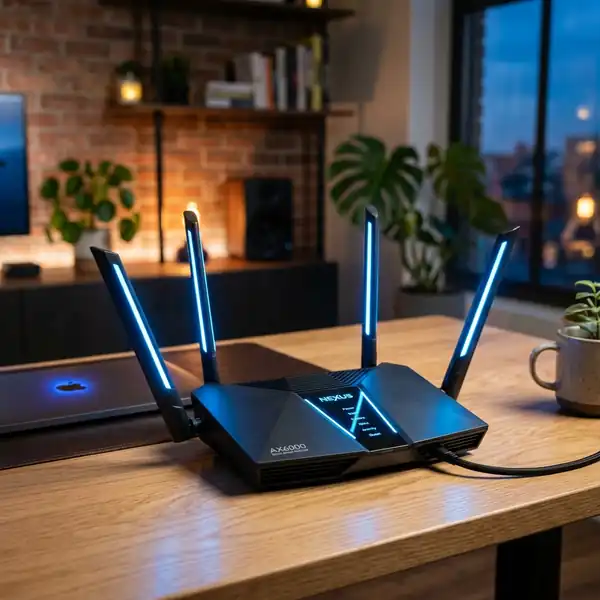
Modern dual-band routers and mesh systems often come with a feature called Smart Connect or Band Steering enabled by default. This feature combines the 2.4GHz and 5GHz frequencies under a single network name (SSID) and password. The router then automatically directs connected devices to the best available frequency band based on their distance and bandwidth usage.
While this automation is convenient for smartphones, tablets, and laptops, it often causes setup errors for 2.4GHz-only smart devices. During the initial pairing of the Xiaomi 360 camera, your smartphone needs to communicate directly with the camera—often by displaying a QR code for the camera to scan or by connecting to a temporary Wi-Fi network hosted by the camera itself.
If your smartphone is connected to a combined Smart Connect network but is currently operating on the 5GHz band (because you are close to the router), the Mi Home app will send the 5GHz network credentials to the camera. When the camera tries to connect using those credentials, it cannot detect the 5GHz signal, causing the pairing process to fail. In addition, some routers block communication between devices on different bands (2.4GHz and 5GHz), preventing the phone and camera from communicating even if they are on the same network name.

How to Separate Router Bands (SSID Splitting): Step-by-Step Guide
The most effective solution for pairing issues with the Xiaomi 360 camera is to split your router's wireless bands into two separate network names. Follow these steps to configure your router:
- Access the Router Admin Panel: Open a web browser on a computer or phone connected to your network. Enter your router's default gateway IP address (common addresses are 192.168.0.1, 192.168.1.1, or 192.168.15.1) into the address bar. Log in using the admin username and password (found on the label on the bottom of the router if they have not been changed);
- Disable Smart Connect: Navigate to the "Wireless Settings" or "Local Network" menu. Locate the setting labeled "Smart Connect", "Band Steering", or "Unify SSIDs" and change its status to "Disabled";
- Rename the Networks: Once Smart Connect is disabled, you will see separate settings for the 2.4GHz and 5GHz wireless bands. Enter a unique name (SSID) for each band. For example:
- 2.4GHz Network Name:
MyNetwork_2G - 5GHz Network Name:
MyNetwork_5G
- 2.4GHz Network Name:
MyNetwork_2G), and enter the password. Temporarily turn off "auto-reconnect" for the 5GHz network to prevent your phone from switching back during setup;Advanced Router Adjustments for Connection Stability
After separating your network bands and pairing the camera, you may still experience intermittent connection drops or video buffering. To improve connection stability, you can adjust several advanced settings on your router.
First, set the Channel Width for the 2.4GHz band. Many routers default to an automatic 20/40 MHz channel width. While 40 MHz channels offer higher potential speeds, they are more susceptible to wireless interference from neighboring networks because they occupy more wireless spectrum. For IP security cameras, which require a stable connection rather than high raw speeds, configure the 2.4GHz channel width to a fixed 20 MHz. This increases signal range and reduces packet loss.
Next, manually select a static Wireless Channel. Setting your router to automatic channel selection can cause temporary connection drops when the router changes channels to avoid noise. On the 2.4GHz band, only channels 1, 6, and 11 do not overlap with each other. Use a free mobile app like Wifi Analyzer to check which of these channels is the least congested in your area, and set your router to use that channel permanently.
On the network layer, assign a Static IP (DHCP Reservation) to your camera's MAC address. This ensures that the router always assigns the same IP address to the camera, even after power outages, which helps prevent IP conflicts and improves connection reliability with local Network Video Recorders (NVRs). Finally, change the router's DNS settings to use reliable public DNS servers like Cloudflare (1.1.1.1 and 1.0.0.1) or Google (8.8.8.8 and 8.8.4.4) to ensure fast and reliable lookups with Xiaomi's cloud servers.
| Technical Feature | 2.4 GHz Band | 5 GHz Band |
|---|---|---|
| Signal Range | Long (up to 45-50 meters indoors) | Short (up to 10-15 meters indoors) |
| Obstacle Penetration | High (passes through walls and wooden doors easily) | Low (strongly attenuated by concrete and brick) |
| Bandwidth (Data Rate) | Lower (sufficient for HD/2K video streaming) | Much Higher (ideal for high-speed downloads) |
| Interference Vulnerability | High (congested by Bluetooth, microwaves, neighbors) | Very Low (larger number of non-overlapping channels) |
| IoT Compatibility | Universal (standard for almost all smart home hardware) | Very Limited (only supported by premium devices) |
Mi Home Settings: Server Regions and Location Permissions
If you have split your Wi-Fi bands and the Mi Home app still fails to pair the camera, the issue may be related to regional restrictions in the Xiaomi software ecosystem. Import versions of Xiaomi cameras (designed for the Chinese domestic market) cannot connect to international servers due to regional IP restrictions in the firmware.
If you try to pair a Chinese-market camera while your Mi Home app region is set to "Brazil" or "United States", the app will not detect the device. To fix this, open the Mi Home app, go to Profile -> Settings -> Region, and change the region to "Chinese Mainland". Note that switching regions will display the devices registered on the Chinese cloud servers, which may require you to re-add your other smart devices if they were set up on a different region.
Additionally, make sure the Mi Home app has full Location (GPS) permissions enabled in your smartphone's operating system settings. Modern mobile OS versions require location permissions to allow apps to scan for local Wi-Fi networks. Without this permission, the Mi Home app cannot identify the SSID your phone is connected to, which prevents it from auto-filling the network name during setup.
If you have other smart home devices that drop their connection, troubleshooting network settings can help resolve the issue. For instance, you can read our guide on how to fix Alexa Wi-Fi connection issues, which explains how local network settings and signal interference affect device pairing.
Wireless Security Protocols: WPA2 vs WPA3 and Client Isolation
The security encryption protocol configured on your router can also affect your smart camera's ability to connect. Modern routers (Wi-Fi 6 or newer) often enable WPA3 security by default. However, most budget-friendly smart cameras do not support WPA3. If your router is set to WPA3-only, the camera will fail to connect. Ensure your router is set to a mixed mode (WPA2/WPA3-PSK Personal) or WPA2-PSK AES to ensure compatibility.
Another common setting that can prevent smart cameras from connecting is AP Isolation (Client Isolation). When enabled, this setting prevents wireless devices on the same network from communicating directly with each other. Because your smartphone needs to send configuration data directly to the camera during setup, AP Isolation will block the pairing process. Turn this setting off temporarily during setup. If you want to isolate your IoT devices for security, you can create a dedicated Guest Network or VLAN with client isolation enabled, while keeping your main network accessible for setup.
Frequently Asked Questions (FAQ)
1. Can I connect my Xiaomi 360 camera to a Wi-Fi range extender?
Yes, you can connect the camera to a Wi-Fi range extender, provided the extender is broadcasting a stable 2.4GHz signal. Avoid low-quality extenders, as they can cause packet loss and video buffering during live streams.
2. Can I set up the Xiaomi 360 camera without an internet connection?
No. While the camera can record video to a local MicroSD card without internet access, the initial setup process in the Mi Home app requires an active internet connection to register the device with Xiaomi's cloud servers.
3. Why doesn't the Mi Home app display my Wi-Fi network name?
Make sure your phone is connected to a 2.4GHz network and that the Mi Home app has location (GPS) permissions enabled in your phone's settings. The app requires location access to scan for and display local Wi-Fi SSIDs.
4. What is the recommended distance between the camera and the router?
For indoor setups with typical walls and obstacles, keep the camera within 15 to 20 meters of the router. If the signal drops below -70 dBm, you may experience video buffering and frequent connection drops.
Final Network Hardening Steps
Connecting your Xiaomi 360 camera to your home network simply requires configuring your wireless settings to accommodate the camera's 2.4GHz hardware limits. By separating your Wi-Fi bands, selecting non-overlapping wireless channels, and ensuring proper security protocols like WPA2-PSK, you can establish a stable connection for your security camera and other smart home devices.