Best Battery & Solar Powered Wi-Fi Security Cameras
Installing a home surveillance system used to require running long electrical cables, drilling through thick concrete walls, and running conduits to supply power to every outdoor camera. Today, wire-free security cameras without electricity have transformed residential surveillance. Powered by high-capacity rechargeable lithium-ion batteries and compact monocrystalline solar panels, these Wi-Fi cameras operate independently from the power grid, opening up monitoring opportunities for remote areas like long driveways, perimeter fences, and agricultural properties.
However, cutting the cord completely requires a comprehensive understanding of low-power hardware architecture, thermal management, and wireless network properties. A solar-powered camera must run on a tight energy budget where every microampere counts. A poorly configured system or low sunlight exposure can quickly lead to depleted batteries, rendering your security system useless during critical events. Below, we detail the microelectronics, networking protocols, thermal limits, and practical steps needed to deploy an efficient and reliable wire-free camera network.
The Technology and Engineering of Battery & Solar Powered Wi-Fi Cameras
Wireless security cameras designed to operate without electrical mains rely on an integrated power-harvesting subsystem. This subsystem pairs rechargeable lithium batteries with a solar panel array (typically ranging from 3W to 6W of peak power). To achieve indefinite operational runtime, the solar panel must be mounted in a position that receives maximum direct sunlight. In the northern hemisphere, this means facing geographic south; in the southern hemisphere, it must face geographic north. The optimal tilt angle typically ranges between 15 and 30 degrees, corresponding to the local latitude, to ensure balanced solar irradiance throughout the changing seasons.
Partial shading is the single biggest threat to solar-powered camera setups. Even if a small leaf or building gutter casts a shadow over a single section of the solar panel, the output drop is not linear. Because the photovoltaic cells are wired in series, a shadowed cell acts as a high-resistance bottleneck, severely limiting the output current of the entire panel. Under direct, unshaded sunlight, a 3W panel can fully recharge a standard 5200mAh battery pack in approximately 5 to 7 hours, providing a massive buffer that allows the camera to remain operational through two weeks of continuous overcast or rainy weather.
Micro-Solar Power Electronics: MPPT Controllers and Lithium Cells
Inside the camera’s power management integrated circuit (PMIC), special regulators control how solar energy is transferred to the battery. High-end wire-free cameras feature Maximum Power Point Tracking (MPPT) charge controllers. MPPT controllers dynamically adjust their input impedance to match the maximum power point of the solar panel as sun intensity fluctuates. This technology provides up to 30% higher charging efficiency compared to cheap Pulse Width Modulation (PWM) controllers, which simply pull the panel's operating voltage down to match the battery's current voltage level, wasting valuable solar energy under low-light or cloudy conditions.
The energy is stored in cylindrical lithium-ion cells (typically 18650 or 21700 form factors) or high-density lithium-polymer (LiPo) packs. These batteries have a nominal voltage of 3.7V, operating between a safe lower discharge threshold of 3.0V and a maximum charging threshold of 4.2V. The charge controller utilizes a Constant Current / Constant Voltage (CC/CV) algorithm to safely replenish the cells. Furthermore, to prevent irreversible chemical degradation or thermal runaway, the PMIC is connected to Negative Temperature Coefficient (NTC) thermistors that monitor the battery's temperature, immediately halting charging if temperatures drop below 0°C or exceed 45°C.
Low-Power Current Measurements: Deep Sleep (10µA) vs. Active Streaming (300mA)
To sustain months of runtime on battery power, wire-free cameras employ an aggressive hardware sleep cycle. Instead of running the main system-on-chip (SoC) and Wi-Fi radio continuously, the camera spends over 95% of its time in a deep sleep state. During deep sleep, the CPU, image processor, and wireless transmitter are completely powered down. In this mode, the camera draws a minimal standby current of only 10µA to 20µA. Only a low-frequency timer and the analog circuitry of a Passive Infrared (PIR) motion sensor remain active, listening for triggers.
When the PIR sensor detects a moving heat source, it triggers a hardware interrupt that wakes the main SoC. This cold boot process takes less than 500 milliseconds. Once awake, the camera enters its active state: the CMOS image sensor powers up, the digital signal processor (DSP) begins encoding the video stream, and the Wi-Fi radio performs a handshake with the wireless router. During active recording and data transmission, the current draw spikes to approximately 250mA to 300mA. If the camera detects low ambient light and activates its onboard infrared LEDs or white-light LED floodlight, the consumption rises further, reaching 450mA to 500mA. Therefore, the frequency of daily motion events is the primary factor dictating the battery's overall lifespan.
The Role of Passive Infrared PIR Sensors in Wire-Free Hardware
Standard security cameras analyze motion by continuously processing digital video frames at the pixel level. This requires the CMOS sensor and image processor to run at 30 frames per second, drawing a constant 300mA. On a 5000mAh battery, this continuous load would drain the device in less than 17 hours. To overcome this limitation, battery-operated cameras rely on Passive Infrared (PIR) sensors for motion detection. PIR sensors operate by detecting long-wave infrared radiation (around 9.4 microns) emitted naturally by human bodies and warm-blooded animals.
The PIR sensor is housed behind a segmented plastic dome known as a Fresnel lens. This lens focuses incoming thermal radiation onto multiple internal pyroelectric elements. As a warm body crosses the sensor's field of view, it moves between the focal zones of the lens, creating a differential voltage signal that triggers the camera's wake-up sequence. To reduce false triggers from wind, passing vehicles, or small pets, modern cameras use digital sensitivity filters. Properly adjusting the PIR detection distance and angle prevents unnecessary wake-up cycles, keeping energy consumption within the daily budget.
Embedded Cache Memory Management in Smart IoT Cameras
IoT IP cameras run lightweight operating systems (often stripped-down Linux kernels or real-time operating systems like RTOS) that manage a small partition of onboard flash memory or static RAM. This cache acts as a temporary buffer to ensure smooth video recording. If the Wi-Fi network suffers a brief dropout or signal degradation, the camera writes the encoded video frames directly into this local RAM cache. As soon as the network connection is restored, the buffer is flushed, uploading the recorded clip to the cloud without losing critical frames of the event.
However, recording to local MicroSD cards puts high stress on flash storage. Regular consumer MicroSD cards have limited write endurance and suffer from rapid NAND wear when subjected to frequent overwriting. This wear leads to bad sectors, resulting in file system corruption, delayed write speeds, and camera system lockups. To prevent this, users should format the storage card regularly using the camera’s application to rebuild the file allocation table (such as FAT32 or exFAT) and choose "High Endurance" MicroSD cards, which are engineered with MLC (Multi-Level Cell) flash memory to handle the rigorous write demands of security monitoring.
Optimizing Router Wireless Channels for 2.4 GHz Devices
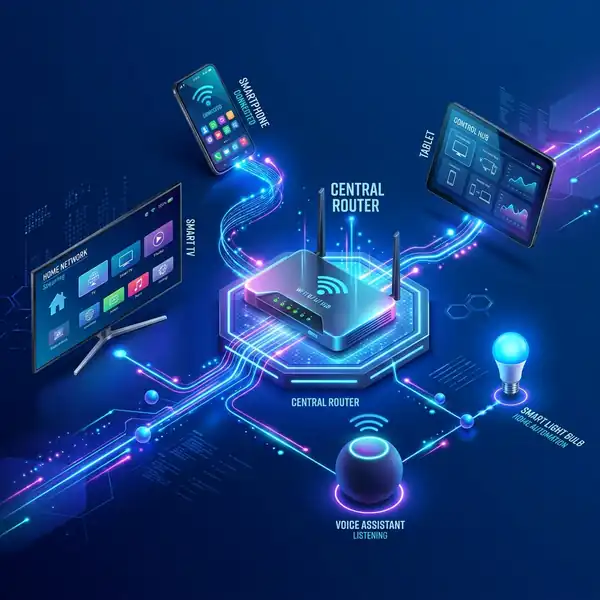
The 2.4 GHz Wi-Fi band is the industry standard for smart home IoT devices due to its favorable physical propagation characteristics. With a wavelength of roughly 12 centimeters, 2.4 GHz signals travel farther and penetrate solid walls, wooden doors, and brick structures much better than higher-frequency 5 GHz signals. However, the 2.4 GHz band is crowded with interference from neighboring networks, Bluetooth devices, baby monitors, and microwave ovens. This high radio frequency noise causes packet collisions and packet loss, forcing the camera to repeatedly retransmit data, which keeps the Wi-Fi radio active longer and drains the battery.
To optimize wireless performance, users should scan the local wireless spectrum using network analyzers and lock their router's 2.4 GHz band onto non-overlapping channels: 1, 6, or 11. Additionally, adjusting the router’s DTIM (Delivery Traffic Indication Message) interval can save battery. Increasing the DTIM value (e.g., from 1 to 3 or 5) allows the camera to stay in sleep mode longer, waking up less frequently to check the router for pending beacon transmissions, which significantly reduces standby battery draw.
Thermal Dissipation Limits of Outdoor IP Camera Housings
Outdoor security cameras face harsh environmental conditions, including direct sunlight, moisture, and temperature fluctuations. Solar-powered cameras are especially vulnerable to solar radiation, which heats the polycarbonate or aluminum enclosure. High internal temperatures increase thermal noise in the CMOS image sensor, leading to color distortion, graininess, and a degraded signal-to-noise ratio in the video feed. Extreme heat can also cause inexpensive plastic lenses to warp, permanently deforming the optical focus.
To manage heat, cameras utilize passive thermal dissipation, transferring heat from the processor to the metal frame of the housing using thermal pads. When installing these cameras, it is best to place them under eaves, gables, or roof overhangs. This positioning shields the camera body from direct mid-day sun and prevents heavy rain from directly impacting the rubber gaskets sealing the MicroSD slot and USB charging port, ensuring the camera maintains its IP65 or IP66 weatherproofing rating over time.
The Impact of Voltage Fluctuation on Smart Camera Hard Drive Cards
For cameras that utilize wired USB adapters for power, voltage stability is critical. Cheap, uncertified power bricks often produce high electrical noise (voltage ripple) and fail to deliver constant current under load. In a surveillance setup, these fluctuations can compromise the wireless radio receiver and corrupt the files written to the local storage drive.
When the camera transitions from day to night mode, it switches on its power-hungry infrared LED array. If the power supply cannot handle this sudden current demand, the voltage on the USB line can drop below 4.75V, triggering a microcontroller brownout reset. This causes the camera to reboot repeatedly, corrupting the firmware and damaging the local flash memory. Utilizing high-quality, certified power adapters with integrated surge protection (TVS diodes) prevents these power-related failures and ensures continuous system operation.
Next-Generation Smart Edge Computing for Cloud CCTV Storage
Modern surveillance architecture is shifting toward Edge AI computing. Instead of streaming raw footage to a cloud server for analysis, modern cameras use integrated Neural Processing Units (NPUs) to analyze video locally on the device. These NPUs can detect human shapes, pets, and vehicles in real time while drawing very little power. This local processing prevents the camera from uploading useless footage, saving massive amounts of network upload bandwidth.
In this edge-computed model, the camera only uploads short, compressed video clips containing validated events. Using secure encryption protocols like AES-256 and HTTPS/TLS protects these streams during transmission. This setup offers dual redundancy: even if an intruder destroys the camera or steals the MicroSD card, the video clip documenting the event is already stored securely in the cloud, out of the intruder’s reach.
The Importance of Video Codec Selection for Security Bandwidth
The efficiency of video transmission depends heavily on the compression codec. Historically, H.264 (AVC) was the industry standard, compressing video by analyzing spatial and temporal redundancies. However, with the rise of High Definition (1080p, 2K, and 4K) cameras, H.264 requires substantial bandwidth, which can saturate residential upload connections and cause buffering on mobile viewer apps.
Modern cameras use the H.265 (HEVC) codec, which reduces bandwidth and storage requirements by 50% compared to H.264 while maintaining the same image quality. H.265 replaces the fixed macroblocks of H.264 with dynamic Coding Tree Units (CTUs) of up to 64x64 pixels. This allows the compressor to process large areas of uniform color (like walls or skies) much more efficiently. For battery-powered cameras, using H.265 reduces the time the Wi-Fi transmitter must remain active to upload a file, directly conserving battery charge.
DIY Alternatives: RTSP Protocols and Codecs in Legacy Phones
As a budget-friendly alternative to commercial solar cameras, many users repurpose old Android and iOS smartphones as DIY security cameras. Older phones contain advanced processors and image sensors that often outperform cheap entry-level security cameras. Free surveillance applications like Alfred Camera, Haven, and IP Webcam modify the device’s software stack to act as a compact IP camera server.
In these DIY setups, the application encodes the camera sensor’s feed using H.264 or MJPEG codecs. The video can be streamed locally over the Real-Time Streaming Protocol (RTSP) on port 554, allowing integration into standard Network Video Recorders (NVRs) or home automation platforms like Home Assistant. For remote viewing, these apps establish secure Peer-to-Peer (P2P) network tunnels using STUN (Session Traversal Utilities for NAT), TURN (Traversal Using Relays around NAT), and ICE (Interactive Connectivity Establishment) protocols. This bypasses NAT routers and firewalls without requiring manual port forwarding on the home network.
Thermal Safety and Battery Swelling Risks in Continuous Charging Setups
Repurposing an old phone as a permanent security camera introduces a major hardware risk: lithium-polymer (LiPo) battery swelling. Unlike purpose-built outdoor cameras that manage charging to preserve cell life, a repurposed smartphone is typically left plugged into a USB wall charger 24/7. This constant current keeps the battery cell floating at its maximum voltage (usually 4.2V to 4.45V) indefinitely, which stresses the battery’s internal chemistry.
The heat generated by continuous video encoding, Wi-Fi transmission, and the charging circuit can push internal phone temperatures above 40°C. Under these conditions, the battery's liquid electrolyte oxidizes and breaks down, generating gas (such as carbon dioxide and carbon monoxide) that swells the battery's outer pouch. To prevent battery swelling and potential fire hazards, users should either remove the physical battery and power the phone directly via a buck converter (dummy battery) or connect the charger to a smart plug programmed to cycle power off periodically, allowing the battery to drain partially. Additionally, setting software-based thermal throttling limits ensures the phone suspends high-power video tasks if internal temperatures exceed 45°C.
Frequently Asked Questions (FAQ)
How do I know if the camera is compatible with my home wireless router?
Almost all consumer smart cameras operate on the standard 2.4 GHz wireless frequency. Check your router's administration page to ensure the 2.4 GHz band is enabled and configured with WPA2-PSK security encryption for maximum compatibility.
How many mobile devices can access a single shared camera feed?
Most camera companion apps allow you to share access with an unlimited number of accounts. However, streaming live HD video simultaneously to multiple devices requires sufficient internet upload bandwidth at the camera’s location.
Will the camera continue to record if the Wi-Fi connection drops?
Yes. If the camera has a compatible MicroSD card installed and remains powered, it will continue to write motion-triggered video clips to local storage. The camera will sync and update its status once the Wi-Fi connection is restored.
What is the best way to clean a dirty or blurry security camera lens?
First, power off the camera. Use a clean bulb blower to remove any loose abrasive dust. Then, gently wipe the outer glass lens using a clean microfiber cloth dampened with a drop of 99.8% pure isopropyl alcohol, which evaporates quickly without leaving optical streaks.
What is the difference between MPPT and PWM solar charge controllers?
MPPT controllers dynamically track the panel’s maximum voltage and current output, converting excess voltage into additional charging current to maximize efficiency. PWM controllers act as simple electronic switches, clamping the solar panel's voltage to match the battery level, which wastes potential power during low-light conditions.
Is it safe to run an old smartphone as a security camera 24/7?
Leaving a phone permanently plugged into a charger causes chemical stress on its lithium battery, increasing the risk of swelling and overheating. For safety, utilize high-quality chargers, ensure adequate airflow around the device, set up automated power cycles, or remove the physical battery entirely using a dummy battery adapter.
Final Security Thoughts
Deploying a wire-free, solar-powered security system is a powerful way to monitor your property, provided you build it on a solid foundation. From selecting the right class of high-endurance MicroSD storage for continuous overwrite loops to optimizing router wireless channels and managing battery thermals, these engineering details determine the longevity of your setup. By implementing these configuration practices and hardware considerations, you can maintain a resilient, off-grid surveillance network that keeps your home protected year-round.