Does a Wi-Fi Light Bulb Camera Function as a Regular Light?
The rise of smart cameras designed to screw directly into standard E27 light bulb sockets has provided homeowners with an incredibly convenient installation method. Eliminating the need for complex electrical wiring or external power bricks by leveraging existing light fixtures is an appealing solution. However, a major concern before purchasing these hybrid devices is: does a Yoosee light bulb camera function as a regular light, and can it truly replace the primary illumination source of a porch, garage, or hallway? In this article, we break down the electrical specifications, software automation modes, and physical limits of these smart security devices.
Lighting Specifications of E27 Camera Bulbs: Flux in Lumens
The brightness output of a security camera's built-in lights is measured in lumens. While a standard domestic bulb is designed solely to disperse visible light in all directions, a light bulb camera is a hybrid device. It must split its physical housing volume and E27 electrical input between the camera module (sensors, PTZ motors, motherboard, Wi-Fi antenna) and the lighting array. The white light illuminator on these models typically consists of 4 to 6 small surface-mounted (SMD) LEDs positioned around the camera lens.
Technical measurements reveal that the luminous flux generated by these integrated LEDs rarely exceeds 200 to 300 lumens, drawing approximately 2W to 3W of actual electrical power. In lighting engineering terms, this is classified as a local fill light or indicator light rather than a main illumination source. While the Yoosee app allow users to slide a brightness bar on high-end models, the physical limits of the circuit prevent the device from casting enough light to illuminate a large room evenly.
Configuring Lighting Triggers in the App: Auto Smart vs. Manual Override
The Yoosee companion app provides three primary operational modes to control the built-in white light LEDs. The first is Manual Mode. Under this setting, the user uses the mobile app as a simple remote switch. Tapping the light bulb icon turns the white LEDs on or off. While straightforward, this mode relies on manual user interaction and does not offer any automated security benefits.
The second and most recommended setting is Smart Auto Mode. In this mode, the camera operates at night with its white LEDs turned off, using invisible infrared (IR) illuminators to capture clear monochrome (black and white) video feeds. The moment the camera's image processor detects motion within the scene, it triggers the white LEDs to turn on instantly. This sudden light serves a dual purpose: it acts as a powerful visual deterrent to scare away intruders, and it supplies the illumination necessary for the camera to record color video clips of the event. The third is Scheduled Mode, which allows users to program specific time windows for the light to remain active, simulating occupancy while the family is away.
Comparing Bulb Camera LED Arrays vs. Standard 9W-12W Household Lamps
To put this performance into perspective, let's compare the numbers directly. A standard 9W domestic LED light bulb generates approximately 800 lumens, while a 12W model produces around 1,100 lumens of light, usually distributed across a wide 200° beam angle. This output is designed to light up an entire 12-square-meter room or driveway comfortably for human activity.
Conversely, the 250 lumens of a Yoosee E27 camera bulb create a narrow, directional beam of light. Replacing the primary ceiling light in a room or porch with a bulb camera will leave the area dim, with deep shadows in the corners. Therefore, security engineers recommend treating the bulb camera as a security device and not a replacement for your home's main lighting. The ideal approach is to install the camera alongside an existing high-power light fixture or use a socket splitter (Y-socket adapter) to keep both a standard LED bulb and the camera connected to the same junction box.
Focal Length Selection: Wide Angle 2.8mm vs. Telephoto 4mm and 6mm
A camera's optical field of view and target detection range are defined by the focal length of its lens. Most consumer-grade Yoosee bulb cameras come equipped with a 2.8mm fixed lens. A 2.8mm focal length is a wide-angle design, offering a horizontal field of view of about 110°. This makes it excellent for close-range surveillance, as it captures a wide perspective of the immediate surroundings, minimizing blind spots in indoor rooms.
However, the trade-off of a wide field of view is the dispersal of pixels over a large area. As a subject moves further from the lens, the pixel density drops. For instance, attempting to identify a stranger's facial features or a car license plate at a distance of 50 feet is nearly impossible with a 2.8mm lens, as the target will appear small and pixelated. If your goal is to monitor long driveways, gates, or specific points at a distance, you should look for cameras with 4mm or 6mm lenses. A 4mm lens narrows the view to 80°, while a 6mm lens narrows it to 50°, concentrating the pixels onto a smaller target zone to deliver sharp details at 50 to 70 feet.
Evaluating CMOS Pixel Density (PPI) for Target Recognition
To design an effective security layout, installers calculate the Pixels Per Inch (PPI) or Pixels Per Foot (PPF) at the target area. A 1080p camera has a fixed pixel grid of 1920x1080. If that grid is spread over a wide 110° view, the PPI at a distance of 15 feet will be low. For general activity detection, a density of 20 PPI is sufficient. For recognizing a known individual, you need 50 to 80 PPI. For forensic evidence (such as reading text or identifying an unknown person), you must have at least 100 to 150 PPI at the target's location.
When installing a Yoosee bulb camera, you must match the sensor resolution and lens to the distance of your security perimeter. Placing a 1080p camera with a 2.8mm lens to watch a gate 40 feet away will fail to capture identifiable details, because the pixel density at that distance falls below 30 PPI. To capture forensic-grade details at that distance, you would need to upgrade to a 4MP or 8MP sensor or switch to a narrower 6mm lens to concentrate the pixels.
RF Path Loss and the Automatic Stream Downgrade (1080p to SD)
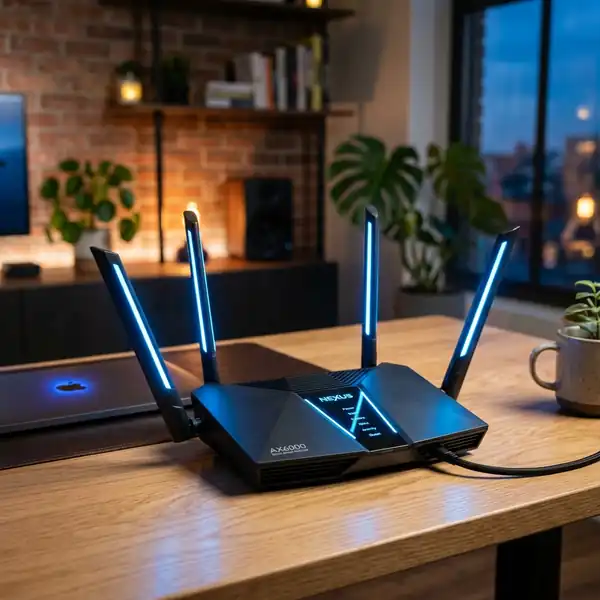
Wireless security cameras depend on a stable radio frequency (RF) link to transmit their video streams. Most smart home cameras operate on the 2.4 GHz band because of its ability to penetrate solid walls compared to the higher-frequency 5 GHz band. However, as the distance between the camera bulb and the Wi-Fi router increases, the RF signal degrades due to path loss, interference, and environmental obstacles.
To maintain a continuous connection and prevent the video from dropping, the camera's firmware uses adaptive bitrate algorithms. When the Received Signal Strength Indicator (RSSI) drops below -75 dBm, the camera automatically lowers its transmission bitrate and downscales the video resolution from Full HD (1080p) to Standard Definition (SD 360p or 480p). While this keeps the feed active, it degrades the quality of the recorded video. A camera that captures high-quality details under a strong Wi-Fi signal will record blurry, low-resolution clips if it is forced into SD mode due to a weak RF connection.
Signal Interference Table: Construction Material Attenuation (dB)
When installing a Wi-Fi camera, you must account for the signal attenuation caused by different building materials. The table below outlines typical signal loss values for common construction elements in the 2.4 GHz frequency band. A loss of 3 dB cuts the signal strength in half, while a loss of 10 dB represents a 90% reduction in signal power:
| Barrier Material | Average Thickness | Typical Attenuation (dB) | Impact on Wi-Fi Range |
|---|---|---|---|
| Standard Glass (Window) | 4 mm | ~1 to 2 dB | 10% to 15% reduction in signal strength |
| Solid Wood (Door) | 35 mm | ~3 to 5 dB | 30% to 40% reduction in signal strength |
| Brick / Masonry Wall | 100 mm | ~6 to 8 dB | 50% to 60% reduction in signal strength |
| Reinforced Concrete (Slab) | 120 mm | ~12 to 15 dB | Critical loss of up to 80% of signal power |
| Metal Gate / Sheet Metal | Variable | ~10 to 18 dB | Severe blockage leading to constant drops |
If your wireless router is located in the center of the house and the bulb camera is mounted on an outdoor garage porch, the signal must penetrate multiple brick walls and glass windows. The combined path loss can easily exceed 15 dB, resulting in lag, buffering, and video downscaling. In these cases, installing a dedicated outdoor Wi-Fi access point or a mesh node close to the camera is necessary to ensure a stable HD video feed.
CMOS Optical Performance: f-stop Lens Aperture and Image Sensor Size
Low-light performance is defined by the sensor size and lens aperture. The lens aperture, measured in f-stops (such as f/1.6, f/2.0, or f/2.4), dictates how much light reaches the CMOS sensor. A lower f-stop number indicates a wider physical aperture, allowing more photons to pass through. A lens with an f/1.6 aperture captures nearly double the light of an f/2.4 lens, allowing the camera to produce bright color images in low-light environments without relying heavily on noisy digital amplification.
Additionally, the physical dimensions of the CMOS sensor (such as 1/2.7-inch versus 1/3-inch or 1/4-inch) affect light gathering capacity. Larger sensors have larger individual pixels (photosites), which collect light more efficiently and minimize electronic noise. When buying a Wi-Fi camera, do not look only at the Megapixel rating. A 2MP camera with a 1/2.8-inch sensor and an f/1.6 lens will perform much better at night than a 4MP camera with a 1/3-inch sensor and an f/2.4 lens, which will suffer from severe grain and motion blur in the dark.
Memory Buffer Operations and Local Flash Directory Optimization
Many smart camera lag and stuttering issues are caused by file system corruption rather than Wi-Fi problems. These IoT devices run lightweight embedded operating systems (usually Linux-based) that write continuous system logs, connection metadata, and video frame buffers to their internal flash memory cache. If these caches become corrupted or full, the processor slows down, leading to dropped frames and app latency.
This problem is worsened by using slow or counterfeit MicroSD cards (below Class 10 UHS-I U3 specifications). When the camera's write speed to the card cannot match the incoming video stream, the internal memory buffer overflows, causing the camera to crash or reboot. To prevent this, users should format the MicroSD card directly through the camera app using FAT32 or exFAT file systems, and configure a weekly automatic reboot schedule in the app's maintenance settings to clear out accumulated temporary system logs.
H.264 versus H.265 Compression Performance Under Low Bandwidth
The video codec determines how efficiently raw image data is compressed for wireless transmission and storage. The older H.264 (MPEG-4 AVC) standard requires a relatively high bitrate to maintain clean 1080p resolution (around 4 Mbps at 15 frames per second). This can clog residential Wi-Fi networks when multiple cameras are streaming simultaneously.
The newer H.265 (HEVC) codec uses advanced spatial-temporal prediction algorithms to compress video up to 50% more efficiently than H.264 without losing image quality. On a weak Wi-Fi connection, H.265 allows a 1080p stream to transmit smoothly at just 1.5 to 2 Mbps. This prevents the camera from triggering its adaptive bitrate downscale, keeping the image in high-definition and saving space on the local MicroSD card or cloud storage server.
Thermal Dissipation Architecture and Outdoor Overheating Mitigation
Operating a security camera under direct sunlight can shorten its lifespan. Standard outdoor IP cameras are designed to operate between -10°C and 50°C (14°F to 122°F). However, direct solar radiation can raise the internal temperature of a plastic camera housing to over 65°C (149°F). This extreme heat causes thermal noise on the CMOS sensor, leading to color distortion and dead pixels.
Furthermore, prolonged high temperatures can cause cheap plastic lenses to warp slightly, shifting the focal plane and causing permanent image blur. To mitigate thermal stress, cameras should be installed under eaves or roof overhangs, or protected by a ventilated metal sunshield that deflects direct sunlight while allowing air to circulate around the device housing.
Electrical Stability and Voltage Droops Under IR Night Mode Loads
Unstable power delivery is a leading cause of camera malfunctions. Most domestic Wi-Fi cameras run on 5V DC (via micro-USB) or 12V DC. Budget power adapters often suffer from voltage drops under load. During the day, the camera consumes minimal power (around 300mA). However, at night, when the IR LEDs and white spotlights turn on, the power draw can increase to 1.5A or more.
If the power cable is too long or of thin gauge (such as 28 AWG), the electrical resistance will cause a voltage drop. If the voltage at the camera terminal drops below 4.5V (for a 5V system), the processor will freeze or enter a continuous boot loop. Installers should use high-quality, 24 AWG copper extension cables and power adapters rated for at least 50% more current than the camera's maximum specified draw to ensure stable night-time operations.
Frequently Asked Questions (FAQ)
How do I know if the camera is compatible with my home wireless router?
Check the technical specifications. Almost all smart home security cameras operate on standard 2.4 GHz Wi-Fi bands, which are supported by all consumer routers. If you use a modern dual-band or mesh router, make sure the 2.4 GHz band is enabled, or configure a separate 2.4 GHz guest network to simplify the initial pairing process.
How many mobile devices can access a single shared camera feed?
You can share camera access with multiple users through the app. However, simultaneous HD video playback requires a fast internet upload bandwidth at the camera location. If three or more users watch the stream at the same time, the feed may buffer if your home network upload speed is below 10 Mbps.
Will the camera continue to record if the Wi-Fi connection drops?
Yes. If a compatible MicroSD card is installed and the device remains powered, the camera records video files onto its local storage block without internet. Once the Wi-Fi connection is restored, you can access these local files remotely via the smartphone application.
What is the best way to clean a dirty or blurry security camera lens?
Power off the camera and use a clean microfiber cloth slightly dampened with isopropyl alcohol to remove smudges, grease, and dust from the lens glass surface. Avoid using harsh household glass cleaners or paper towels, which can scratch the optical coatings of the lens.
Final Security Thoughts
Maintaining a reliable home video surveillance system requires attention to infrastructure setup. From choosing the correct class of MicroSD card for continuous loop writes, configuring your Wi-Fi router's wireless channels, and setting guest access tiers on the smartphone app, these steps keep your home video recorder online when it matters most. Implement these practices and enjoy a secure, automated household.