Best Self-Emptying Robot Vacuums: The Ultimate Technical Guide
Best Self-Emptying Robot Vacuums: The Ultimate Technical Guide
If you want to fully automate your floor maintenance and want to know which models represent the pinnacle of automated home care, here is the direct technical answer: the best self-emptying robot vacuums are those equipped with a minimum of 20,000 Pa base station extraction suction, high-precision LiDAR or dToF navigation for collision-free pathing, and a fully sealed multi-layer allergen filtration system in the dock. These advanced home automation machines have transformed cleaning by using high-pressure airflow to suck debris from the robot's small internal dustbin into a sealed disposable bag or container at the dock, enabling up to 60 days of completely hands-free operation.
1. Understanding the Mechanics of Self-Emptying Docking Stations
The core physical process of a self-emptying station depends on a high-velocity airflow system powered by a high-wattage vacuum motor (ranging from 800W to 1000W) built into the docking base. When the robot vacuum finishes its cleaning cycle and aligns with the charging plates on the dock, the base station microcontrollers trigger the extraction sequence.
The station aligns its intake ports with the spring-loaded, one-way rubber valves located on the bottom or back of the robot's dustbin. The motor inside the tower is activated, producing a severe negative static pressure (vacuum) of 20,000 Pa to 30,000 Pa. This massive airflow pulls all dust, hair, and larger debris out of the robot and through an internal intake duct into the disposable collection bag inside the tower. The process typically takes 10 to 15 seconds and generates sound levels comparable to a traditional upright vacuum cleaner.
Air seal integrity is crucial at the physical connection point. Molded thermoplastic elastomer (TPE) seals around the docking ports ensure that no static pressure is lost during the air extraction process. Any gap in the seal reduces the speed of the airflow, leaving dirt inside the robot's dustbin. If you face connection issues after setting up your dock near other home automation gear, check our guide on the KaBuM! Smart 700 Wi-Fi connection fix to optimize your home network settings.
In addition, the extraction system has to overcome the aerodynamic resistance of the collection ducting and the high-grade filters installed inside the base unit. The pathing of these channels is carefully designed to avoid sharp 90-degree corners, which create air turbulence and decrease the linear velocity of air, leading to blockages in the pipework.
2. Bagged vs. Bagless Auto-Empty Docks: A Technical Comparison
In today's market, self-emptying docks are categorized into two primary mechanical designs: bagged systems and bagless cyclonic systems.
Bagged systems utilize disposable multi-layer synthetic dust bags (usually with a capacity of 2.5 to 4.0 liters) that serve as both the collection container and the final air filter. These bags are manufactured using electrostatic fibers that capture 99.9% of fine dust particles down to 0.3 microns, preventing them from blowing back into the room. When the bag is full, it is pulled out and thrown away. A sliding plastic tab seals the bag opening automatically during removal to prevent dust leaks. The only disadvantage is the recurring cost of purchasing replacement bags.
Bagless cyclonic systems use a rigid plastic container and centrifugal force to separate dust from the air stream. While this design eliminates the ongoing expense of replacement bags, emptying the plastic bin manually releases a cloud of fine dust back into the air, which can trigger allergic reactions. Additionally, the internal mesh and foam filters within the bagless tower must be washed regularly to prevent a drop in base extraction suction.
Static electricity build-up inside the plastic bins of bagless models is another technical drawback. It causes fine particles and pet hair to stick to the container walls, requiring manual wiping with anti-static materials to maintain clean optics.
3. Navigation and Mapping Sensors: LiDAR, ToF, and AI Cameras
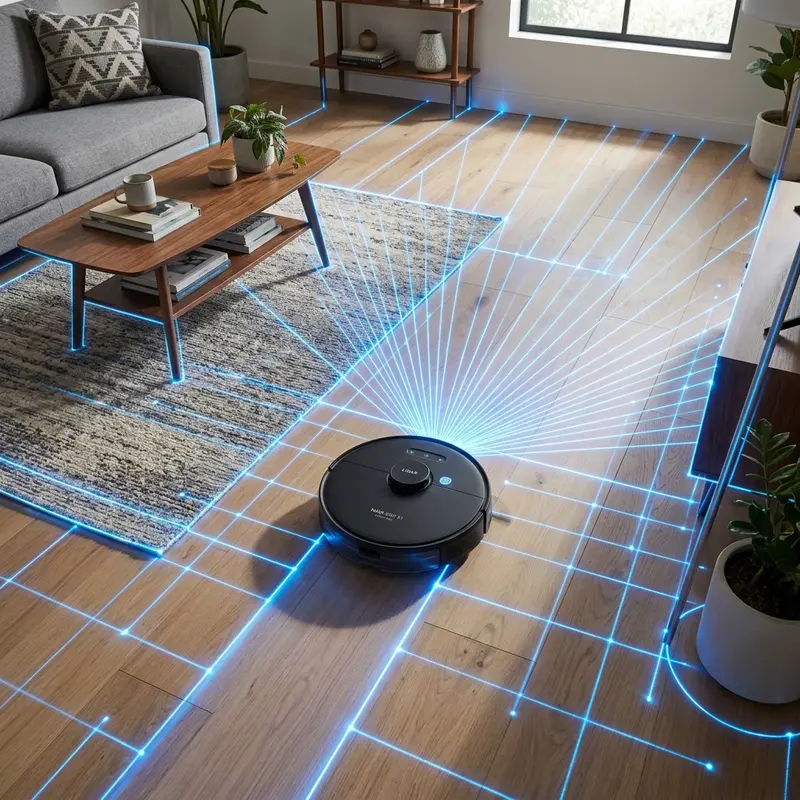
For a self-emptying robot vacuum to operate reliably without human intervention, it must return to its base station consistently. This requires an advanced sensor suite. The top self-emptying vacuums employ LiDAR (Light Detection and Ranging), dToF (Direct Time-of-Flight), or V-SLAM camera systems.
LiDAR works by spinning a laser diode on top of the robot, emitting infrared laser pulses, and measuring the time it takes for those pulses to bounce off surrounding walls and furniture. This allows the onboard processor to generate a highly accurate 2D map of the home. dToF sensors represent the next generation of laser navigation, providing longer range and better detection of small obstacles under bright sunlight. If your device starts showing navigation anomalies, read our troubleshooting guide on how to fix a robot vacuum spinning in circles to clean the optical and wheel sensors.
Premium models also include front-facing RGB cameras and structured light sensors. Combined with AI-driven object recognition software, these sensors identify everyday household items like power cords, slippers, and pet waste, adjusting the navigation path to prevent mechanical jams.
The sampling frequency of high-resolution LiDAR systems reaches up to 2,000 distance measurements per second. This enables real-time path recalculation as moving objects are encountered in the home, which is vital for locating the docking base in difficult room layouts.
4. Suction Performance, Airflow Dynamics, and Surface Adaptability
A robot's cleaning efficiency depends on its suction rating (Pascal — Pa) and brush roll design. While entry-level models operate around 1,000 Pa, modern self-emptying robot vacuums provide suction power between 4,000 Pa and 8,000 Pa.
This high suction is critical for extracting fine dust and pet hair from carpet fibers. Most advanced systems use underside ultrasonic sensors to detect carpets. When carpet is detected, the firmware increases the motor speed to max suction (Turbo mode) and stops water flow if the mop attachment is installed.
The brush roll design also affects performance. Multi-surface rubber brushes with anti-tangle designs prevent hair from wrapping around the brush axles, routing it directly into the suction stream. This reduces maintenance, keeping the automated cleaning path free of blockages.
Furthermore, different surfaces require dynamic speed adjustments of the side sweeping brushes to prevent scatter. On hard floors, the side brush speed is slowed down automatically to allow the main vacuum port to collect the dust before it is pushed away.
5. Integrated Mop Washing and Hot Air Drying Base Stations
The new wave of self-emptying robot vacuums has expanded the concept of hands-off automation. Today's premium docks do not just empty dry dust; they completely automate the maintenance of wet mopping systems.
These advanced stations feature dual internal water reservoirs of high volume (usually 3 to 5 liters) split between clean water and dirty recovered waste liquid. When the robot returns to the dock during or after cleaning, the station starts an active mop washing cycle. The dock sprays clean water onto the mop pad while moving scrub plates or rotating cleaning pins against the microfiber cloth to remove embedded dirt and oils.
A vacuum pump pulls the dirty wastewater into the recovery tank. After the physical cleaning is complete, the dock initiates active thermal drying. A ceramic PTC heater warms air to 45°C (113°F) and blows it underneath the wet pad for 2 to 4 hours. This thermal drying removes all moisture from the fabric, preventing the growth of anaerobic bacteria and eliminating the musty odors associated with damp mop cloths.
6. Essential Maintenance Procedures for Self-Cleaning Systems
Although self-emptying robot vacuums require less daily intervention, they are not maintenance-free. To keep the extraction airflow at peak performance, perform these routine checks:
- Dust Bag Replacement: Replace the disposable bag as soon as the app shows a bin full error. An overfilled bag blocks airflow, straining the suction motor;
- Contact Cleaning: Clean the metal charging contacts on both the robot and the base using a dry cloth or isopropyl alcohol to ensure consistent power connections;
- Duct Inspection: Regularly check the clear plastic airflow channel underneath the base for any blockages caused by large debris;
- IR Window Wiping: Wipe the infrared docking transmitter window on the base station to keep the robot's docking sensor aligned.
Keeping these elements clean prevents docking failures and maintains high airflow during the self-emptying process. Wipe down the docking rubber gaskets periodically to ensure the vacuum seal remains intact during extraction cycles.
7. Pros and Cons of Automated Self-Emptying Vacuum Cleaners
Buying a self-emptying robot vacuum improves convenience but involves financial and space considerations.
The main advantage is hands-free cleaning. Users can go weeks without thinking about emptying the vacuum, which is perfect for busy households or frequent travelers. Furthermore, the sealed filtration of bagged docks protects users from inhaling dust, making it the best option for allergy sufferers.
The downsides are the higher initial purchase price, the ongoing cost of replacement bags, and the physical size of the dock. The docking station requires a clear wall space with sufficient clearance on the sides and front for the robot to maneuver. The noise generated during the 15-second extraction process is also loud and may disturb pets or sleepers if run late at night.
| Technical Feature | Premium Self-Emptying Dock | Standard Charging Base |
|---|---|---|
| Dust Capacity Autonomy | Up to 60 days of hands-free operation | Must be emptied manually after every run |
| Dock Extraction Suction | 20,000 Pa to 30,000 Pa (motor-driven) | No extraction motor included |
| Filtration Standards | Sealed multi-layer HEPA dust bags | Basic mesh/foam filter on the robot |
| Space footprint | Larger (Requires open wall and floor space) | Compact (Fits easily under low furniture) |
| Ongoing Costs | Moderate (Requires replacement dust bags) | None (Only standard wear parts) |
Decibel Levels and Acoustic Dampening in Auto-Empty Stations
One critical aspect of self-emptying base stations is their acoustic output during the debris extraction cycle. While the robot vacuum itself operates at a quiet 55 dB to 65 dB, the suction motor in the auto-empty base station typically draws between 800W and 1200W of power, generating noise levels ranging from 75 dB to 82 dB. This high decibel levels can be disruptive, though the cycle only lasts for 10 to 15 seconds. To mitigate this noise, manufacturers use acoustic sound-dampening foam and curved airflow bypass baffles inside the tower, which absorb high-frequency motor whines. When scheduling your cleanings, consider setting the extraction cycles to run during daytime hours to prevent waking up family members during night runs.
HEPA Filtration Ratings in Base Station Dust Bags
The dust extraction process in self-emptying docks creates high air pressure, which could potentially release micro-dust back into the room if not sealed properly. To prevent this secondary contamination, premium base stations utilize disposable dust bags made from multiple layers of electrostatically charged melt-blown synthetic fibers. These bags act as an H10 or H11 pre-filter, trapping 95% of fine dust particles and allergens. Furthermore, the dock's motor exhaust is often lined with a secondary foam filter. Ensuring that the dust bag is fully seated and the dock lid is sealed prevents air leakage and keeps your indoor air clean during the auto-empty cycles.
Frequently Asked Questions (FAQ)
Can a self-emptying robot vacuum clean thick carpets?
Yes. Premium models with carpet detection and suction power exceeding 4,000 Pa can clean thick carpets effectively. They automatically boost suction to the maximum level when carpet is detected.
How often do I need to replace the dust bag in the base station?
For a standard home without pets, a 3 to 4-liter dust bag lasts between 45 and 60 days. In homes with multiple shedding pets, you may need to replace it every 30 days.
Can you turn off the loud self-emptying suction noise?
You cannot change the sound level of the extraction motor, but most apps allow you to set a "Do Not Disturb" period. This prevents the base from self-emptying during specific hours of the day or night.
Do self-emptying stations also clean and dry the mop pads?
The latest high-end multi-functional robot vacuums include advanced docks that empty the dustbin, wash the mop pads with water, dry them with hot air, and refill the robot's water tank.
Conclusion
If you want to automate your home cleaning routines, a self-emptying robot vacuum is the most effective investment you can make. The combination of LiDAR navigation and automated dust extraction ensures clean floors and cleaner air with minimal human intervention.




