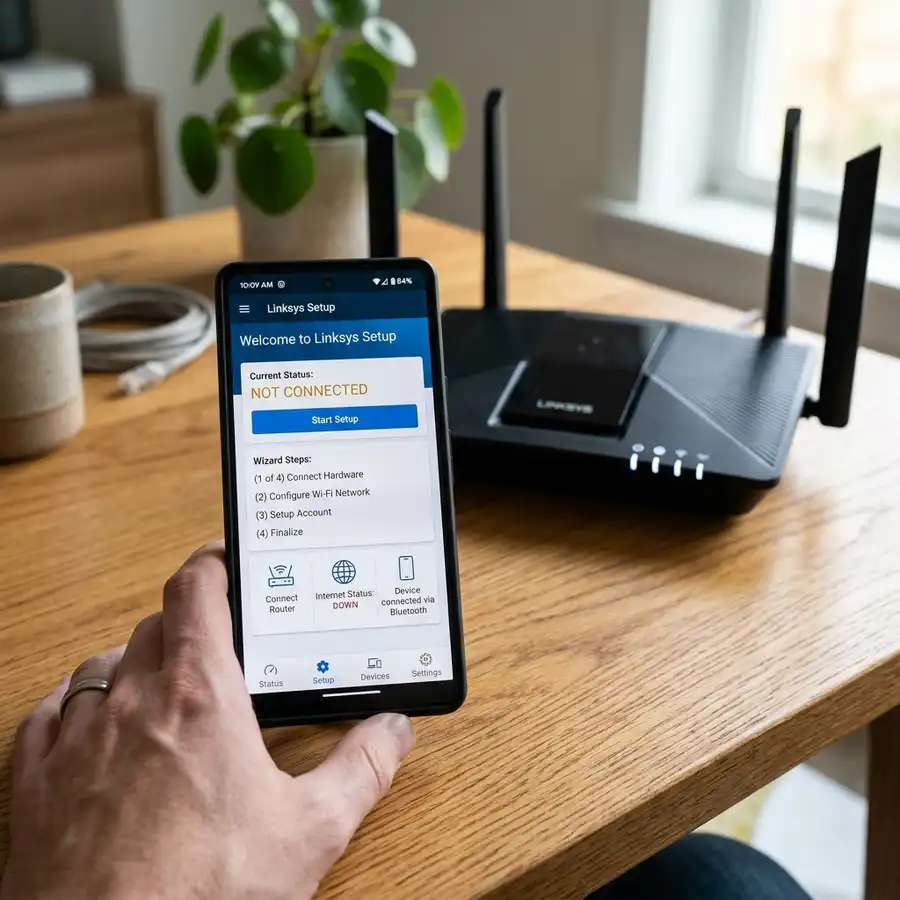
Configuring a mesh Wi-Fi system like the TP-Link Deco M4 is the most effective way to eliminate Wi-Fi dead zones caused by weak ISP-provided modems. However, connecting a new router to an existing modem requires specific settings to avoid performance issues. To set up the TP-Link Deco M4 mesh system with your existing modem, connect an Ethernet cable from the modem's LAN port to either of the ports on the main Deco M4 node, configure the system using the Deco app, and then disable the Wi-Fi on your ISP modem (via 192.168.1.1, 192.168.0.1, or 192.168.15.1) or set it to Bridge Mode to prevent IP conflicts and Double NAT.
Leaving both your ISP modem's wireless signal and your new Deco mesh network active simultaneously creates channel interference. It also results in a configuration error known as "Double NAT" (Double Network Address Translation). Double NAT forces your network packets through two routers, which can break port forwarding, cause connection dropouts in online gaming lobbies, and prevent smart home devices from communicating with local network servers. This step-by-step guide explains how to integrate your Deco M4 system correctly.
1. Physical Connections and Pre-Setup Checklist
Before launching the TP-Link Deco app, you need to set up the physical connections between your hardware. The ISP-provided modem (whether Fiber ONU, Cable, or DSL) must remain connected to the wall outlet to process the incoming internet signal.
Follow these hardware installation steps:
- Unplug Your Modem: Unplug your existing modem's power cable for 30 seconds. This resets the ARP cache and allows it to properly assign an IP address to the new main mesh node.
- Connect the Ethernet Cable: Connect one end of a high-quality Ethernet cable (CAT5e or CAT6) to any available LAN port on your ISP modem (usually colored yellow). Connect the other end to either of the two Gigabit ports on the back of the primary Deco M4 tower. Keep in mind that both ports on the Deco are auto-sensing WAN/LAN ports.
- Power Up Both Devices: Plug your ISP modem back into the power outlet. Wait 2 minutes for its boot sequence to finish and for all status lights (Power, PON, Online) to turn solid green. Next, plug in the Deco M4. The small LED indicator on the top should turn solid yellow, then blink blue, indicating it is ready to pair.
2. Setting Up the Deco M4 via the Smartphone App
With the main node powered on and its LED blinking blue, you will complete the initial setup using the Deco app on your mobile device:
- Download the App: Install the official "TP-Link Deco" app from the Apple App Store or Google Play Store.
- Log In or Register: Open the app and log in with your TP-Link ID. If you do not have one, click register to create an account.
- Select Your Device: Tap "Let's Begin" and select the "Deco M4" (or M4 series) from the hardware list.
- Enable Bluetooth and Location Services: Ensure your smartphone's Bluetooth and GPS location services are turned on. The app uses Bluetooth to detect the Deco M4 node automatically.
- Select Connection Type: When prompted to choose the WAN connection type, select Dynamic IP (DHCP) in most residential setups. This allows your Deco M4 to automatically receive an IP address from your ISP modem. If your provider uses PPPoE, make sure you have your account username and password at hand.
- Create SSID and Password: Create a new network name (SSID) and a secure password for your mesh Wi-Fi. Do not use the same name as your old ISP Wi-Fi network yet, as this can cause routing confusion during the transition.
- Connect to Your Mesh Network: Connect your smartphone to the new Wi-Fi network. The Deco M4's LED status light will change from blinking blue to solid white, confirming a successful internet connection.
3. Disabling Wi-Fi and Enabling Bridge Mode on Your ISP Modem
This is the most critical step. To ensure a stable network, you must disable the Wi-Fi transmitters on your ISP modem and configure it to pass internet traffic directly to the Deco M4.
Accessing the ISP Modem Admin Interface
Connect a computer or phone to your ISP modem's Wi-Fi network (or connect a PC directly to the modem with an Ethernet cable). Open a web browser and type the default IP address of the modem:
- Common ISP IPs: The default address is typically 192.168.1.1, 192.168.0.1, or 192.168.15.1. Check the sticker on the bottom of the modem for the exact IP address and the default admin username and password.
Disabling Wi-Fi Transmitters
Once logged into your modem's admin panel:
- Navigate to the Wireless Settings, Wi-Fi Setup, or WLAN configuration page.
- Locate both the 2.4 GHz and 5 GHz wireless network options.
- Toggle the switch to "Disabled" or uncheck "Enable Wireless". Save the changes to stop the modem from broadcasting its old Wi-Fi signals. This prevents local airwave crowding.
Enabling Bridge Mode (Recommended Setup)
To configure your modem as a simple bridge:
- Look for "Bridge Mode", "Bridging", or "Device Mode" in the advanced settings or WAN configuration menu.
- Change the mode of operation from "Router" (or Routing/PPPoE) to "Bridge Mode".
- Save and apply settings. The modem will reboot. It will now act as a transparent bridge, passing your public IP address directly to the primary Deco M4 node's WAN port. This allows the Deco system to manage all IP routing and network translation tables directly.
4. Troubleshooting Guide for Deco M4 Integration
The table below lists common integration issues, their causes, and how to resolve them during setup:
| Issue / Error Message | Probable Cause | Resolution Steps |
|---|---|---|
| Deco LED is solid red | The Deco M4 is not receiving an internet connection on its WAN port. | Check the Ethernet cable connections. Reboot your ISP modem, then power cycle the Deco M4. |
| Double NAT Error in Console Settings | Both the ISP modem and Deco are routing traffic. | Enable Bridge Mode on the ISP modem, or switch the Deco M4 to Access Point Mode. |
| Deco app fails to find nodes via Bluetooth | Bluetooth is off or location permissions are missing. | Enable Bluetooth and check application permissions in phone settings. Restart the Deco node. |
| The secondary node is placed too far from the primary node. | Move the secondary node closer to the main Deco node to establish a stronger backhaul link. |

5. Choosing the Right Mode: Router Mode vs Access Point Mode
The TP-Link Deco M4 can operate in two different modes. Choosing the right one depends on your network requirements and whether you can modify your ISP modem settings:
Router Mode (Default and Recommended): In this mode, the primary Deco node acts as your main router, handling IP address assignment (DHCP), parental controls, device prioritization (QoS), and firewall rules. This requires your ISP modem to be configured in Bridge Mode (or have its Wi-Fi turned off) to avoid Double NAT. This mode provides access to all advanced software features in the Deco app, including remote monitoring and guest network isolation.
Access Point (AP) Mode: If your ISP modem is locked down (which is common with some fiber optic modems that also manage phone or IPTV services) and you cannot enable Bridge Mode, switch the Deco M4 to Access Point Mode. In the Deco app, go to More > Advanced > Operating Mode and select "Access Point". In AP mode, the ISP modem continues to assign IP addresses and handle routing, while the Deco M4 nodes act as a bridge for the wireless mesh network. This avoids Double NAT but disables features like QoS, parental blocks, and custom DNS routing in the Deco app. It is simple to switch back if your requirements change.
6. Adding and Syncing Secondary Deco Nodes
Once your primary Deco M4 node is set up, adding secondary nodes to expand coverage is simple. Follow these steps:
- Place the secondary Deco M4 node in your chosen location (remembering the halfway rule).
- Plug the node into a power outlet. The LED on top will turn solid yellow, then blink blue slowly.
- Open the Deco app on your phone and tap the "+" icon in the top-right corner of the dashboard.
- Select "Add a Deco Unit" and choose the M4 model. The app will search for and sync the new node automatically.
- Name the room where the node is located (e.g., "Bedroom" or "Kitchen") to complete the setup. The LED will turn solid white when connected successfully. If the LED stays red, the node is too far away.
7. Advanced Optimization Settings for the Deco App
To get the best performance out of your new mesh network, consider adjusting these advanced settings in the Deco app:
Configure Custom DNS Servers: Provider DNS servers can be slow or unreliable. Speed up domain name resolution by going to Advanced > DHCP Server > Primary DNS and entering 1.1.1.1 (Cloudflare) or 8.8.8.8 (Google). Set the Secondary DNS to 1.0.0.1 or 8.8.4.4. This reduces domain lookup latency for all connected devices.
Enable Fast Roaming (802.11r): In the app settings, toggle "Fast Roaming" on. This allows modern smartphones to transition between nodes faster. If you notice older smart home devices (like older Wi-Fi smart plugs or printers) disconnecting, turn Fast Roaming off to maintain compatibility with legacy hardware.
IP Reservation: For gaming consoles, network printers, or NAS drives, reserve a static IP in the Deco DHCP list. This ensures they always use the same local address, which simplifies port forwarding and local file sharing setups.
Disable Smart Connect (Optional): If you want to force specific devices onto the 5 GHz band, you can disable Smart Connect to separate the 2.4 GHz and 5 GHz bands into different SSIDs, allowing you to choose the frequency manually. This is ideal if you have a PC or gaming console that keeps connecting to the slower 2.4 GHz channel.
Configuring Port Forwarding: If you are running servers or gaming lobbies that require open ports, navigate to Advanced > Port Forwarding in the Deco app. Here, you can forward ports like TCP/UDP 3074 or 80 to your console's reserved IP address. Ensure UPNP is turned on for dynamic port openings. This is particularly useful for avoiding Moderate or Strict NAT status in gaming.
8. Technical Analysis of Dynamic Backhaul and Mesh Routing
Behind the scenes, the TP-Link Deco M4 uses an Adaptive Path Selection algorithm to route traffic between nodes efficiently. When configured wirelessly, the nodes use a shared wireless backhaul (utilizing both the 2.4 GHz and 5 GHz bands dynamically) to transfer data back to the primary node connected to your modem. While this works well for standard usage, the physical limitations of wireless signals mean that some throughput is lost over distance. To maximize performance, connect nodes using an Ethernet cable (Wired Backhaul). This frees up the wireless bands entirely for client devices, providing maximum speeds and lower latency throughout your home. In a wired configuration, the Deco nodes act as a transparent switch, reducing transmission overhead and packet drops to zero.
Furthermore, setting the MTU (Maximum Transmission Unit) to match your ISP requirements can prevent packet fragmentation. For instance, if your Vivo modem uses PPPoE authentication, setting the WAN MTU to 1480 instead of 1500 can improve throughput. You can also analyze Wi-Fi speeds using tools like Speedtest to verify if the ports are negotiating at 1000 Mbps instead of 100 Mbps. If a cable is damaged, the port will fall back to Fast Ethernet, capping your speeds to 100 Mbps.
Important Notice About Accessing Your ISP Modem Post-Bridge Mode
Once you configure your ISP modem in Bridge Mode and set up your Deco M4 network, you will no longer be able to access the modem's administrative page (such as 192.168.1.1 or 192.168.15.1) while connected to the Deco Wi-Fi. This is because the Deco M4 operates on a different subnet (typically 192.168.68.X). To access your ISP modem's settings in the future, connect a computer directly to one of the modem's LAN ports using an Ethernet cable and manually assign a static IP address (such as 192.168.1.50) to your computer's network adapter.
Frequently Asked Questions
Do I need to turn off the Wi-Fi on my old modem?
Yes. Disabling your old modem's Wi-Fi is highly recommended. Leaving it active causes signal congestion, channel interference, and may confuse your devices, causing them to connect to the slower network.
Will Deco M4 work with any internet provider?
Yes. The Deco M4 connects via a standard RJ-45 Ethernet cable, making it compatible with any modem provided by fiber, cable, DSL, or satellite internet providers.
What should I do if my Deco M4 LED is blinking red?
A blinking red LED indicates the node has lost its connection to the primary Deco or the internet. Check the physical Ethernet cables, restart your modem, and ensure the nodes are within range of each other.
Can I connect a desktop PC to a secondary Deco node's Ethernet port?
Yes. The Ethernet ports on secondary Deco M4 nodes act as standard LAN ports. You can connect gaming consoles, desktop PCs, smart TVs, or switches directly to them for a stable, wired connection.




