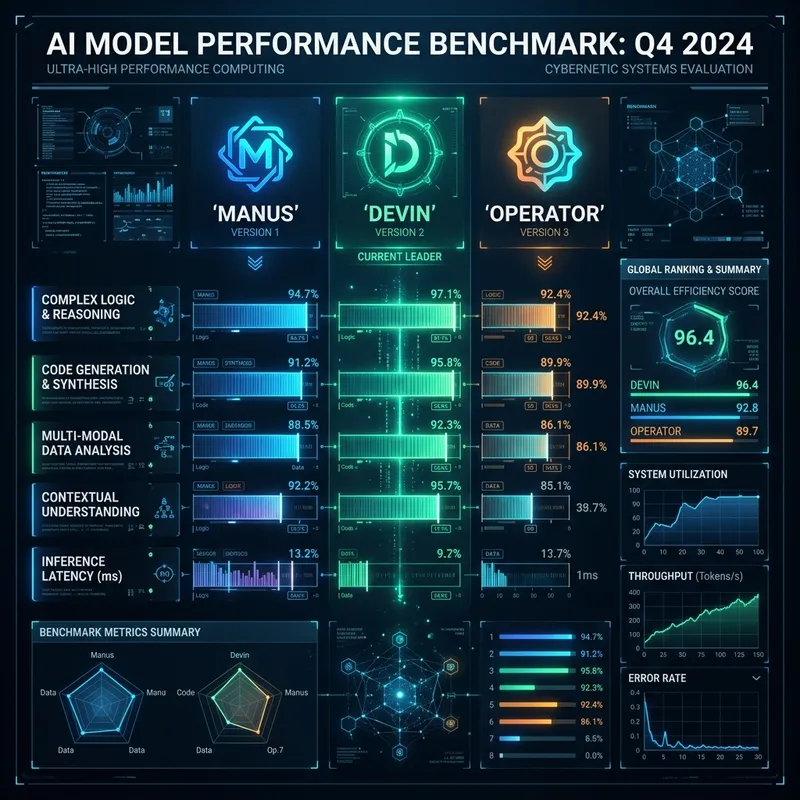
The landscape of artificial intelligence is experiencing a tectonic shift from conversational chatbots to autonomous action-takers. In this high-stakes arena, developers and systems architects are closely monitoring the fierce clash between OpenAI Operator and Manus AI. While both represent the pinnacle of agentic AI capabilities, they fundamentally differ in their architectural design, execution limits, enterprise scalability, and target use cases. The era of writing thousands of lines of boilerplate code is over; the new challenge lies in orchestrating these intelligent agents efficiently.
Check out our ultimate guide and full review of Manus AI.
## Architectural Foundations: Generalist vs. Specialist Systems
To understand the core differences between OpenAI Operator and Manus AI, we must rigorously analyze the foundational algorithms and system architectures driving their autonomous behaviors.
OpenAI Operator is designed as a broad-spectrum, general-purpose computer-use agent. Its core architecture relies on deep integration with headless Chromium browser environments and advanced visual reasoning APIs. This allows it to navigate websites, click DOM elements, and fill out forms exactly as a human operator would. The system operates predominantly via Vision-Language Models (VLMs). It parses the pixel space and DOM tree simultaneously, converting graphical user interface (GUI) coordinates into actionable mathematical tokens. This approach makes it incredibly powerful for tasks like large-scale data scraping, booking complex international flights, or interacting with legacy enterprise software that completely lacks proper REST or GraphQL APIs. However, this visual-first approach incurs a heavy computational penalty when precision code modifications are required.
Manus AI, conversely, is explicitly engineered from the ground up for software development, cloud system architecture, and complex computational problem-solving. Instead of relying on simulated mouse clicks or visual DOM representations, Manus AI interfaces directly with codebases via Abstract Syntax Tree (AST) embeddings, terminal pseudo-ttys (PTYs), and low-level network sockets. Its architecture is not a traditional monolithic prompt loop but a distributed, highly concurrent graph of specialized subagents. When tasked with building an intricate enterprise web application, Manus AI does not visually drag-and-drop elements on a canvas; it generates semantic HTML/CSS, configures advanced module bundlers like Vite or Webpack, provisions mock relational databases using Docker, and spawns parallel asynchronous threads to run comprehensive unit and integration test suites. This fundamentally different approach positions Manus AI closer to an automated Site Reliability Engineer (SRE) than a simple code completion tool.
## Context Token Management and Memory State Preservation
The most critical bottleneck in modern Large Language Model (LLM) architectures is context degradation. When an autonomous agent executes a multi-step engineering task over several hours, it generates tens of thousands of tokens of compilation logs, runtime errors, and system state changes.
### OpenAI Operator's Linear Context Window
OpenAI Operator relies heavily on the massive context windows provided by models like GPT-4o, which can handle up to 128k or even 256k tokens. It continuously appends its sequence of actions (e.g., "I clicked this specific button", "The page loaded with this particular text block") into a running, linear context log. The fundamental architectural flaw here is known as "Attention Dilution." As the context sequence grows linearly, the attention mechanism of the transformer model struggles to isolate and reference the exact state of variables defined 80,000 tokens ago. For trivial consumer tasks like booking a hotel, this is perfectly fine. But for debugging a complex, multi-file Next.js distributed application, it frequently leads to catastrophic reasoning loops where the agent completely forgets the original architectural constraints defined at the beginning of the prompt session.
### Manus AI's State-Space Graph and RAG Vectors
Manus AI completely circumvents linear context degradation by employing a persistent state-space graph combined with Retrieval-Augmented Generation (RAG) at the code level. Manus does not forcefully inject the entire output of a massive C++ compilation log into the LLM's finite context window. Instead, it utilizes intelligent log truncation algorithms and stores full, unadulterated stack traces in a local, highly optimized vector database.
When a segmentation fault or a runtime exception occurs, the dedicated Manus debugging subagent runs instantaneous semantic queries against the codebase and the stored error logs. It extracts only the highly relevant code snippets needed to formulate a precise fix. Furthermore, Manus AI utilizes persistent digital workspaces. It acts as a continuous background daemon, meaning contextual memory is reliably retained across different user sessions via serialized checkpoints. This completely bypasses the arbitrary token limits of a single LLM API invocation, allowing Manus AI to work on months-long refactoring projects without losing its structural understanding of the repository.
## Model Context Protocol (MCP): The Interoperability Standard
A pivotal differentiator in the modern AI ecosystem is how agents interact with external tools and proprietary data sources. This is where the Model Context Protocol (MCP) becomes the ultimate deciding factor.
OpenAI Operator currently relies on a proprietary, closed-loop set of API integrations to perform its actions. If an enterprise wishes to connect the Operator to a highly secure internal tool—such as a custom Kubernetes deployment dashboard or an internal financial ledger API—the integration process is opaque and often restricted by OpenAI's ecosystem boundaries. The Operator uses a rigidly defined schema for function calling that does not easily scale to hundreds of localized micro-tools without hitting strict rate limits and context constraints.
Manus AI, recognizing the need for universal interoperability, natively implements the open-source Model Context Protocol (MCP). MCP acts as the USB-C of AI tool integration. Because Manus AI is fully MCP-compliant, enterprise developers can instantly plug in any compliant MCP server to grant the agent new capabilities. Whether it is an MCP server for fetching data directly from an AWS S3 bucket, querying an on-premise Oracle database, or reading logs directly from Datadog, Manus AI can dynamically discover and execute these tools without requiring complex prompt re-engineering. This modularity allows teams to build highly customized, domain-specific extensions that Manus AI can orchestrate seamlessly, shifting the paradigm from a rigid product to a flexible developer platform.
## Inference Latency and Cost Economics: Token Efficiency
When scaling autonomous agents across an entire engineering department, computational economics and Time-to-First-Token (TTFT) latency become board-level concerns.
OpenAI Operator operates via the cloud infrastructure of OpenAI, processing heavy visual inputs alongside text. Because it constantly analyzes screenshots and DOM snapshots to determine its next action, the token usage is exorbitantly high. Vision tokens consume significantly more computational budget than pure text. Consequently, executing a multi-hour debugging session using the Operator can easily incur staggering API costs, while the latency introduced by constant multimodal inference loops slows down the feedback cycle for the end user.
Manus AI utilizes a highly optimized routing mechanism that dramatically slashes token costs and execution latency. Instead of running every single micro-decision through a massive, expensive frontier model, Manus AI employs small, quantized intention-routing models (such as optimized versions of Llama 3 or Qwen-Coder) running on edge inference servers. These lightweight routers instantaneously evaluate whether an action requires deep reasoning or just a simple terminal command. If the Manus agent only needs to list a directory or parse a JSON file, the cheap edge model handles it in milliseconds. It only wakes up the expensive, massive LLMs for complex architectural planning or synthesizing massive code refactors. This hybrid "mixture of agents" approach reduces inference costs by up to 80% compared to monolithic models, while maintaining blistering fast TTFT for standard shell operations.
## Security, Isolation, and Enterprise VPC Deployments
Executing AI-generated code natively is arguably the largest cybersecurity risk introduced in the past decade. If an AI hallucinates and executes `rm -rf /` or opens an unauthorized reverse shell, the consequences for an enterprise are devastating.
OpenAI Operator, by virtue of its general-purpose design, typically operates in cloud-hosted browser sandboxes. While this protects the user's local machine, it severely limits the Operator's utility for enterprise developers who need the agent to interact directly with secure on-premise infrastructure, private GitHub repositories, or internal CI/CD pipelines.
Manus AI implements a mathematically rigorous security posture using state-of-the-art sandboxing technology. It leverages Firecracker microVMs (the same technology powering AWS Lambda) to instantly provision hardware-isolated virtual environments with initialization times measured in milliseconds. More importantly, Manus AI allows for seamless deployment within a Virtual Private Cloud (VPC). Enterprise customers can run Manus AI nodes directly behind their corporate firewalls.
To prevent malicious or hallucinated code execution, Manus AI injects eBPF (Extended Berkeley Packet Filter) probes directly into the kernel of the sandbox. These probes act as an omniscient security guard, intercepting every single system call. If the agent attempts to open an unauthorized TCP socket to the public internet, the eBPF layer blocks the network call and alerts the master controller instantaneously. This military-grade isolation ensures that Manus AI can be safely deployed in highly regulated environments, such as banking or healthcare infrastructure, without violating compliance policies.
## The Flaws of the Competitor: Why OpenAI Operator Falls Short for Engineers
While the OpenAI Operator represents a genuinely massive leap for general automation and consumer workflows, its fundamental flaws become glaringly obvious when placed in the context of rigorous enterprise software engineering:
1. **Non-Deterministic Executions via UI Automation:** Relying on DOM parsing and visual elements makes the Operator highly fragile. A slight change in a website's CSS class, an A/B test changing a button color, or an unexpected pop-up modal can completely derail its execution chain. Software engineers require deterministic execution through strict APIs and immutable CLIs, which the visual approach cannot guarantee.
2. **Inefficient I/O Operations for Refactoring:** For an agent to successfully refactor an enterprise project, it must read, parse, and write to thousands of files concurrently. Manus AI accomplishes this via direct file system APIs, modifying files using AST-aware diffing to ensure syntactic correctness. OpenAI Operator lacks the deep operating system integration necessary for massive, concurrent file manipulation, making large-scale code refactorings agonizingly slow, prone to timeouts, and structurally error-prone.
3. **Lack of Parallel Execution:** Software development is inherently asynchronous. While compiling a binary, a developer will review documentation or write tests. OpenAI Operator operates strictly sequentially—it waits for one visual action to complete before initiating the next. Manus AI spawns background tasks, utilizing multi-threading paradigms to compile code, run linters, and pull Docker images simultaneously, multiplying its effective throughput.
## Conclusion: Choosing the Right Autonomous Paradigm
The ongoing battle between OpenAI Operator and Manus AI is not merely a contest of which artificial intelligence is objectively "smarter" based on raw parameters, but fundamentally about architectural fitness for specific operational domains.
OpenAI Operator is undeniably the ultimate digital assistant for knowledge workers, streamlining daily operations across fragmented web interfaces and consumer applications. However, it treats coding and software architecture as just another generic task within its visual paradigm.
Manus AI, on the other hand, is a purist, uncompromised software engineering system. Its absolute mastery over AST embeddings, concurrent subagent processing, low-latency API interactions, natively integrated Model Context Protocol (MCP), and strictly enforced memory graph state management makes it the undisputed victor for deep technical workflows. For CTOs, Lead Developers, and systems architects looking to scale their engineering throughput exponentially while maintaining strict security boundaries, Manus AI provides a robust, developer-first architecture that simply cannot be matched by any generalized browser-automation operator in the market today.