1. Direct Introduction
The phenomenon commonly described as the internet continuously disconnecting represents one of the most pervasive and structurally complex anomalies within modern digital telecommunications. At its core, this systemic failure is rarely a singular event but rather a cascading collapse of protocol handshakes, localized hardware exhaustion, or widespread routing inefficiencies that compromise the integrity of the data stream. When addressing this persistent disconnection issue, it is absolutely paramount to transcend the superficial diagnostic approaches that merely suggest rebooting consumer-grade routing equipment. Instead, a profound examination of the Open Systems Interconnection model is required, specifically focusing on the symbiotic relationship between the physical layer's signal-to-noise ratio and the transport layer's transmission control protocol state machine. The modern internet relies on a highly volatile equilibrium of borderline instantaneous request and response cycles, meaning that even a microsecond of desynchronization can trigger a catastrophic teardown of the entire session state.
To fundamentally comprehend why the internet keeps disconnecting, one must first deconstruct the anatomy of a persistent network connection. A connection is not a physical pipeline; it is an abstract mathematical agreement between multiple autonomous systems distributed globally. These systems utilize dynamic routing protocols to negotiate the optimal path for packets, but when transient congestion or physical degradation occurs, the continuous stream of acknowledgments is interrupted. This interruption forces the transport layer to initiate aggressive retransmission algorithms, which ironically can exacerbate the underlying congestion, leading to a localized network collapse often perceived by the end-user as a sudden internet dropout. Consequently, rectifying this continuous disconnection requires a holistic methodology that evaluates everything from the spectral efficiency of the local fiber optic node to the macroscopic stability of the Border Gateway Protocol routing tables maintained by the upstream Internet Service Provider.
Furthermore, the diagnostic journey must meticulously account for the proliferation of stateless architectures attempting to masquerade as stateful connections through the clever manipulation of keep-alive packets and artificial session timers. When the local network apparatus fails to accurately predict or maintain these timers, intermediate firewalls and intrusion prevention systems will silently discard the associated session data, resulting in what appears to be a random termination of internet connectivity. Ultimately, this comprehensive technical guide will navigate the labyrinthine depths of network instability, offering an unprecedented, microscopic analysis of connection volatility. By dismantling the archaic assumptions surrounding network reliability, we establish a robust framework for identifying, isolating, and permanently eliminating the systemic bottlenecks responsible for intermittent connectivity drops in highly demanding environments.
2. Basic Architecture
The basic architecture of a resilient internet connection is constructed upon a tremendously complex hierarchy of interwoven protocols and hardware abstraction layers. At the foundational edge of this architecture resides the customer premises equipment, typically a modem or optical network terminal, which serves as the critical demarcation point between the local area network and the provider's wide area network infrastructure. This hardware is responsible for modulating and demodulating intricate waveforms across physical mediums such as coaxial copper lines, unshielded twisted pairs, or delicate strands of silica glass. The modulation schemes employed, such as Orthogonal Frequency-Division Multiplexing, are highly susceptible to electromagnetic interference and signal attenuation. When the physical architecture is compromised by microscopic fractures in the cabling or anomalous radio frequency ingress, the raw bit error rate escalates beyond the error-correcting capabilities of the hardware, precipitating an immediate and unceremonious disconnection.
Ascending the protocol stack, the data link layer assumes the monumental task of framing these modulated bits into coherent Ethernet frames while simultaneously negotiating medium access control. Here, the architectural stability is often threatened by microscopic temporal misalignments known as jitter, which can disrupt the delicate synchronization required for high-speed frame transmission. Beyond the local network boundary, these frames are encapsulated into Internet Protocol packets, marking the transition into the universally routed internet architecture. This transition introduces the critical dependency on upstream aggregation routers and centralized core switches, which utilize immensely complex algorithms to dynamically manage immense queues of diverse traffic. The architectural integrity of this routing layer is heavily reliant on maximum transmission unit parity; any discrepancy in packet size limits between the local interface and the provider's gateway will inevitably result in devastating packet fragmentation or silent drops, manifesting as a cryptic and highly intermittent loss of internet access.
Integral to this architectural framework is the Domain Name System resolution hierarchy, which acts as the invisible scaffolding supporting almost all modern network interactions. If the architectural configuration of the local recursive resolver is suboptimal, or if the upstream authoritative servers experience transient unreachability, the fundamental ability to initiate new connections is entirely paralyzed, simulating a complete internet outage even when the underlying transport layer remains completely viable. Additionally, the proliferation of Carrier-Grade Network Address Translation has fundamentally altered the classic end-to-end architecture of the internet, forcing massive multitudes of local endpoints to share a severely constrained pool of public IP addresses. This architectural shift creates immense state-tracking burdens on the provider's NAT gateways, and when these gateways exhaust their state tables during peak utilization, they arbitrarily sever active connections, demonstrating the profound fragility embedded within contemporary internet architecture.
3. Challenges and Bottlenecks
Addressing the relentless cycle of internet disconnections requires navigating an incredibly dense minefield of technical challenges and deeply entrenched infrastructural bottlenecks. The most insidious of these challenges is the phenomenon recognized as bufferbloat. In a misguided attempt to prevent packet loss during bursts of high traffic, hardware manufacturers historically integrated excessively large memory buffers into consumer and enterprise routing equipment. However, when these massive buffers fill to capacity during periods of network congestion, they introduce staggering amounts of queuing delay. This artificial latency devastates time-sensitive protocols and entirely destroys the carefully calibrated congestion control algorithms inherent to TCP. The resulting chaotic oscillation of packet delivery times inevitably triggers severe connection timeouts, causing applications and operating systems to incorrectly deduce that the internet connection has completely vanished.
Another monumental bottleneck exists within the realm of asymmetric routing and its catastrophic interaction with stateful packet inspection firewalls. In complex enterprise networks or multi-homed ISP environments, outbound packets may traverse a completely different topological path than inbound response packets. While technically permissible within the stateless design of standard IP routing, this asymmetry becomes a profound bottleneck when intermediate security appliances attempt to track the bi-directional state of a connection. If a firewall only observes one half of the transmission cycle, it will definitively classify the traffic as a severe security violation and ruthlessly terminate the session. Diagnosing this specific bottleneck is exceptionally challenging, as the underlying physical connection remains flawlessly intact, yet the logical transport layer is continuously decapitated by overzealous security mechanisms.
Furthermore, the inherent instability of the Border Gateway Protocol introduces macroscopic challenges that transcend any localized administrative control. BGP is the routing protocol that glues the internet together, but it is notoriously vulnerable to route flapping—a scenario where an unstable physical link or a misconfigured router rapidly alternates between advertising and withdrawing a route. This flapping propagates globally, causing immense computational strain on core internet routers and resulting in transient black holes where traffic is routed directly into oblivion. For the end-user, BGP flapping manifests as seemingly random, unpredictable disconnections that perfectly self-resolve mere moments later, creating an investigative nightmare for network administrators attempting to identify the root cause of the instability.
4. Scalability Benefits
Implementing a comprehensive fix for internet disconnection issues yields profound scalability benefits that fundamentally transform the operational capacity of any digital environment. When the foundational connectivity is stabilized and the microscopic fluctuations in packet delivery are eradicated, the entire network architecture becomes capable of supporting an exponentially larger volume of concurrent sessions. This increased session capacity is largely attributed to the drastic reduction in retransmission overhead. In a degraded network, hardware and software must dedicate immense computational resources to tracking lost packets, maintaining expansive state tables for stalled connections, and continuously attempting to re-establish broken handshakes. By optimizing the physical and transport layers to eliminate unexpected drops, these processing cycles and memory allocations are liberated, allowing the routing infrastructure to scale gracefully even under extreme loads.
The scalability benefits extend heavily into the realm of distributed applications and microservices architectures. Modern software development heavily relies on ephemeral, highly volatile connections between geographically dispersed databases, application programming interfaces, and content delivery networks. When the underlying internet connection is prone to random disconnections, the intricate choreography of these distributed systems fractures, leading to cascading software failures and severe database lock contentions. A highly resilient connection architecture guarantees that the intricate webs of API polling and persistent WebSocket connections can scale dynamically without being artificially bottlenecked by transport layer unreliability. This stabilization allows enterprises to seamlessly deploy high-density containerized workloads, knowing that the underlying network fabric can sustain the relentless chatter required for continuous orchestration.
Furthermore, a stabilized internet connection provides the necessary foundation for implementing advanced Software-Defined Wide Area Networking technologies, which offer unprecedented scalability through dynamic load balancing and multi-path optimization. When the primary connection is optimized and guaranteed to remain stable, SD-WAN controllers can confidently aggregate multiple disparate internet links—combining fiber, broadband, and high-speed cellular networks into a single, massive logical pipeline. This aggregation not only multiplies the total available bandwidth but also creates an environment of absolute failover redundancy. The scalability achieved through this methodology is immense, as organizations can seamlessly add new connection mediums to the aggregated pool as their bandwidth demands increase, all without suffering the disruptive re-convergence delays traditionally associated with classic failover routing protocols.
5. Practical Integration
The practical integration of a highly resilient, disconnection-proof internet architecture requires a meticulous, multi-tiered deployment strategy that addresses every layer of the network stack simultaneously. The crucial first step in this integration involves the deployment of advanced Active Queue Management algorithms on the boundary routing equipment. Technologies such as Fair Queuing Controlled Delay must be systematically implemented to ruthlessly police network buffers and prevent the accumulation of stale packets. By integrating these advanced queuing mechanisms, administrators can completely eradicate bufferbloat, ensuring that critical control packets and keep-alive messages always bypass bulk data transfers, thereby maintaining the fundamental heartbeat of the internet connection even during periods of absolute maximum saturation.
Following the optimization of internal queues, the integration strategy must focus on the meticulous configuration of Bidirectional Forwarding Detection. BFD is an incredibly aggressive, microsecond-level polling protocol designed to detect path failures long before traditional routing protocols recognize a problem. Integrating BFD between the local gateway and the provider's upstream edge router allows for the instantaneous detection of silent physical layer failures or intermediary switch lockups. When integrated successfully, BFD can trigger an automatic routing failover to a secondary connection in less than fifty milliseconds, ensuring that the transition is completely imperceptible to end-user applications and maintaining the flawless illusion of a completely uninterrupted internet connection.
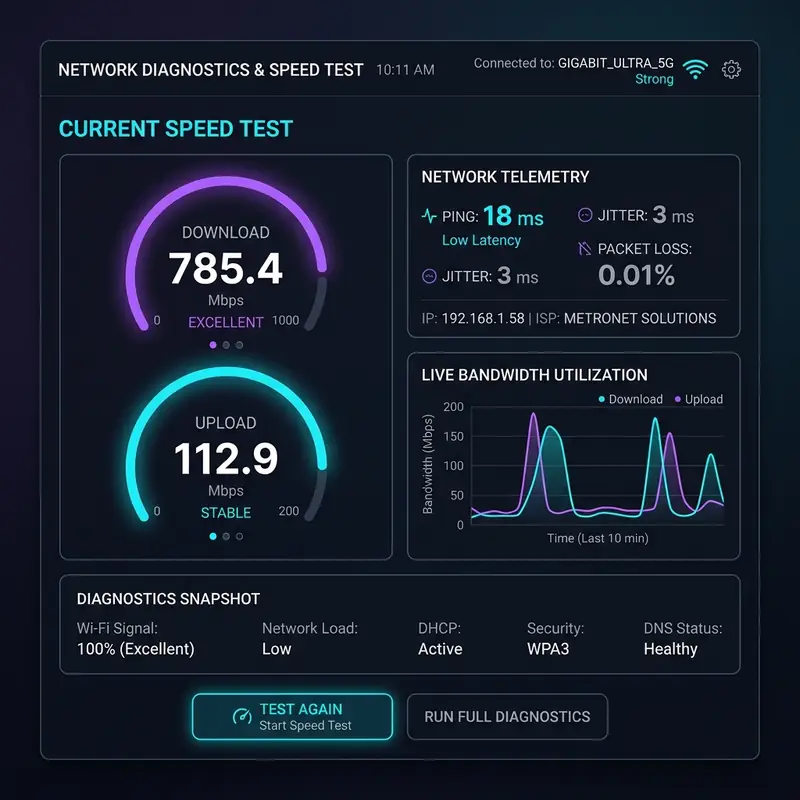
Additionally, the practical integration must encompass the deployment of highly sophisticated, synthetic monitoring agents across the local network infrastructure. Relying on user complaints to identify internet disconnections is an archaic and highly ineffective management paradigm. Instead, administrators must integrate automated probes that continuously execute simulated DNS resolutions, establish encrypted transport layer security sessions with external endpoints, and analyze the resulting jitter and latency metrics in real-time. This continuous telemetry data must be ingested by a centralized observability platform, which utilizes advanced heuristic analysis to detect the subtle pre-indicators of a connection failure. By establishing this proactive monitoring integration, network engineers can preemptively identify and resolve degrading optical signals or saturated state tables hours or even days before they culminate in a total loss of internet connectivity.
6. Security and Compliance
The pursuit of an uninterrupted internet connection introduces a profound array of complex security and compliance challenges that must be delicately navigated. One of the primary security conflicts arises from the necessary deployment of deep packet inspection engines and next-generation firewalls. These highly advanced security appliances are legally mandated by numerous compliance frameworks to ruthlessly scrutinize every inbound and outbound packet for malicious signatures. However, the immense computational overhead required to decrypt, inspect, and re-encrypt high-velocity traffic often introduces significant processing latency. If this latency exceeds the extremely tight tolerance thresholds of strict transport protocols, the connection will invariably timeout and disconnect. Thus, securing the network while simultaneously preventing artificial disconnections requires the deployment of highly specialized hardware acceleration processors explicitly designed to offload cryptographic mathematics.
Another monumental security consideration involves the utilization of highly persistent Virtual Private Network tunnels, particularly those utilizing the IPsec protocol suite. In environments where strict data sovereignty and compliance mandates demand absolute encryption of all transit data, IPsec tunnels are continuously maintained between remote branches and centralized datacenters. These tunnels are notoriously fragile and highly susceptible to even microscopic disruptions in the underlying internet connection. A momentary drop in packet delivery can easily desynchronize the intricately rotating cryptographic keys utilized by the Encapsulating Security Payload protocol. When this desynchronization occurs, the tunnel violently collapses, immediately halting all compliant data transfer. Mitigating this requires the implementation of aggressive Dead Peer Detection algorithms and highly optimized re-keying schedules to ensure that the encrypted connection can instantly recover from underlying internet volatility.
Furthermore, the increasingly hostile landscape of the modern internet dictates that robust Distributed Denial of Service mitigation strategies must be deeply integrated into the connection architecture. However, automated DDoS mitigation platforms frequently rely on aggressive behavioral heuristics to identify anomalous traffic patterns. If a local network attempts to quickly re-establish thousands of dropped connections following a brief physical layer interruption, the provider's upstream DDoS protection may incorrectly classify this massive burst of synchronous requests as a volumetric attack. This false positive will trigger an immediate, automated blacklisting of the network's public IP address, resulting in an artificially induced, highly persistent internet disconnection. Therefore, maintaining strict security compliance without sacrificing connection stability requires meticulous whitelist configurations and continuous collaboration with upstream transit providers to perfectly tune anomaly detection thresholds.
7. Costs and Optimization
Analyzing the financial implications of continuous internet disconnections reveals a staggering landscape of hidden costs and severe operational inefficiencies. The direct costs associated with a dropping connection are typically calculated by measuring the complete cessation of employee productivity and the immediate suspension of digital revenue streams. However, the true financial devastation is far more insidious, manifesting as corrupted database transactions, failed automated backup procedures, and the immense accumulation of technical debt as engineering teams are continuously diverted from feature development to troubleshoot transient network anomalies. The financial imperative to optimize and permanently fix these disconnections is absolute, as the cumulative cost of microscopic, daily outages vastly eclipses the capital expenditure required to upgrade the foundational network architecture.
Optimization strategies designed to permanently resolve internet disconnections must heavily prioritize the implementation of true, multi-path redundancy. Relying on a single Internet Service Provider, regardless of their promised service level agreements, is a fundamentally flawed optimization strategy. True cost optimization is achieved by provisioning diverse connection mediums—for instance, pairing a primary dedicated fiber optic circuit with a secondary fixed-wireless millimeter-wave connection. While the initial operational expenditure of maintaining two disparate connections may appear high, the optimization is realized through the absolute eradication of downtime. By utilizing intelligent traffic steering, non-critical bulk data can be continuously routed over the less expensive secondary link, while latency-sensitive voice and video traffic strictly traverses the premium fiber, thereby optimizing the return on investment for both circuits.
Moreover, aggressive cost optimization requires a profound analysis of internal network hardware lifecycles. Many organizations unknowingly suffer from persistent internet disconnections simply because their boundary routing equipment lacks the essential silicon required to process modern, highly complex routing tables. When a router's control plane processor is continuously pinned at maximum utilization simply trying to calculate optimal paths, the data plane is starved of resources, leading to dropped packets and severed connections. Optimizing this bottleneck requires a calculated financial investment in enterprise-grade silicon, specifically Application-Specific Integrated Circuits designed explicitly for high-speed packet forwarding. Upgrading to specialized hardware guarantees that the internal infrastructure will never become the limiting factor or the source of a disconnection, permanently optimizing the stability of the external internet connection.
8. Future of the Tool
The future trajectory of methodologies and architectures designed to fix internet disconnections is heavily focused on the radical integration of artificial intelligence and machine learning at the absolute edge of the network. Future connection stability will not rely on static routing protocols or manually configured failover thresholds; instead, highly autonomous neural networks will continuously analyze the microscopic behavioral patterns of every individual packet stream. These AI-driven routing engines will be capable of predicting localized congestion events or impending hardware failures on the provider's network minutes before they actually occur. By predicting the failure, the local network architecture can preemptively reroute critical traffic along alternative topological paths, ensuring that the impending disconnection is entirely bypassed and the end-user experiences absolutely zero interruption.
Additionally, the future of internet resilience is intrinsically linked to the ubiquitous adoption and architectural enforcement of the Internet Protocol version 6. The current reliance on complex Network Address Translation gateways to artificially extend the lifespan of IPv4 creates an incredibly fragile connection state that is prone to sudden collapses. As the global infrastructure finally completes the transition to IPv6, the necessity for stateful NAT tracking will be completely eradicated, returning the internet to its original, highly resilient end-to-end routing paradigm. This fundamental architectural shift will instantly eliminate one of the primary causes of transient internet disconnections, as intermediate gateways will no longer be responsible for maintaining the complex memory tables currently required to map millions of internal devices to a single public IP address.
Furthermore, the physical topology of the internet is undergoing a massive revolution with the deployment of highly advanced Low Earth Orbit satellite constellations. These orbital networks are fundamentally altering the traditional concepts of internet connectivity and failure mitigation. In the near future, enterprise and consumer hardware will seamlessly integrate these satellite arrays as an ultimate failover mechanism. When terrestrial fiber links are physically severed or local cellular networks are congested, routing equipment will instantaneously redirect critical connection states through the orbital grid. This integration will utilize advanced multipath TCP algorithms to simultaneously send data across both terrestrial and space-based links, creating an indestructible mesh of connectivity that renders the concept of an internet disconnection entirely obsolete.
9. Final Conclusion
In final conclusion, the persistent and highly disruptive issue of an internet connection that continuously disconnects is never a simplistic anomaly; it is a profound symptom of deep architectural instability within the complex hierarchy of modern telecommunications. Addressing this volatility requires a total paradigm shift away from superficial consumer troubleshooting toward a deeply technical, highly analytical methodology that ruthlessly interrogates every layer of the Open Systems Interconnection model. From the fragile modulation of the physical medium to the complex state tracking of advanced security firewalls, every component within the data path must be perfectly optimized, continuously monitored, and aggressively safeguarded against transient congestion.
The journey to absolute connection stability mandates the meticulous elimination of bufferbloat through advanced queue management, the integration of microsecond-level failure detection protocols, and the deployment of intelligent, multi-path redundant architectures. Organizations and individuals must recognize that relying on a singular, unoptimized pathway to the global internet is a fundamentally flawed strategy that guarantees eventual failure. The true cost of a volatile connection extends far beyond mere annoyance, inflicting severe financial and operational damage by disrupting the intricate, highly dependent choreography of modern distributed software architectures and continuous digital workflows.
Ultimately, solving the disconnection epidemic requires an uncompromising dedication to robust network engineering principles. By abandoning archaic, reactive methodologies and embracing a future defined by autonomous machine learning analytics, omnipresent IPv6 routing, and ultra-resilient Low Earth Orbit satellite integration, the fragility of the modern internet can be permanently eradicated. The establishment of an unbreakable, flawlessly continuous internet connection is not merely a convenience; it is the absolute foundational necessity for participating in the increasingly complex, high-velocity digital future, ensuring that the relentless flow of critical data remains completely unimpeded by the microscopic failures of underlying hardware.

![Como Navegar Anônimo na Internet de Verdade [Guia Antirrastreamento]](/images/posts/wifi-router.webp)