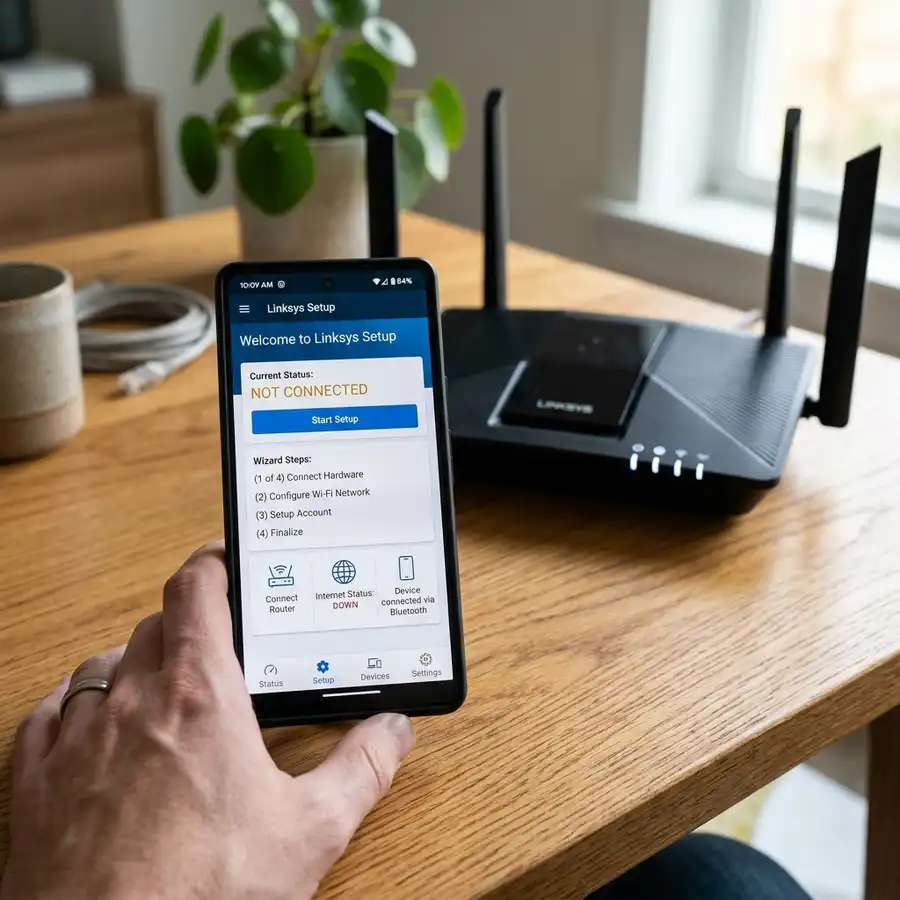
If you are experiencing intermittent connection drops, slow speeds, or if you simply forgot the administrative password of your wireless network, learning how to reset tp-link router from phone is the fastest and most effective troubleshooting step you can take.
To reset a TP-Link router from your phone, press the physical Reset button for 10 seconds or restore factory defaults via the Tether app/web GUI.
This technical guide provides a detailed walkthrough of both physical and logical reset procedures designed to restore any TP-Link router to its factory default settings using your smartphone, whether on Android or iOS. We will cover the hardware specifications of common chipsets (including Qualcomm Atheros, Broadcom, and MediaTek SoCs), walk you through the exact paths on legacy and modern router firmwares, and show you how to execute this task using the official TP-Link Tether application. If you have been struggling with a slow internet connection or need to know if someone is using your Wi-Fi without your authorization, performing a factory reset is the perfect first step to reclaim full control over your home network.
Physical Reset vs. Logical Reset: Detailed Comparison of Methods
Before proceeding, it is important to understand the fundamental difference between the two main methods of factory resetting. The physical reset (using the hardware button on the back of the device) wipes the non-volatile random-access memory (NVRAM) completely without requiring any password authentication. This is your only option if you have lost your administrator password. In contrast, the logical reset (via the web browser interface or mobile app) accomplishes the same storage cleanup but requires you to authenticate with the current administrative login credentials, making it a safer and more controlled option.
| Technical Aspect | Physical Reset (Hardware Button) | Logical Reset (Web Browser / Tether App) |
|---|---|---|
| Password Required | None. Perfect if you are locked out of the administration panel. | Yes, requires the current admin login credentials. |
| Physical Access | Direct physical contact with the router unit is mandatory. | Wireless network connection only; no physical contact needed. |
| NVRAM Action | Electrical discharge of the reset capacitor triggering RAM wipe. | Software command replacing active configuration with factory ROM copy. |
| LED Behavior | All LEDs flash simultaneously, go dark, and reboot. | Progressive reboot monitored via the app or web status bar. |
| Hardware Wear Risk | Potential mechanical damage to the internal button switch. | None; process runs purely on firmware level. |

How NVRAM Cleansing and Boot Cycle Work in TP-Link Hardware
To understand the mechanics of resetting your router, it helps to look under the hood. TP-Link routers feature a System-on-Chip (SoC) microprocesser combined with a flash memory chip storing the firmware (operating system) and a specific storage area called NVRAM (Non-Volatile Random Access Memory) where custom user configurations are stored. The configuration file contains customized settings such as the SSID, your WPA2/WPA3 password keys, customized DNS configurations, and DHCP lease mappings. When you execute a reset, you send an electrical or logical signal that initiates a wipe command on the NVRAM partition. Consequently, the next boot sequence loads the clean factory image from the read-only memory (ROM) partition.
By default, the factory state sets the LAN IP address to either 192.168.0.1 or 192.168.1.1, activates the DHCP server range from 192.168.0.100 to 192.168.0.199, and restores default logins. On older routers, this default login is the standard "admin" user and "admin" password. On modern TP-Link models, however, the default admin password is deleted for security reasons, and the firmware forces you to set up a brand new administrative password upon your first login attempt. This prevents quick remote attacks and ensures compliance with modern cybersecurity standards.
Furthermore, the physical reset pin works as an active-low hardware interrupt. The button triggers an immediate CPU signal to purge the local partition tables (usually JFFS2 or SquashFS writable segments). This electrical safety valve is incredibly useful: even when the router's embedded Linux kernel hangs or is affected by software loops, the hardware interrupt remains accessible, making it impossible to permanently lock yourself out of the configuration unless the hardware itself is physically damaged.
Method 1: Resetting Your TP-Link Router Physically Using Your Mobile Phone
This is the definitive hardware-based method you must use if you cannot log into your router's administration portal. Follow these technical steps carefully:
- Locate the router and check the power state: Ensure your TP-Link router is plugged in and the Power LED is solid green or blue.
- Find the physical Reset button: Inspect the rear interface panel of the router. You will spot a small button labeled "Reset" or "WPS/RESET". On many models, it is recessed within a tiny pinhole to prevent accidental resets. You will need a paperclip, a sewing needle, or a SIM card tray ejection tool.
- Press and hold the button: Insert the tool into the pinhole (or press the button firmly if it is external) and hold it down for approximately 8 to 10 seconds.
- Observe the LED status lights: Watch the front panel LEDs. The lights will blink simultaneously, go dark for a brief second, and then light up again. This indicates that the CPU has initiated the memory reset cycle. You can now release the button.
- Wait for the boot sequence: Let the router reboot for 1 to 2 minutes. The SoC will load the factory default configuration.
- Connect your phone to the factory Wi-Fi: Go to the Wi-Fi settings on your phone. The custom network name will have vanished. In its place, you will see a new network named "TP-Link_XXXX" (where XXXX represents the last four digits of the router's physical MAC address). The factory password (PIN) is printed on the barcode label located underneath the router's base.
On dual-band devices like the Archer series, you might find a dual-purpose WPS/RESET button. Pressing it for a short duration (1-2 seconds) only launches the Wi-Fi Protected Setup pin negotiation protocol. To reset the system configuration, you must continue pressing the button past the 8-second mark until you see the LEDs flash. This prevents users from accidentally deleting their configuration during simple device pairings.
Method 2: Resetting via Web Browser Interface on Mobile
If you remember the administrator password, you can reset the router through its software interface. This avoids having to touch the router hardware directly. Follow these steps:
- Establish a Wi-Fi connection: Connect your smartphone to the active Wi-Fi network of the TP-Link router you wish to reset.
- Open a mobile web browser: Launch Safari, Chrome, or any mobile browser of your choice on your smartphone.
- Enter the gateway IP: In the URL address bar, type 192.168.0.1 (or http://tplinkwifi.net) and press Go.
- Log into the administration panel: Enter your credentials. If you never changed the default admin password, use "admin" for both fields. Otherwise, enter your customized password.
- Access the System Settings menu:
- On the legacy blue/green interface: Go to the left menu, select System Tools, and click Factory Defaults.
- On the modern orange/gray interface: Go to the Advanced tab on the top menu, navigate to System Tools in the sidebar, and choose Backup & Restore.
If the web interface does not respond or loads slowly on your mobile browser, try clearing your browser's local cache or open an Incognito/Private window. Sometimes, stored JavaScript variables from previous logins can conflict with the router's web server, leading to page display errors or failed actions.
Method 3: Resetting via the Official TP-Link Tether App
TP-Link provides a mobile app named TP-Link Tether for easy management, available on both Android and iOS platforms. If your router supports this app, follow these steps to reset it:
- Download and open Tether: Install the TP-Link Tether application from your app store.
- Join the Wi-Fi network: Connect your smartphone to the router's wireless network.
- Select your router: Open the app, log in using your TP-Link ID or local admin password, and tap on your router's model from the list under "My Devices".
- Go to Tools: Tap on the Tools tab in the bottom-right corner of the user interface.
- Open System Settings: Scroll down and select the System option.
- Tap Reboot & Restore: Choose Factory Restore or Restore Factory Defaults and confirm the safety prompt. The app will send the TCP reset command, and the router will begin its wipe process immediately.
The Tether app provides a clean and modern user interface that bypasses common browser-based rendering issues. It is particularly useful for managing multiple TP-Link devices under a single cloud account. Note that if your router loses its WAN connection, the app can still connect locally as long as your phone is linked to the router's local Wi-Fi radio.
How to Reconfigure Your TP-Link Router After a Reset
After a factory reset, your router is in its default state with no internet connection. To restore internet connectivity, you need to reconfigure it. Follow these steps on your phone:
- Connect to the default "TP-Link_XXXX" Wi-Fi network using the default password printed on the sticker beneath the router.
- Open your web browser and navigate to
http://tplinkwifi.netor192.168.0.1. - Create a new, secure administrator password to protect the router's interface.
- Select your WAN Connection Type. If your fiber provider uses a bridge modem, select PPPoE and type in the username and password provided by your ISP. If your ISP modem distributes IPs automatically, choose Dynamic IP and click next.
- Set your new Wi-Fi Network Name (SSID) and create a strong security password using WPA2-PSK or the modern WPA3-SAE protocol.
- Save and apply settings. The router will restart its wireless radios, and you will need to reconnect your phone to the newly created SSID.
For optimal network performance, consider separating the 2.4 GHz and 5 GHz frequency bands with distinct SSIDs. The 2.4 GHz band is ideal for longer range and passes through walls easily but has limited bandwidth. The 5 GHz band offers much faster data transmission rates but has a shorter range. Alternatively, enable the router's Smart Connect feature to let the device automatically steer clients to the best available band.
DomineTec Tip: During reconfiguration, make sure to enable the IPv6 protocol. It reduces the processing load on the router's CPU by eliminating the need for NAT translation for compatible websites. This translates to lower latency in online gaming and faster loading times.
Security Best Practices and Hardening Your Router After Setup
After a factory reset, it is critical to secure your network to prevent unauthorized access. The first security step is to disable the remote management feature over the WAN interface. When active, this feature exposes your router's login page to the public internet, making it vulnerable to brute force attacks. Ensure it is configured to allow local network administration only.
Additionally, disable the WPS (Wi-Fi Protected Setup) feature in your wireless settings. WPS has known vulnerabilities that allow attackers to crack your network password in a short amount of time using PIN-guessing software. Finally, update your router's firmware to the latest version. Manufacturers regularly release patches to fix security bugs and improve network performance. Keeping your firmware updated ensures your network is protected against modern threats.
We also strongly advise changing the router's default IP gateway subnet address. For instance, if the default IP address is 192.168.0.1, you can change it to a non-standard private IP address range such as 172.16.50.1 or 192.168.88.1. This minor change provides a layer of security through obscurity, as automated malware or local intruders trying to guess your gateway address will fail to locate the login portal. It also prevents IP address conflicts if you ever bridge multiple routers together.
Finally, always configure Protected Management Frames (PMF) if your router supports it. PMF provides security protection for unicast and multicast management frames, preventing attackers from launching de-authentication attacks that temporarily disconnect your smartphones or smart devices from the network to capture security keys.
Frequently Asked Questions (FAQ)
1. What happens if the router loses power during a physical reset?
If power is cut while the CPU is rewriting the startup files in the flash memory, the router might get "bricked". This means the firmware is corrupted, and the device will no longer boot or respond to normal signals. In such cases, you will need advanced firmware restoration tools (like TFTP) or assistance from a professional repair center.
2. What is the default password for a TP-Link router after a reset?
For older TP-Link router models, the default username and password are both admin. On modern models, there is no default admin password; you must create a new one on your first login attempt. The default wireless password (PIN) is located on a white label on the underside of the router.
3. Why is tplinkwifi.net not loading on my phone?
This usually happens because your mobile data (3G/4G/5G) is enabled, forcing your phone to look for the website on the internet rather than on the local network router. Turn off cellular data, verify that you are connected directly to the router's Wi-Fi network, and reload the browser page.
4. Does resetting the router erase my internet provider configurations?
Yes, it completely erases all settings, including PPPoE login credentials, static IP configurations, custom DNS, Wi-Fi passwords, and VLAN settings. You must have your ISP setup details ready before performing a factory reset to avoid losing internet access.
Conclusion
Resetting a TP-Link router from your mobile phone is a highly effective troubleshooting method that restores your device to its default factory state. Whether you use the physical hardware button or navigate the web GUI and Tether app, the process is quick and reliable. After resetting, always configure WPA2/WPA3 security passwords and change the default administrative credentials to keep your network secure.




