Gigabit vs Fast Ethernet Router: What is the Speed Difference?
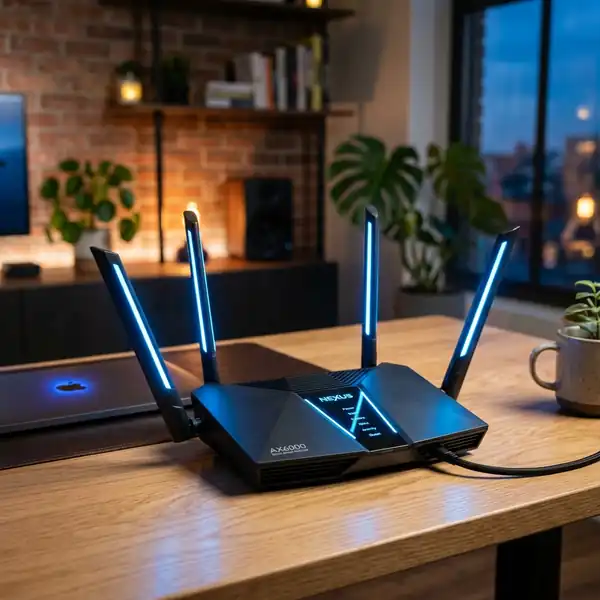
When subscribing to high-speed fiber broadband, many consumers face a frustrating problem: speed tests over their network never exceed 100 Mbps, even on plans advertised at 300 Mbps, 500 Mbps, or higher. This bottleneck is usually caused by a hardware limitation in the home router. The difference is port speed: Fast Ethernet caps at 100 Mbps, while Gigabit supports up to 1000 Mbps, essential for fiber plans over 100 Mbps.
Choosing between a router with Fast Ethernet ports and one with Gigabit Ethernet ports is critical for home network performance. As internet service providers roll out affordable, high-speed fiber optic packages, using a router with Fast Ethernet ports creates a bottleneck. Understanding wired networking hardware, cable categories, and the real-world impact of port speeds will prevent you from buying obsolete equipment.
In this guide from DomineTec, we explore the differences between Gigabit and Fast Ethernet routers. We will explain how the 100 Mbps physical limit works, the role of network cable categories (Cat5, Cat5e, Cat6), and how to verify your hardware settings. For more advice on managing home hardware, check out our guide on best cheap gigabit routers for fiber or learn about cabling options with Cat5e vs Cat6 ethernet cable differences to ensure your network infrastructure supports full speed.
1. What are Fast Ethernet and Gigabit Ethernet Routers?
The terms "Fast Ethernet" and "Gigabit Ethernet" refer to the maximum data transfer speed supported by the physical RJ45 ports (both WAN and LAN) on your router. These ports use copper twisted-pair cables to route data packets between devices.
The Fast Ethernet standard (IEEE 802.3u) was introduced in the 1990s, increasing wired speeds from the original 10 Mbps Ethernet up to 100 Mbps. While this was sufficient for older DSL and coaxial broadband, modern networks require more throughput. The Gigabit Ethernet standard (IEEE 802.3ab) multiplied this speed by ten, supporting transfer rates of up to 1000 Mbps (1 Gbps). Gigabit routers utilize faster internal processors and chipsets to handle this increased bandwidth.
This technical difference has a deep impact on the internal architecture of the router. To process 1 Gbps of data traffic in real time, a Gigabit router must be built with a high-frequency CPU (often dual-core or with dedicated network hardware processors) and larger RAM allocations, typically 128MB or 256MB. In comparison, a Fast Ethernet router only needs a basic single-core SoC and 32MB of RAM, which is far cheaper to manufacture but struggles to manage complex modern routing workloads without choking.
Furthermore, Fast Ethernet ports utilize a physical layer standard known as 100BASE-TX, which encodes electrical signals using MLT-3 (Multi-Level Transmit 3) encoding. This technology transmits data over two pairs of copper wires. In contrast, Gigabit Ethernet ports rely on 1000BASE-T standards, which use 5-level Pulse Amplitude Modulation (PAM-5) encoding. This sophisticated signaling protocol allows the interface to transmit and receive data simultaneously over all four pairs of copper wires inside the network cable, achieving the massive tenfold increase in bandwidth without requiring a tenfold increase in physical frequency.
2. The Physical Speed Limit: Understanding the 100 Mbps Bottleneck
The 100 Mbps bottleneck is a hard hardware limitation. A Fast Ethernet port cannot physically process more than 100 million bits of data per second. If you subscribe to a 400 Mbps fiber plan and connect your modem to a Fast Ethernet WAN port on your router, your incoming speed will be capped at 100 Mbps.
In practice, network overhead (the extra data required to manage packets) reduces the maximum real-world throughput of Fast Ethernet connections to around 94 Mbps or 95 Mbps in speed tests. The remaining 300 Mbps of bandwidth from your plan is lost, resulting in wasted money and slower downloads on your home devices.
To put this in perspective, think of the connection as a water supply system. Even if the city water main is a huge two-foot pipe providing high-pressure flow (equivalent to your 400 Mbps fiber connection), if the input pipe to your home is only half an inch wide (the Fast Ethernet port), the water pressure inside your house will always be limited to the capacity of that small half-inch pipe. Any device in your home that tries to pull more water will be starved of flow due to the physical restriction.
The reason for the exact limit of ~94.9 Mbps in speed tests comes down to TCP/IP packet construction. An Ethernet frame carries 1500 bytes of payload data (MTU - Maximum Transmission Unit), but it also requires headers for the Ethernet layer, IP layer, and TCP layer, along with inter-packet gaps and preamble sequences. This overhead consumes about 3% to 5% of the total raw transmission capacity. On a Fast Ethernet port, this limits the maximum theoretical data throughput to approximately 94.9 Mbps. No firmware update or software optimization can ever bypass this physical barrier.
3. Why High-Speed Fiber Optic Broadband Requires Gigabit Ports
Fiber to the Home (FTTH) technology has made plans of 300 Mbps or higher standard for residential connections. To take advantage of these speeds, every link in your network path must support speeds greater than 100 Mbps.
A Gigabit Ethernet router features a WAN port that accepts high-speed data streams from your modem without restrictions. This allows the full bandwidth of your plan to be distributed to your network. Devices connected via Ethernet cables to the router's Gigabit LAN ports (such as desktop PCs or game consoles) will receive maximum download speeds, minimizing latency and buffering during heavy usage.
Furthermore, gigabit ports are essential to let your Wi-Fi run at its full speed. If you purchase an "AC1200" wireless router, it is capable of transmitting up to 867 Mbps over the 5 GHz band locally. However, if the physical WAN port on that same router is a 100 Mbps Fast Ethernet port, the data feed coming from your modem is capped at 100 Mbps. Even if your phone connects to the Wi-Fi at a high link rate, your actual internet browsing speed will still be restricted to 95 Mbps.
Using a Fast Ethernet router on a high-speed fiber connection also introduces a severe queue management bottleneck. When multiple devices try to download large files at once, the router's WAN port runs at its maximum capacity, creating packet queues. If the router's processor is weak, this queue causes bufferbloat, which dramatically increases ping times and jitter. Upgrading to a Gigabit router eliminates this queue bottleneck, allowing packet streams to flow freely and keeping gaming ping times low even during heavy downloads.
4. The Crucial Role of Ethernet Cables (Cat5, Cat5e, Cat6) in Speed Negotiation
Wired network speed negotiation depends on the Ethernet cables connecting your devices. Even if you have a Gigabit router and a Gigabit network card in your PC, the connection will drop to 100 Mbps if the cable is incorrect or damaged.
Here is how cable categories compare:
- Cat5 (Category 5): An older, obsolete standard that only supports speeds up to 100 Mbps. It should not be used in modern gigabit networks.
- Cat5e (Category 5e): An improved version of Cat5. It supports speeds up to 1000 Mbps (1 Gbps) over distances up to 100 meters. This is the minimum requirement for Gigabit connections.
- Cat6 (Category 6): Features internal shielding and tighter twists to reduce interference. It supports speeds up to 10 Gbps over short distances (up to 55 meters) and 1 Gbps up to 100 meters, making it ideal for modern home wiring.
There is also an important technical detail to keep in mind regarding pinouts: 10/100 Mbps Ethernet connections only require 2 pairs of wires (4 pins) to transmit and receive data. In contrast, 1000 Mbps Gigabit Ethernet requires all 4 pairs of wires (8 pins) inside the cable to negotiate speeds. If a Cat5e or Cat6 cable has a damaged or loose wire, or if it was poorly crimp-connected using only 4 pins, the network interfaces will automatically fall back to 100 Mbps Fast Ethernet as a fallback. This protects the link but restricts your speed, making it important to inspect your cables.
5. How to Check if Your Current Router Has Fast or Gigabit Ports
Some routers are marketed as "AC1200" to highlight high wireless speeds, but actually feature Fast Ethernet ports (100 Mbps). This limits your internet connection to 100 Mbps, regardless of the theoretical wireless performance. Verify your hardware specs to ensure you are getting full speed.
You can check your router's port specifications using these methods:
- Read the Technical Specifications: Check the specifications section in the product manual or on the manufacturer's website. Look for "WAN/LAN Ports: 10/100/1000 Mbps" (Gigabit) or "10/100 Mbps" (Fast Ethernet).
- Inspect the Ports and LEDs: On some devices, Gigabit ports feature metal shields or status lights that indicate connection speed (e.g., green for Gigabit, amber for Fast Ethernet).
- Check Windows Link Speed: Connect your PC to the router with a network cable. Open Settings > Network & Internet > Ethernet. Look at the "Link speed (Receive/Transmit)" field. If it displays "1000/1000 (Mbps)", your router is Gigabit. If it shows "100/100 (Mbps)", your router, cable, or network card is limiting the speed.
If you are unsure of your router model, check the label underneath the device. Models with a "G" suffix or "Gigabit" in the name (such as the Archer C6 or Archer C80) are equipped with 1000 Mbps ports. Legacy models (like the Archer C20 or Archer C50) only feature Fast Ethernet ports to lower manufacturing costs.
6. Detailed Comparison: Fast Ethernet vs. Gigabit Ethernet Routers
Selecting the right networking hardware requires comparing the underlying technical capabilities of the different port standards. Review the comparison below to understand how these technologies perform in real-world environments:
| Technical Feature | Fast Ethernet Router | Gigabit Ethernet Router |
|---|---|---|
| Maximum Theoretical Speed | 100 Mbps | 1000 Mbps (1 Gbps) |
| Real-World Speed Test Limit | Around 94 to 95 Mbps | Up to 940 to 960 Mbps |
| Minimum Required Cable Category | Cat5 | Cat5e (Cat6 recommended) |
| Recommended Internet Plan Range | Under 100 Mbps only | 100 Mbps to 1000 Mbps+ |
| Local Network Data Transfer (LAN) | Slow. Transfers large files slowly. | Excellent. Fast enough for local 4K streaming. |
7. Real-world Impact: Gaming, File Transfers, and Smart Home Streaming
Beyond raw internet download speeds, port types affect local network data transfers (Intranet). If you use a Network Attached Storage (NAS) device, run automated backups, or stream high-definition media locally via Plex, a Fast Ethernet router will cause bottlenecking and lag.
For online gaming, download times for large game files (which can be over 100 GB) are significantly reduced. A 100 GB game download takes hours on a Fast Ethernet connection, but can be completed in minutes on a Gigabit network with a compatible plan. Gigabit connections also offer slightly lower latency by reducing queuing delays on the router's processor.
In addition to speed, Gigabit routers are built to handle heavier traffic loads from multiple devices. If your home has smart home assistants, laptops, and smart TVs streaming content at the same time, the stronger processors found in Gigabit models will manage these queues efficiently, preventing latency spikes and buffering issues across your network.
From an enterprise or advanced home-office perspective, Gigabit Ethernet also supports advanced features like Jumbo Frames. Standard Ethernet frames are capped at 1518 bytes. However, Gigabit interfaces can enable Jumbo Frames up to 9000 bytes. By packing more data into a single frame, the CPU overhead on both the sender and receiver devices is drastically reduced. This is a game-changer for local backup systems, editing high-definition raw video directly off a NAS, or transferring virtual machine images across local servers.
8. Cost-Benefit Analysis and Buying Guide for Gigabit Network Upgrades
If you are upgrading your home network, use this checklist to ensure you get the best performance:
- Verify that your internet plan is faster than 100 Mbps.
- Ensure all network cables connecting your modem, router, and devices are at least Cat5e or Cat6, with all 8 copper wires correctly pinned.
- Confirm that the router features Gigabit WAN and LAN ports (10/100/1000 Mbps). Avoid models with mixed port speeds (e.g., Gigabit WAN but Fast LAN).
- Verify that the network cards on your computers support Gigabit speeds.
DomineTec Tip: When purchasing a new AC1200 or Wi-Fi 6 (AX) router, check the product specifications carefully to ensure it is labeled as "Gigabit" or "10/100/1000 Mbps". Some budget models use Fast Ethernet ports to lower costs, which will cap your wired internet speed.

Frequently Asked Questions
1. Does a Gigabit router improve Wi-Fi signal coverage?
No. Gigabit ports only affect the speed of wired connections and the data link between the modem and the router. Wi-Fi range and coverage depend on transmitter power, antennas, frequency bands (2.4 GHz vs. 5 GHz), and physical obstacles.
2. Can I use a standard Cat5 cable in a Gigabit Ethernet port?
Yes, but the link speed will be limited to 100 Mbps. Standard Cat5 cables lack the twists required for reliable 1000 Mbps transmissions. Use a Cat5e or Cat6 cable to enable full Gigabit speeds.
3. How do I know if my PC has a Gigabit network card?
In Windows, open the Device Manager, expand the "Network adapters" section, and check the name of your Ethernet card. Gigabit controllers usually include terms like "Gigabit", "GBE", "10/100/1000M", or "Family Controller" in their names.
4. Is a Gigabit router worth it for a 100 Mbps internet plan?
Yes. Gigabit routers generally feature faster processors and more memory, enabling them to manage traffic from multiple devices more efficiently. Upgrading to a Gigabit router also prepares your network for future speed plan increases.




