How to Connect Two Routers on One Network Using Ethernet Cable
How to Connect Two Routers on One Network Using Ethernet Cable: Step-by-Step Guide
To connect two routers on the same network using a wired RJ45 Ethernet cable, the best approach is a LAN-to-LAN configuration where you disable the DHCP server on the secondary router, change its LAN IP address to match the primary router's subnet range (such as setting it to 192.168.1.2 if the primary router is 192.168.1.1), and run the physical Ethernet cable from a LAN port on the primary router directly to a LAN port on the secondary router. This configuration turns the secondary router into a transparent Access Point, placing all your household devices, wireless printers, and computers in a single logical local subnet, avoiding the performance issues and connection errors caused by Double NAT when using the WAN port.
1. Why Ethernet Cables Outperform Wireless Extenders and Repeaters
When seeking to eliminate Wi-Fi dead zones, many users choose wireless repeaters. However, wireless repeaters have structural limitations. Because wireless networks operate in Half-Duplex mode, a radio interface cannot transmit and receive data at the same time on the same channel. A wireless repeater must split its available bandwidth: half to communicate with the primary router and half to transmit data to the client device. This results in an immediate 50% drop in speed at the extension point.
Additionally, wireless signals suffer from attenuation when passing through barriers like masonry walls, concrete slabs, mirrors, and plumbing, and are susceptible to RF noise from neighbor networks and home electronics. An Ethernet cable (Cat5e, Cat6, or higher) operates in Full-Duplex mode, enabling simultaneous data transmission and reception. It provides near-zero latency (under 1 millisecond) and is immune to RF interference. Using a physical cable to connect your second router ensures maximum connection stability, full Gigabit throughput, and low latency for gaming and video calls. This makes wired cascading much superior to any wireless repeating.
2. Network Topologies: LAN-to-LAN vs. LAN-to-WAN Connection Types
There are two primary methods for linking two routers using a physical Ethernet cable. Your choice depends on how you want to manage device communications on your local network:
- LAN-to-LAN Connection (Recommended): The Ethernet cable is plugged into a LAN port on the primary router and goes into a LAN port on the secondary router. In this setup, the secondary router functions as a transparent bridge or Access Point. The DHCP server on the secondary router is disabled, allowing the primary router to assign IP addresses to all devices on the network. All devices remain on the same broadcast domain, making it easy to share printers, access NAS files, and play multiplayer games with other local devices;
- LAN-to-WAN Connection (Cascaded Subnets): The cable runs from a LAN port on the primary router to the WAN (Internet) port of the secondary router. This setup creates a separate sub-network (for example, the main network uses 192.168.1.X, while the second network uses 192.168.2.X). While useful for isolating networks—such as a home office separated from home devices—it causes a Double NAT (Network Address Translation) condition. Your traffic must pass through two NAT translation processes, which can disrupt online gaming matchmaking, break UPnP port mappings, and prevent file sharing between the two networks.
| Technical Aspect | LAN-to-LAN Connection (Bridge) | LAN-to-WAN Connection (Subnet) |
|---|---|---|
| Subnet Layout | Single unified subnet (Same IP range) | Separate, isolated subnets (Different ranges) |
| Secondary DHCP Server | Must be disabled | Must be enabled |
| Physical Cable Port 2 | LAN Port (Yellow/numbered) | WAN Port (Blue/labeled Internet) |
| NAT Processing | Single NAT (Managed by primary router only) | Double NAT (Translates addresses twice) |
| Device Discovery & Sharing | Fully supported (Printers, NAS, gaming) | Blocked (WAN devices cannot see LAN 1) |
| Best Suited For | Seamless home network expansion & gaming | Isolated guest access or home offices |
3. Pre-Configuration Planning: IP Ranges and Cable Check
Before configuring settings on your router's administration pages, plan the logical IP addressing. For this guide, we assume the primary router (usually provided by your ISP) is configured with these standard settings:
Primary Router IP Address: 192.168.1.1
Subnet Mask: 255.255.255.0
DHCP Address Pool: 192.168.1.10 to 192.168.1.254
To avoid IP conflicts (which happen when two devices share the same IP address on a network, causing both to disconnect), you must assign the secondary router a static IP address within the primary router's subnet range (192.168.1.X) but outside the DHCP IP pool. Setting the secondary router's IP to 192.168.1.2 is a good choice because it is easy to remember and will not conflict with devices receiving dynamic IPs from the primary router. You should also ensure that the subnet masks on both routers match exactly as 255.255.255.0, which dictates that only the last octet of the IP address changes for local network devices.
Next, check your cabling. We recommend using a Cat5e or Cat6 copper cable wired to the T568B standard on both ends. Cat6 cable is highly recommended for cables running longer than 15 meters or near electrical wires, as it has a plastic spline dividing the wire pairs to reduce crosstalk. Modern routers feature Auto-MDIX ports, which automatically detect and adjust for crossover connections, allowing you to use a standard straight-through Ethernet patch cable without needing specialized crossover equipment.
4. Step-by-Step Configuration Guide: LAN-to-LAN Setup
Follow these steps to configure a unified local network without IP conflicts or routing loops:
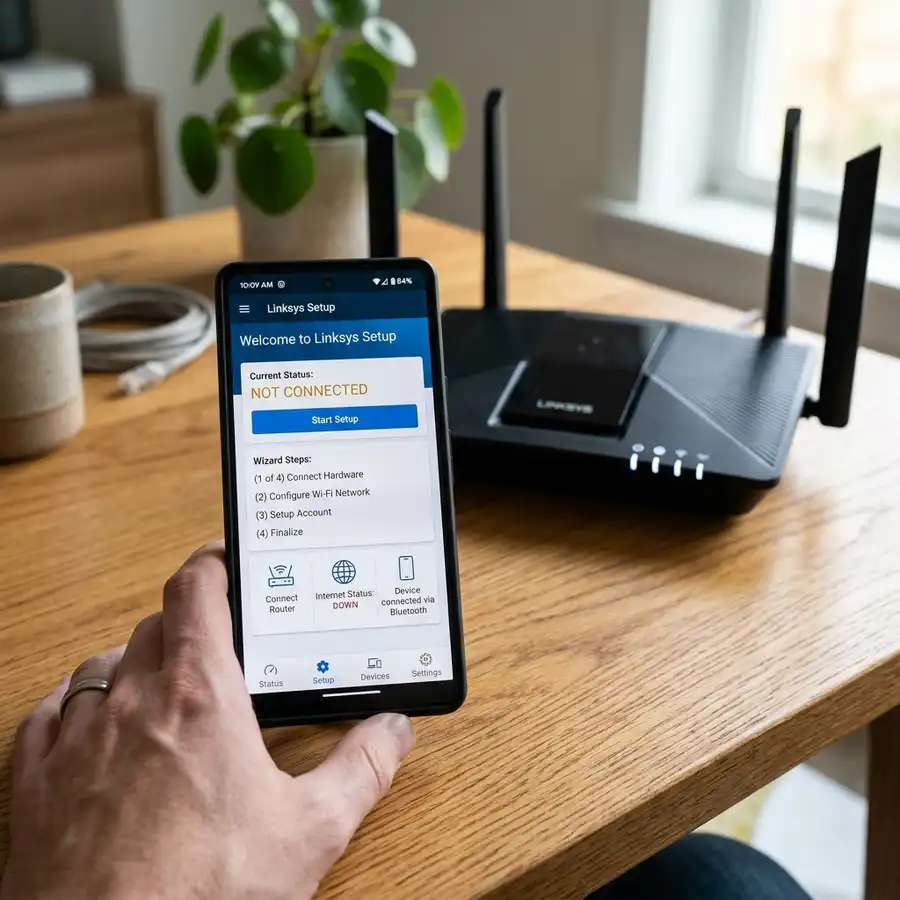
- Isolate the Secondary Router: Do not connect the two routers with the Ethernet cable yet. Power on the secondary router and connect a computer to one of its LAN ports using an Ethernet cable, or connect to its default Wi-Fi network using a smartphone;
- Access the Web Interface: Open a web browser (such as Chrome, Safari, or Edge) and enter the secondary router's default IP address (typically printed on its label, e.g.,
192.168.0.1or192.168.1.1). Enter the administrator username and password (oftenadmin/admin); - Change the LAN IP Address: Locate the "LAN Settings," "Network," or "LAN Config" menu. Change the IP address to
192.168.1.2. Save your changes and apply. The router will restart. To access its settings panel after this change, use the new IP address:192.168.1.2; - Disable the DHCP Server: Log back into the settings panel at
192.168.1.2. Navigate to the "DHCP Server" menu and set the DHCP option to "Disabled" or "Off." Save your changes. This step is critical: disabling the secondary router's DHCP server prevents it from assigning conflicting IP addresses to devices on your network; - Configure Wi-Fi for Roaming: To allow your mobile devices to switch between routers as you move around the house, set the secondary router's Wi-Fi network to use the same network name (SSID), same password, and same security type (WPA2-AES or WPA3) as the primary router. However, select manual, non-overlapping channels. For the 2.4 GHz band, if the primary router uses channel 1, set the secondary router to channel 6 or 11;
- Connect the Ethernet Cable: Now that the settings are configured, connect the Ethernet cable. Plug one end into a LAN port on the primary router and the other end into a LAN port on the secondary router. Keep the secondary router's WAN port empty (unless using a specific "Access Point Mode" setting that converts it to a LAN interface, though manual LAN-to-LAN configuration is compatible with all router brands).
5. Managing Wi-Fi Channels to Avoid Wireless Interference
When using the same SSID and password on both routers to create a roaming Wi-Fi network, configure the wireless channels to prevent signal interference. If both routers transmit on the same channel in the same area, their signals can degrade performance, causing packet loss and connection drops. This is because Wi-Fi uses Carrier Sense Multiple Access with Collision Avoidance (CSMA/CA), meaning devices must wait for a clear channel before transmitting data.
In the 2.4 GHz band, only channels 1, 6, and 11 do not overlap. If the primary router is set to channel 1, set the secondary router to channel 6 or 11. In the 5 GHz band, you have more channels to choose from. Select channels that are spaced apart (for example, channel 36 on the primary router and channel 149 on the secondary router) and keep the channel width at 80 MHz for optimal performance. This ensures both routers can transmit at maximum speeds without sharing airtime resources.
6. Advanced Roaming Standards: Understanding 802.11k, 802.11v, and 802.11r
For users who want a seamless transition where real-time voice calls (VoIP) or online gaming streams do not drop as they walk through the house, understanding active roaming standards is key. In basic setups with identical SSIDs on two separate routers, devices undergo passive roaming. The client device (smartphone or tablet) is solely responsible for determining when to drop a weak connection and search for a stronger one, often resulting in "sticky" client behavior where the device remains connected to a weak router far away.
In modern Wi-Fi architectures, three standards work together to enable seamless transitions. IEEE 802.11k (Radio Resource Measurement) provides client devices with a curated list of neighboring access points, allowing them to search for a new connection much faster. IEEE 802.11v (Wireless Network Management) allows the network to actively suggest that a client switch to a less congested router or a higher frequency band. Finally, IEEE 802.11r (Fast Transition) pre-authenticates the client device with the new router before the switch occurs. This reduces the connection handoff time from several hundred milliseconds to under 50 milliseconds, making the transition completely unnoticeable to the user.
7. Troubleshooting Common Installation and Network Issues
If you experience connectivity issues after setting up the routers, use these steps to resolve them:
No Internet access when connected to the secondary router: Check that the Ethernet cable is connected to the LAN ports on both routers. If the cable is plugged into the secondary router's WAN port by mistake, devices will not be able to access the internet in a LAN-to-LAN configuration. Also, verify that the static IP address assigned to the secondary router does not conflict with the primary gateway or another device on the network.
Devices stay connected to a weak signal instead of switching routers: Some mobile devices do not roam between access points efficiently and may stay connected to a weak signal from a distant router. To help devices switch to a stronger signal, reduce the transmission power (Tx Power) on both routers from "High" to "Medium" in their advanced wireless settings. This encourages devices to connect to the nearest access point.
For more troubleshooting information on network drops and link diagnostic tools, read our guide on troubleshooting a router that keeps disconnecting from the internet. If you notice status lights blinking on your primary router, read our article explaining what a router blinking orange light means to help diagnose ISP authentication issues or cable faults.
Frequently Asked Questions (FAQ)
Can I connect a third router using the same method?
Yes. You can connect a third router by running an Ethernet cable from a free LAN port on either the first or second router to a LAN port on the third router. Configure the third router with DHCP disabled and assign it a static IP address like 192.168.1.3.
What happens if I forget to disable DHCP on the second router?
Having two DHCP servers active on the same subnet will cause IP address conflicts. Connected devices may receive incorrect IP addresses and gateway configurations, resulting in intermittent or lost internet connections.
Do I need to use a crossover cable to link the LAN ports?
No. Modern network hardware supports Auto-MDIX, which automatically adjusts for cabling configurations. You can use standard straight-through Cat5e or Cat6 cables to link the routers.
Can devices connected to the second router print to a printer on the first router?
Yes. Because the LAN-to-LAN configuration places all devices on the same subnet (192.168.1.X), network resource sharing, device discovery, and printing work across both routers.
Building a Stable Home Network Backbone
Connecting two routers via an Ethernet cable is a reliable way to eliminate wireless dead zones while maintaining your high-speed internet connection throughout your home. Setting up the IP configuration correctly helps prevent network conflicts and ensures a stable connection. If you want to use an older router as a dedicated wireless bridge, check out our guide on how to turn an old router into a Wi-Fi repeater for step-by-step instructions.




