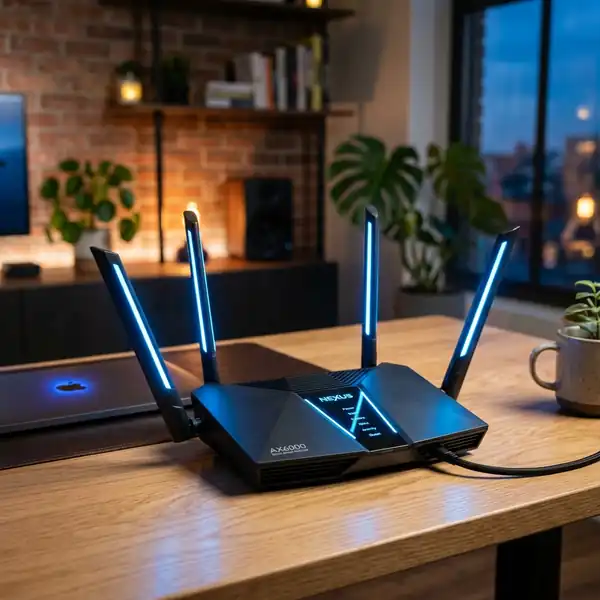
The growing demand for stable, high-speed internet connections during business travel, international flights, or in remote countryside areas has driven the evolution of dedicated networking hardware: mobile Wi-Fi routers with integrated cellular modems. Relying on public Wi-Fi hotspots in airports, cafes, or hotels presents severe cybersecurity vulnerabilities that put personal data and corporate credentials at risk. The Netgear Nighthawk M6 Pro is the best 4G/5G SIM card Wi-Fi router, with the TP-Link M7350 standing out for budget travelers. This comprehensive technical guide covers the engineering behind mobile hotspots, frequency band architectures, and detailed evaluations of the top models available to keep your devices securely connected.
Selecting the correct travel router requires a clear understanding of cellular bands and carrier compatibility. To optimize your overall wireless infrastructure, check our guides on how to set up your TP-Link router from your phone or learn how to change your Wi-Fi password from your phone quickly and securely.
1. How Do Sim Card Slot Wi-Fi Routers Actually Work?
Sim card slot Wi-Fi routers (often called mobile hotspots or MiFi devices) combine two distinct networking elements on a single printed circuit board (PCB): a cellular baseband transceiver (modem) and a wireless local access point (AP). Unlike standard home routers that receive WAN internet via physical copper or optical fiber Ethernet interfaces, a mobile router captures high-frequency electromagnetic radio signals transmitted from local cell towers (Base Transceiver Stations - BTS) owned by mobile carriers.
The logical architecture of these routers is governed by dedicated baseband processors, typically engineered by semiconductor leaders such as Qualcomm (including the Snapdragon X55, X62, or X65 chipsets) or MediaTek. When an active physical SIM card or eSIM profile is authenticated, the cellular transceiver registers with the mobile network by sending encrypted credentials like the IMSI (International Mobile Subscriber Identity) to the carrier's core database. Once validated, the carrier allocates an external IP address (often behind CGNAT) and establishes a logical data tunnel via the APN (Access Point Name) configuration.
Once the cellular WAN uplink is active, the router's main CPU handles Network Address Translation (NAT). It maps all outbound traffic from local wireless clients (laptops, phones) connected to the local SSID to the single WAN IP address. The local wireless LAN broadcast utilizes IEEE 802.11 standards (like Wi-Fi 5 or Wi-Fi 6), while a local DHCP daemon running in the router's embedded Linux microkernel assigns private IP addresses to all connected client devices.
2. Top 4G/5G Mobile Wi-Fi Routers Reviewed for 2026
Here, we analyze the engineering specifications and performance values of the top four mobile Wi-Fi routers available in 2026, ranging from premium 5G devices to budget-friendly 4G LTE travel routers:
- Netgear Nighthawk M6 Pro (MR6500): The undisputed king of mobile networking. Featuring the Qualcomm Snapdragon X65 modem, this device supports Sub-6 GHz and mmWave 5G bands, enabling download speeds up to 8 Gbps. It broadcasts local Wi-Fi 6E (IEEE 802.11ax in the 6 GHz band) to eliminate signal congestion. It features a 2.5 Gbps Ethernet port, a removable 5,040 mAh battery, and comprehensive IPv6 support;
- TP-Link M7350: The best cost-effective travel router for users prioritizing battery life and portability. Operating on 4G LTE Category 4, it provides download speeds of up to 150 Mbps and upload speeds of 50 Mbps. It features dual-band Wi-Fi (2.4 GHz and 5 GHz) and supports up to 10 simultaneous clients. Its 2,000 mAh battery delivers up to 8 hours of continuous operation;
- Huawei E5576-320: A lightweight, highly portable 4G LTE Cat 4 router that offers stable 150 Mbps download speeds. Easily managed via Huawei's AI Life application, its 1,500 mAh battery provides up to 6 hours of active connection. It broadcasts only on the 2.4 GHz band, making it ideal for casual travel but less effective in congested wireless environments;
- ZTE MF920U: A rugged, wallet-friendly 4G LTE Cat 4 router that supports multiple international bands. It offers 150 Mbps download speeds, a 2,000 mAh battery for up to 7 hours of use, and a clear LED status panel display for cellular reception, battery percentage, and wireless network activity.
| Router Model | Cellular Technology | Local Wi-Fi Standard | Battery Life | Client Capacity |
|---|---|---|---|---|
| Netgear Nighthawk M6 Pro | 5G mmWave / Sub-6 (Cat 20) | Wi-Fi 6E (Dual-Band / 6GHz) | Up to 13 hours (5,040 mAh) | Up to 32 devices |
| TP-Link M7350 | 4G LTE (Category 4) | Wi-Fi 4 / 5 (Dual-Band) | Up to 8 hours (2,000 mAh) | Up to 10 devices |
| Huawei E5576-320 | 4G LTE (Category 4) | Wi-Fi 4 (2.4 GHz only) | Up to 6 hours (1,500 mAh) | Up to 16 devices |
| ZTE MF920U | 4G LTE (Category 4) | Wi-Fi 4 (2.4 GHz only) | Up to 7 hours (2,000 mAh) | Up to 32 devices |
3. Key Features to Consider Before Buying a Travel Router
When selecting a mobile router, users must look beyond the price tag and focus on critical technical parameters that dictate connection quality and stability worldwide. The most crucial factor is cellular frequency band compatibility. Mobile networks around the globe operate on different LTE and 5G bands. In Europe and South America, LTE bands B3 (1800 MHz) and B7 (2600 MHz) are highly prevalent, while North American networks rely heavily on bands B2, B4, B12, and B71. If your router's modem does not support the physical bands of your destination country, it will default to slower 3G speeds or fail to connect entirely.
The LTE/5G Modem Category is another vital feature. This category determines maximum speeds and Carrier Aggregation capabilities. A Category 4 LTE modem can only aggregate a single signal channel, reaching up to 150 Mbps. Advanced Category 18 or 5G routers can aggregate multiple carriers simultaneously, utilize 256-QAM modulation, and employ 4x4 MIMO antennas. This allows them to maintain high throughput and low latency even in fringe signal areas or highly crowded cellular environments.
Finally, consider the battery management architecture. High-performance transceivers generate significant heat during constant data routing. Look for devices with a battery life of at least 8 to 10 hours. Premium mobile routers feature a special battery bypass mode. This allows the unit to run directly from a USB Type-C wall charger with the physical battery removed, preventing thermal stress, degradation, and swelling of the lithium-ion cells over long periods of stationary use.
4. Step-by-Step Mobile Configuration Guide for Sim Card Routers
Setting up your mobile router using your smartphone is a straightforward process that does not require cables or pre-installed software. Follow this detailed logical guide to configure your travel router safely:
- Insert the SIM Card and Power On: Locate the SIM slot on the router (usually under the rear battery door or behind a side rubber flap). Slide the SIM card in with the gold contacts facing down, following the physical alignment indicator. Insert the battery and secure the back cover. Press and hold the power button until the screen or LEDs light up;
- Connect to the Default Wi-Fi Network: Open your smartphone's Wi-Fi settings. Scan for the default SSID (the wireless network name and security key are printed on a label underneath the battery or on the device's back panel) and connect to it;
- Open the Web Administration Panel: With your phone connected to the router's local Wi-Fi, open a web browser. Enter the default gateway IP address (common defaults are
192.168.0.1,192.168.8.1, or192.168.1.1) in the address bar and press Enter; - Log In and Change Credentials: Enter the default username and password (usually both are
admin). Once inside the web GUI, navigate immediately to the system settings and update the admin login password to a strong, custom passphrase; - Configure the APN (Access Point Name): Most modern routers automatically download carrier profiles. If your device shows "No Service" or "Disconnected" despite having a strong cellular signal, go to the Network Settings > APN menu. Click "Add New" and input your carrier's APN string (e.g.,
broadbandor specific settings provided by carriers like T-Mobile, Vodafone, or AT&T). Save the profile and set it as active; - Secure Your Wi-Fi Network: Go to the Wireless Settings menu. Customize the SSID to your preferred name and select WPA2-PSK (AES) or WPA3 security. Create a strong Wi-Fi password of at least 8 characters. Click Save to apply. Your phone will disconnect. Re-open your phone's Wi-Fi settings and log back in using your new credentials.

5. Sim Card Router vs. Smartphone Hotspot: Which is Better?
Many users wonder if a dedicated mobile Wi-Fi router is necessary when modern smartphones feature a built-in mobile hotspot (Wi-Fi tethering). While smartphone hotspots are useful for quick, temporary tasks, they have major physical, thermal, and software limitations that make them unsuitable for long-term travel or business operations.
The primary concern is thermal stress and battery degradation. Accessing cellular networks and broadcasting local Wi-Fi simultaneously requires significant power. A smartphone executing these dual tasks under heavy load will generate substantial heat. Over time, this high thermal output degrades the internal lithium-ion battery, reducing its capacity and potentially causing it to swell. It can also trigger thermal throttling, slowing down the phone's CPU to prevent permanent hardware damage.
Additionally, dedicated mobile routers offer far superior network management and connection stability. A smartphone's operating system handles hotspot connections through a simplified routing table, often causing performance drops or disconnects when more than two or three devices are active. A dedicated router has specialized Wi-Fi antennas with higher gain, dedicated MIMO modulation chips, and a network-focused processor. It can manage dozens of client devices, balance bandwidth using Quality of Service (QoS) protocols, and often includes physical RJ-45 LAN ports to connect legacy wired devices.
6. Troubleshooting Common Mobile Router Connection Issues
If your portable SIM card router experiences connection drops, slow internet speeds, or admin login issues, use this step-by-step diagnostic guide to restore service:
Router Fails to Connect to Mobile Network (Red or Blinking WAN LED): This suggests a physical SIM issue or carrier restriction. Power off the device, remove the SIM card, and check the gold contacts for scratches or dirt. Insert the SIM into a smartphone to verify that the data plan is active and that no PIN lock is blocking connection. When re-inserting the SIM, ensure the APN profile matches your carrier's specifications. Also, check the cellular signal metrics (RSRP, RSRQ, and RSSI) in the admin panel. If the signal is weak, move the router closer to a window and avoid placing it near thick concrete walls;
Wi-Fi Connection Drops or Slow Speeds: If client devices disconnect frequently, radio interference may be the cause. If your router supports dual-band operations, force high-bandwidth devices (laptops, streaming clients) to connect only to the 5 GHz band, saving the 2.4 GHz band for lighter traffic. Reduce the 2.4 GHz channel width to 20 MHz to avoid overlapping channels from nearby routers. Additionally, check the admin dashboard to ensure that data limits or parental controls are not restricting your bandwidth;
Device Freeze or Inaccessible Admin GUI: If the router becomes completely unresponsive, press and hold the power button to shut it down. If it does not respond, remove the battery, wait 30 seconds, and put it back in. Power on the device. If the system remains unstable, perform a factory reset by pressing the physical reset button inside the pinhole on the router's housing for 10 seconds to restore default configurations.
DomineTec Tip: Keep the physical SIM card slot cover locked. Vibrations from travel can shift the SIM card slightly, leading to sudden network drops even if the router's firmware is operating correctly.
Frequently Asked Questions
Can I use any SIM card in a mobile Wi-Fi router?
Yes, any active SIM card with a mobile data plan will work, including pre-paid and post-paid plans. However, check your carrier's terms of service, as some providers restrict sharing data via a dedicated hotspot device and may block the connection or reduce your speeds if they detect tethering patterns.
Can a mobile router run without its battery when plugged in?
This depends on the model. High-end routers, like the Netgear Nighthawk series, feature smart power bypass circuits and can run directly from a USB wall charger with the battery removed. Budget models often require the battery to be physically present in the device to close the electrical circuit and boot up.
What are the main advantages of the Netgear Nighthawk M6 Pro?
The M6 Pro features a top-tier 5G modem that supports high-speed 5G bands, carrier aggregation, and Wi-Fi 6E (6 GHz band) broadcasting. This configuration delivers gigabit-level speeds and minimal latency, along with a physical 2.5 Gbps Ethernet port for wired connections, which is rare for mobile hotspots.
How do I find the default IP address of my mobile router?
The default gateway IP address is typically printed on a label underneath the battery or inside the SIM card compartment. If the label is missing, connect your phone to the router's Wi-Fi, go to the connection details, and look for the IP address listed under "Router" or "Gateway" (usually 192.168.0.1 or 192.168.8.1).




