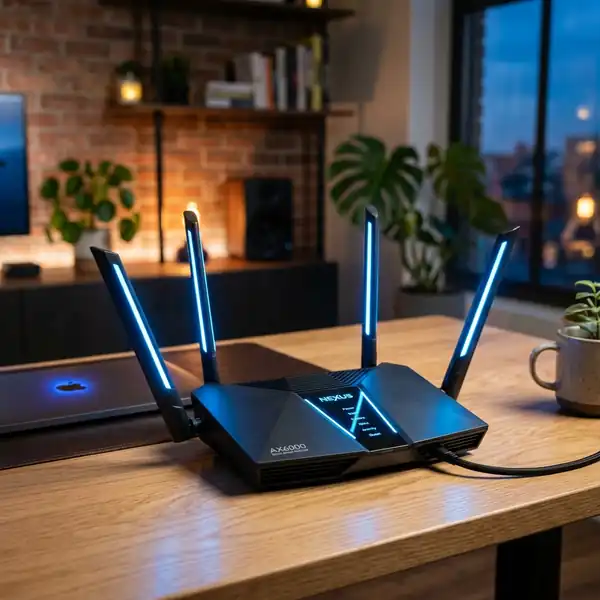
Transitioning home network environments to high-speed fiber optic broadband connections requires an equivalent upgrade to your local wireless infrastructure. Traditional modems supplied by internet service providers (ISPs) often struggle to manage multiple connected devices simultaneously, causing latency, buffering, and dropped packets. To resolve these local bottlenecks and leverage your internet plan, upgrading to a Wi-Fi 6 (802.11ax) router is the ideal solution.
The best budget-friendly Wi-Fi 6 router to buy in 2026 is the TP-Link Archer AX12, offering Gigabit Ethernet ports, AX1500 wireless speeds, and excellent stability for under $50. This device provides sufficient local bandwidth for plans up to 600 Mbps, integrating advanced network features such as OFDMA, MU-MIMO, and native WPA3 security encryption to guarantee a stable and secure connection.
In this technical buying guide from DomineTec, we will analyze the top entry-level Wi-Fi 6 routers available on the market. We will explore chipset specifications, actual wireless throughput in megabits per second, the necessity of physical Gigabit ports, and how to configure wireless channels to optimize performance for your smart home devices.
Why Choose Wi-Fi 6 (802.11ax) for Your Home Network?
The Wi-Fi 6 standard, technically designated as IEEE 802.11ax, was engineered specifically to address network congestion. Unlike its predecessors, Wi-Fi 5 (802.11ac) and Wi-Fi 4 (802.11n), which focused primarily on increasing peak speeds for a single client device, Wi-Fi 6 introduces improvements in spectral efficiency and data throughput when multiple devices are active on the network.
The core technologies built into the Wi-Fi 6 standard include:
- OFDMA (Orthogonal Frequency-Division Multiple Access): This mechanism divides a single wireless channel into smaller sub-channels called Resource Units (RUs). The router can transmit data to multiple devices during a single transmission cycle, reducing network latency and ping times for online gaming and VoIP calls.
- Bi-directional MU-MIMO: Allows the router to use multiple spatial streams to transmit and receive data from several client devices concurrently, rather than sequential round-robin scheduling, maximizing total throughput.
- Target Wake Time (TWT): A smart scheduling protocol that determines when battery-powered clients (such as smartphones and IoT sensors) wake up to transmit data, reducing energy consumption and extending battery life.
- BSS Coloring: Adds a digital signature (color code) to the router's physical signal. Devices connected to your network ignore transmissions on the same channel from neighboring routers, preventing signal degradation and co-channel collision.
With smart assistants, cameras, Smart TVs, and mobile devices operating simultaneously in modern households, Wi-Fi 6 prevents throughput degradation and firmware crashes. If you want to optimize your wireless channels for gaming, see our guide on the best 5 GHz Wi-Fi channel for gaming.
Technical Comparison of Budget Wi-Fi 6 Routers
Below is a comparative breakdown of the most reliable cheap Wi-Fi 6 routers suited for fiber broadband plans:
1. TP-Link Archer AX12 (AX1500)
The Archer AX12 is a popular model among network installers due to its low cost and high reliability. Powered by a MediaTek MT7981B dual-core processor clocked at 1.3 GHz and paired with 128 MB of DDR3 RAM, it handles local routing tables efficiently. It delivers nominal speeds of up to 300 Mbps on the 2.4 GHz band and 1201 Mbps on the 5 GHz band.
The rear panel features 3 Gigabit Ethernet ports (1 WAN and 2 LAN). Four external omnidirectional antennas provide excellent signal coverage. It is a highly stable device suitable for plans up to 600 Mega.
2. Mercusys MR60X (AX1500)
Mercusys, a budget-focused subsidiary of TP-Link, offers the MR60X as a highly affordable entry-level option. Built on a hardware platform similar to the Archer series, the MR60X offers AX1500 speeds, 3 Gigabit Ethernet ports (1 WAN + 2 LAN), and native support for EasyMesh wireless configurations. It is ideal for users seeking to transition to Wi-Fi 6 at the lowest price point.
3. Xiaomi Router AX3000T
For users needing higher raw speeds, the Xiaomi AX3000T is a strong contender. It operates on the AX3000 standard, supporting up to 2402 Mbps on the 5 GHz frequency by utilizing 160 MHz channel bandwidth and 1024-QAM modulation. It features a MediaTek Filogic 820 dual-core 1.3 GHz CPU and 256 MB of RAM, supporting up to 128 active connections. It comes equipped with 4 auto-sensing Gigabit Ethernet ports.
| Router Model | Nominal Speed | Physical Ports | RAM Memory | 5G Channel Width | Value Rating |
|---|---|---|---|---|---|
| TP-Link Archer AX12 | AX1500 (1500 Mbps) | 3 Gigabit Ports | 128 MB | 80 MHz | Excellent (Reliable) |
| Mercusys MR60X | AX1500 (1500 Mbps) | 3 Gigabit Ports | 128 MB | 80 MHz | Very High (Budget) |
| Xiaomi AX3000T | AX3000 (3000 Mbps) | 4 Gigabit Ports | 256 MB | 160 MHz | Excellent (High Speed) |
| Huawei AX2 Pro | AX1500 (1500 Mbps) | 4 Gigabit Ports | 128 MB | 80 MHz | Good (Simple UI) |
For more options on budget Gigabit devices, read our complete technical article analyzing the best cheap Gigabit routers for fiber broadband.
The Impact of Gigabit Ports on Fiber Optic Connections
A common mistake when upgrading home wireless routers is purchasing a device with high nominal wireless speeds but rear Ethernet ports capped at the Fast Ethernet (10/100 Mbps) standard. This hardware limitation creates a permanent network bottleneck.
If your router's wireless interface can transmit data at 1200 Mbps over the air, but the physical WAN port connecting the router to your fiber ONU modem is Fast Ethernet, the link speed between the modem and the router is capped at 100 Mbps. In practice, due to network encapsulation overhead (from TCP/IP headers and PPPoE protocols), your actual download speed will never exceed 94 to 95 Mbps.
Therefore, verify that your new Wi-Fi 6 router is equipped with physical Gigabit Ethernet (10/100/1000 Mbps) WAN and LAN ports. This is mandatory for any fiber optic internet plan above 100 Mbps. Recommended models like the Archer AX12 and Xiaomi AX3000T feature fully Gigabit interfaces, allowing plans of 300 Mbps, 500 Mbps, or higher to pass through without physical constraints.
Optimizing Wireless Frequencies: 2.4 GHz vs. 5 GHz Configurations
Wi-Fi 6 operates across two separate frequency bands, each serving distinct technical functions. The 2.4 GHz band utilizes longer radio wavelengths that travel further and penetrate obstacles like concrete walls easily. However, it offers lower speeds and is prone to interference. In Wi-Fi 6 setups, 2.4 GHz is best reserved for smart home IoT devices and legacy equipment located far from the router.
The 5 GHz band delivers fast download and upload speeds, ideal for 4K streaming and low-latency gaming. Its primary drawback is a shorter signal range and high attenuation through physical barriers. To maximize 5 GHz performance, configure your channel width correctly. While routers default to 40 or 80 MHz, selecting 160 MHz (available on the Xiaomi AX3000T) doubles the available bandwidth by grouping adjacent channels together.
However, in crowded environments like apartment buildings, a 160 MHz channel width may suffer from co-channel interference. In these scenarios, adjusting the setting to 80 MHz provides a more stable connection and reduces ping times. To understand how to configure the lower band, check our guide on the best 2.4 GHz Wi-Fi channel with no interference.
DomineTec Tip: Avoid unifies SSID features (Smart Connect) on your budget Wi-Fi 6 router. Set up separate names for the 2.4 GHz and 5 GHz networks (e.g., "HomeNet_2G" and "HomeNet_5G"). This allows you to manually connect high-demand clients (PCs, consoles, TVs) to the 5 GHz band while keeping the 2.4 GHz band free for smart devices.
Step-by-Step Configuration Guide for Wi-Fi 6 Routers
Follow these steps to set up and configure your new Wi-Fi 6 router:
- Set Bridge Mode on the ISP Modem: Log into the admin portal of the modem supplied by your service provider. Disable its internal Wi-Fi to prevent interference and change the operation mode to "Bridge". This configures the ISP modem to act as a physical signal pass-through.
- Connect the Cables: Connect a solid copper Cat5e or Cat6 Ethernet cable from LAN Port 1 on the ISP modem to the WAN port on your new Wi-Fi 6 router.
- Access the Router Admin Panel: Connect your PC to a LAN port on the new router via cable, or connect to the default Wi-Fi network printed on the label. Open a browser and enter the default IP address (typically
192.168.0.1for TP-Link/Mercusys, or192.168.31.1for Xiaomi). - Configure WAN Settings: In the Internet Setup wizard, select your connection type. Select "PPPoE" and input the username/password provided by your ISP if required. Otherwise, select "Dynamic IP (DHCP)".
- Update DNS Servers: Go to the DHCP Server settings on your router and replace the default ISP DNS addresses with high-performance public DNS servers. Set the Primary DNS to
1.1.1.1(Cloudflare) and the Secondary DNS to8.8.8.8(Google) to improve web page load speeds. - Configure Security: Create a unique name (SSID) for your networks. Set the security protocol to WPA3-Personal (or WPA2/WPA3-Personal hybrid mode for older clients) and choose a strong password. Save settings and reboot the router.

Troubleshooting Performance Bottlenecks
If you experience slow speeds or dropped connections after installing your Wi-Fi 6 router, use this troubleshooting table to locate the cause:
| Symptom | Probable Cause | Verification Test | Recommended Solution |
|---|---|---|---|
| Speeds capped at 90-95 Mbps over LAN or Wi-Fi | Damaged or 4-wire Cat5 Ethernet cable between ONU and router. | Check your PC's network adapter settings to see if it shows a link speed of 100 Mbps instead of 1.0 Gbps. | Replace the cable with a certified 8-wire copper Cat5e or Cat6 Ethernet cable. |
| Frequent disconnects far from the router | Client is on the 5 GHz band, which is attenuated by multiple walls. | Check the signal strength icon on your phone; if it is at 1 or 2 bars, attenuation is causing packet loss. | Connect to the 2.4 GHz SSID for longer range, or set up a Mesh network. |
| Packet loss and jitter during online gaming | Co-channel interference from neighboring networks in range. | Use a Wi-Fi analyzer application to scan the wireless spectrum and find channel congestion. | Change the 5 GHz channel to an unused frequency (e.g., 36, 40, 44, or 48) and set the width to 80 MHz. |
| Older smart devices cannot connect to the Wi-Fi | Smart device does not support WPA3 security or 802.11ax wireless modes. | Verify if IoT devices connect when security protocol is modified in the admin panel. | Set security mode to WPA2-PSK (AES) and change the 2.4 GHz mode to 802.11b/g/n mixed. |
If you require a broader coverage area using multiple interconnected routers, consider a Mesh network solution. Check out our detailed review on the best budget mesh Wi-Fi routers for home networks.
Router Maintenance for Stable Wi-Fi 6 Connections
To keep your budget Wi-Fi 6 router performing optimally over time, implement the following maintenance routines:
- Disable Legacy Features: If your Wi-Fi 6 router has legacy protocols enabled by default (such as compatibility mode for Wi-Fi 2), disable them. This frees up resources on the MediaTek processor.
- Schedule Auto-Reboots: Configure the router to reboot automatically during off-peak hours (e.g., weekly at 4 AM). This clears the RAM cache and releases unused IP addresses.
- Firmware Maintenance: Download and install the latest firmware versions from the manufacturer. Wi-Fi 6 protocols receive regular security patches and stability updates.
Upgrading to a budget-friendly Wi-Fi 6 router in 2026 is a practical way to improve your local connection speed. By choosing a model with physical Gigabit ports and configuring your network settings correctly, you ensure a stable and reliable home network.
Frequently Asked Questions (FAQ)
1. Can I connect older devices to a Wi-Fi 6 router?
Yes. The Wi-Fi 6 standard (802.11ax) is backward compatible with all older Wi-Fi standards (802.11a/b/g/n/ac). Legacy clients (Wi-Fi 4 or Wi-Fi 5) will connect normally, though only Wi-Fi 6 compatible devices will benefit from the advanced efficiency and speed features of the 802.11ax standard.
2. Is a 160 MHz channel width better than 80 MHz?
Only in low-interference environments. A 160 MHz channel width doubles your theoretical speed, but it occupies a larger portion of the radio spectrum, making it susceptible to interference in dense housing areas. An 80 MHz width is recommended for better stability in crowded neighborhoods.
3. What is the difference between the Archer AX12 and the Xiaomi AX3000T?
The Xiaomi AX3000T supports up to 3000 Mbps nominal speed by using 160 MHz channels and advanced modulation, compared to the 1500 Mbps limit of the Archer AX12. The Xiaomi device also features 256 MB of RAM (versus 128 MB on the Archer AX12), allowing it to manage a higher number of simultaneous connections stably.
4. Do cheap Wi-Fi 6 routers cover a larger area than Wi-Fi 5 models?
The maximum physical range is similar, as both operate under equivalent transmission power regulations. The advantage of Wi-Fi 6 is signal quality at the edges of your coverage area. Technologies like refined beamforming and LDPC error correction allow clients to maintain stable speeds even with weaker signals.
Wi-Fi 6 Advanced Security: WPA3 Encryption Explained
One of the most significant architectural updates that comes standard with Wi-Fi 6 is the introduction of WPA3 (Wi-Fi Protected Access 3) security. In previous generations of home routers running WPA2-Personal, the network utilized a Pre-Shared Key (PSK) authentication exchange. This handshake mechanism had a known security flaw: if an attacker intercepted the four-way handshake packets over the air, they could perform offline dictionary attacks to crack the Wi-Fi password without interacting with the router directly. WPA3 replaces this vulnerable method with a more secure handshake protocol known as SAE (Simultaneous Authentication of Equals), sometimes referred to as the Dragonfly Key Exchange.
SAE offers several critical advantages for home network security. First, it protects against brute-force dictionary attacks. Even if a user chooses a weak Wi-Fi password, SAE prevents attackers from guessing multiple passwords offline, forcing them to interact with the physical router for every single guess, which quickly triggers rate-limiting blocks. Second, WPA3 introduces forward secrecy. If an attacker somehow gains access to your main Wi-Fi password in the future, they still cannot decrypt past network traffic that they recorded over the air, protecting legacy data transmissions. Furthermore, WPA3 enforces 128-bit cryptographic strength in personal mode, making it much harder to compromise local data.
However, running these advanced cryptographic algorithms requires higher processing power from the router's internal CPU. While older routers would experience significant slowdowns or crashes under WPA3 workloads, budget-friendly Wi-Fi 6 routers are equipped with modern MediaTek and Broadcom chipsets that handle WPA3 encryption via hardware-level acceleration. This allows you to secure your network without impacting packet routing speeds or wireless latency. If some of your older smart home devices or legacy laptops do not support WPA3, you can easily configure your router to run in a hybrid WPA2/WPA3-Personal Transition Mode, ensuring backward compatibility while protecting newer devices with the updated security standard.
Summary of Home Network Improvements
Choosing the best budget Wi-Fi 6 router in 2026 ensures your home network can handle high-speed fiber internet and eliminates local performance bottlenecks. Using Gigabit Ethernet ports is required to support plan speeds over 100 Mbps, and configuring separate frequency bands helps maintain stable connections for gaming, streaming, and smart home devices.




