Best 2.4GHz Wi-Fi Channel to Avoid Interference & Boost Speed
To maximize wireless network speeds and reduce dropouts on your local network, channels 1, 6, and 11 are the best Wi-Fi channels in the 2.4GHz frequency band because they are the only three channels that do not overlap (non-overlapping), eliminating adjacent-channel interference and drastically reducing packet collisions. Configuring your router manually to operate strictly on one of these three distinct channels, rather than leaving the channel selection set to automatic or choosing intermediate channels, is the single most effective way to optimize a 2.4GHz wireless connection.
The 2.4GHz frequency spectrum is one of the most heavily saturated electromagnetic bands in residential areas. It is shared by older routers, range extenders, smart home electronics, Bluetooth peripherals, and various Internet of Things (IoT) sensors. Because this band is narrow and crowded, users frequently experience signal degradation, buffering, and disconnects. By understanding the physics of RF (Radio Frequency) transmission and using diagnostic tools to select the optimal channel, you can configure your router to deliver the best possible performance.
The Technical Architecture of the 2.4GHz Wireless Band
To understand why specific channels are preferred, we must look at how the 2.4GHz ISM (Industrial, Scientific, and Medical) band is partitioned. In North America and Brazil, the regulatory bodies (such as the FCC and Anatel) allocate a spectrum ranging from 2.400 GHz to 2.4835 GHz. This range is divided into 11 distinct channels (though European and Japanese standards allow for channels 12, 13, and 14).
Every standard Wi-Fi channel requires a transmission envelope of 20 MHz to operate. However, the center frequencies of these 11 channels are separated by only 5 MHz. For example, Channel 1 is centered at 2.412 GHz, which means its spectral mask spreads from 2.402 GHz to 2.422 GHz. Because of this, Channel 1 physically overlaps with Channels 2, 3, 4, and 5. If your router is configured to operate on Channel 3, it will receive signal spillover from any nearby router operating on Channel 1 and Channel 6, leading to massive data errors.
This overlapping behavior causes two specific types of RF interference:
- Co-channel Interference: This occurs when multiple routers are configured to use the exact same channel (for example, two adjacent apartments using Channel 6). Under the 802.11 Wi-Fi standard, devices use a protocol called CSMA/CA (Carrier Sense Multiple Access with Collision Avoidance) to coordinate airtime. Devices will check if the channel is busy before transmitting. If another router is talking, your devices will wait. While this delays transmissions, it prevents packet corruption.
- Adjacent-channel Interference: This occurs when routers operate on overlapping channels (for example, your router is on Channel 1 and your neighbor is on Channel 3). Because the devices cannot decode each other's packets, they interpret the overlapping signals as pure electromagnetic noise. This noise causes wireless packets to collide and corrupt in transit. The devices are forced to continuously retransmit data, which severely degrades your bandwidth and increases latency (ping).
Why You Should Only Configure Channels 1, 6, or 11
To establish a clean wireless environment without adjacent-channel interference, we must select channels that maintain a separation of at least 25 MHz between their center frequencies. When analyzing the 1 to 11 channel chart, the only three channels that satisfy this mathematical criteria are Channels 1, 6, and 11.
If all Wi-Fi routers in a neighborhood are set to either Channel 1, 6, or 11, the networks will only encounter co-channel interference. The CSMA/CA protocol will manage the airtime cleanly, similar to how traffic lights coordinate vehicles at an intersection. However, if a single router is configured to an intermediate channel, such as Channel 3 or 4, it acts as a source of destructive noise for all networks on Channels 1 and 6, degrading the connection quality for everyone in the vicinity.
The Evolution of 802.11 Standards in the 2.4GHz Band
The 2.4GHz band has evolved through several iterations of the IEEE 802.11 wireless standard. Legacy standards, such as 802.11b (relying on DSSS modulations) and 802.11g (utilizing OFDM), laid the groundwork but were highly inefficient. With the introduction of 802.11n (Wi-Fi 4), Multiple-Input Multiple-Output (MIMO) technology allowed routers to transmit data using multiple antennas simultaneously, improving coverage.
Today, modern routers implement 802.11ax (Wi-Fi 6), which introduces OFDMA (Orthogonal Frequency-Division Multiple Access) and BSS Coloring. BSS Coloring tags wireless frames from different networks with a digital identifier (a "color"). If your router detects a transmission on the same channel (co-channel interference) but with a different color, it can ignore the signal and transmit anyway, provided the signal strength is below a certain threshold. However, this technology only works if both the router and the client devices support Wi-Fi 6. Legacy client devices (Wi-Fi 4 or 5) connected to your network will force the router to use backward-compatibility protection mechanisms like RTS/CTS (Request to Send / Clear to Send) handshakes, which add administrative overhead and slow down overall wireless throughput.
Non-Wi-Fi Sources of 2.4GHz Signal Interference
Because the 2.4GHz band is unlicensed, it is used by many non-networking consumer appliances. Even if you optimize your channel settings, these devices can emit significant electromagnetic noise that degrades your connection:
- Microwave Ovens: Microwaves cook food by emitting RF radiation at approximately 2.450 GHz. While they are shielded, small amounts of radiation leakage are common. This leakage is powerful enough to overwhelm local Wi-Fi signals instantly when the microwave is running, particularly if the router or client is nearby.
- Bluetooth Devices: Peripherals like wireless headphones, keyboards, mice, and game controllers communicate using the 2.4GHz band. They utilize FHSS (Frequency Hopping Spread Spectrum) to mitigate collisions, but a high density of active Bluetooth devices will still create residual RF noise.
- Wireless Baby Monitors and Security Cameras: Many older or cheaper monitoring devices stream analog signals continuously on 2.4GHz, completely blocking the channels they occupy.
- Cordless Landline Phones: Devices operating on 2.4GHz can emit constant RF signals that disrupt local networking hardware.
- Zigbee and Thread Smart Home Networks: Modern smart home hubs (like Philips Hue or Amazon Echo devices) often use Zigbee or Thread wireless protocols to control smart bulbs and switches. Since these protocols run on the exact same 2.4GHz spectrum, a poorly planned Zigbee network can easily overlap with Wi-Fi channels 1, 6, or 11. To prevent this, network planners must align Zigbee channels (such as channel 15, 20, or 25) to sit within the "gaps" between active Wi-Fi frequencies, ensuring that home automation systems do not degrade the local wireless internet performance.
How to Scan the Local Wi-Fi Spectrum
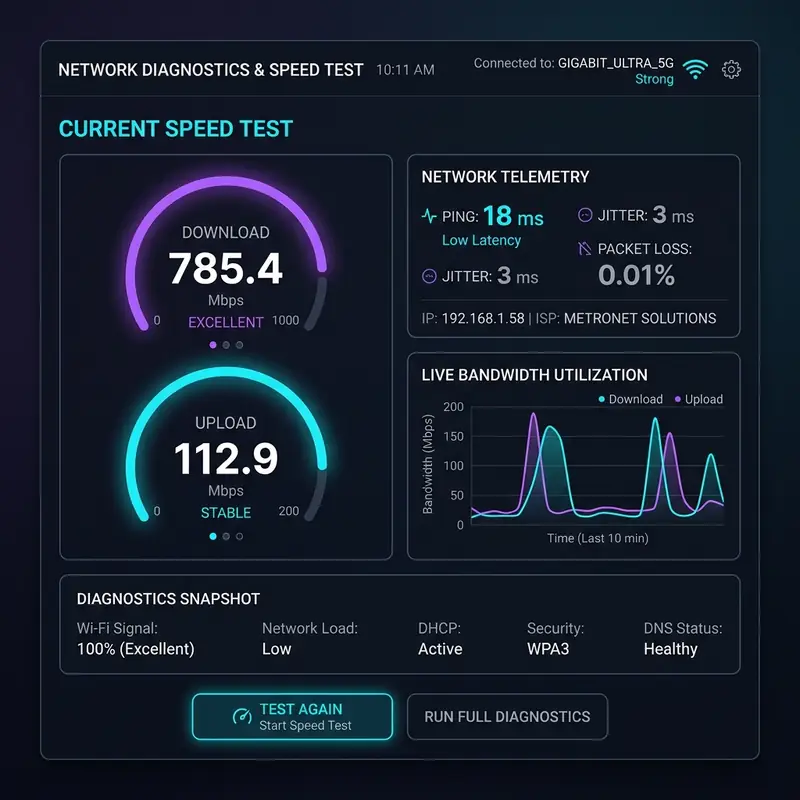
Before configuring your router, you should scan your local environment to identify which of the three non-overlapping channels (1, 6, or 11) is the least crowded. You can use free diagnostic software to perform this analysis:
1. Android (WiFi Analyzer)
Android devices allow applications to interact with the Wi-Fi card to measure local signal strength:
- Download Wifi Analyzer from the Google Play Store.
- Open the app and select the Channel Graph view.
- You will see curves representing all active local networks. The graph shows which channels are crowded.
- Tap the Channel Rating tab. The app will analyze the environment and rate Channels 1, 6, and 11 with stars, indicating which is currently the clearest.
2. Windows (NetSpot or Acrylic Wi-Fi)
For Windows users, applications like NetSpot or Acrylic Wi-Fi Home provide detailed network surveys. They display the SSID, channel, signal strength in dBm, and channel width (20MHz vs 40MHz) of all local networks. A signal strength closer to 0 dBm (e.g., -50 dBm) is strong, while signals below -80 dBm are weak and noisy.
3. macOS (Wireless Diagnostics Scan tool)
macOS includes a hidden network scanner:
- Hold down the Option (Alt) key and click the Wi-Fi icon in the top menu bar.
- Select "Open Wireless Diagnostics..."
- Do not click continue in the wizard. Instead, click Window in the top menu bar and select Scan.
- The utility will search for all local networks and display the recommended channels for both the 2.4GHz and 5GHz bands.
Choosing Channel Width: 20 MHz vs 40 MHz
Your router settings will include a field labeled "Channel Width," "Bandwidth," or "Channel Bandwidth," with choices like 20 MHz, 40 MHz, or Auto. This setting controls the size of the frequency band used by your network.
While 40 MHz increases speed by bonding two adjacent 20 MHz channels together, you should always use 20 MHz on the 2.4GHz band in crowded residential areas. Selecting 40 MHz occupies nearly the entire 2.4GHz spectrum. This makes it impossible to avoid overlapping signals from neighboring networks, resulting in constant packet collisions, high latency (ping), and dropped connections. Keep the 2.4GHz band set to 20 MHz.
Furthermore, locking your bandwidth to 20 MHz prevents co-channel conflicts by concentrating the signal within a tighter, more stable frequency range. Modern Wi-Fi standards use Orthogonal Frequency-Division Multiple Access (OFDMA) in Wi-Fi 6, which partitions the channel into smaller sub-carriers called Resource Units (RUs). This allows the router to serve multiple client devices simultaneously in a single transmission cycle, improving network efficiency even inside congested 20 MHz channels.
Step-by-Step Guide to Changing the Wi-Fi Channel
To change your Wi-Fi channel, you must log into your router's web-based admin interface (usually at 192.168.0.1 or 192.168.1.1). Here is how to do it on popular router brands:
Changing the Channel on TP-Link Routers
- Open a browser, type your router's IP address, and log in.
- Navigate to the Wireless or Advanced Wireless menu.
- Select Wireless Settings.
- Locate the Channel setting (usually set to "Auto").
- Click the dropdown menu and select Channel 1, 6, or 11.
- Locate Channel Width and set it to 20 MHz.
- Click Save to apply the changes. The Wi-Fi connection will restart briefly.
Changing the Channel on D-Link Routers
- Access your D-Link admin page and enter your credentials.
- Go to Settings and click on Wireless.
- Select the 2.4GHz frequency band.
- Under the advanced settings, find the Wi-Fi Channel dropdown.
- Change the value to 1, 6, or 11.
- Set the Channel Width to 20 MHz.
- Click Save to restart the wireless radio with the new settings.
Changing the Channel on ASUS Routers
- Navigate to the ASUS Router dashboard at
192.168.50.1and enter your login details. - Select the Wireless menu under the Advanced Settings column on the left.
- In the General tab, locate the Band selection and select 2.4GHz.
- Find the Control Channel setting and select 1, 6, or 11.
- Set the Channel Bandwidth dropdown strictly to 20 MHz.
- Click the Apply button at the bottom of the page to save.
Diagnostic Comparison Table for Wi-Fi Channel Selection
Use this table to understand the characteristics of each primary channel and choose the best configuration for your environment:
| Channel Option | RF Advantages | Known Issues / Vulnerabilities | Best Use Case |
|---|---|---|---|
| Channel 1 (2.412 GHz) | Clear of higher frequency noise. Completely isolated from Channels 6 and 11. | Can experience interference from analog baby monitors and cameras that default to lower frequencies. | Use when the higher channels (such as Channel 11) are heavily congested by neighboring networks. |
| Channel 6 (2.437 GHz) | Symmetric center channel with balanced propagation characteristics. | Highly congested since it is the default factory setting for nearly all modern routers. | Use only if your wireless scans show that neighboring routers have been moved to Channels 1 and 11. |
| Channel 11 (2.462 GHz) | The highest standard channel in North America. Usually has the lowest local Wi-Fi noise. | Vulnerable to microwave oven leakage, which operates close to 2.450 GHz. | Excellent option if your router is positioned away from the kitchen and Channel 1 is crowded. |
| Overlapping Channels (2-5, 7-10) | None. | Causes severe adjacent-channel interference, degrading your throughput and neighboring networks. | Never use these channels. They degrade local wireless performance. |
Upgrading Your Network: Migrating to 5 GHz and 6 GHz
If you have optimized your 2.4GHz settings and still experience slow speeds, you should consider moving your high-bandwidth devices to newer wireless bands:
1. The 5 GHz Frequency Band
Most modern dual-band routers support both the 2.4GHz and 5GHz bands. The 5GHz band features a wider frequency range, offering up to 24 non-overlapping channels. It also supports wider channel widths (such as 80 MHz and 160 MHz), allowing for significantly faster data rates. While 5GHz signals do not penetrate walls as effectively as 2.4GHz, the lack of congestion makes it the ideal band for high-performance activities like online gaming, video streaming, and transferring large files.
2. Separating your Wi-Fi SSIDs
Many routers use a feature called "Smart Connect" or "Band Steering" to merge both 2.4GHz and 5GHz bands under a single Wi-Fi name (SSID). While convenient, this feature often keeps capable devices connected to the slower 2.4GHz band. To prevent this, log into your router's admin interface, disable Smart Connect, and assign unique names to each band (e.g., "HomeNetwork_2.4G" and "HomeNetwork_5G"). This allows you to manually connect your high-bandwidth devices to the 5GHz network.




