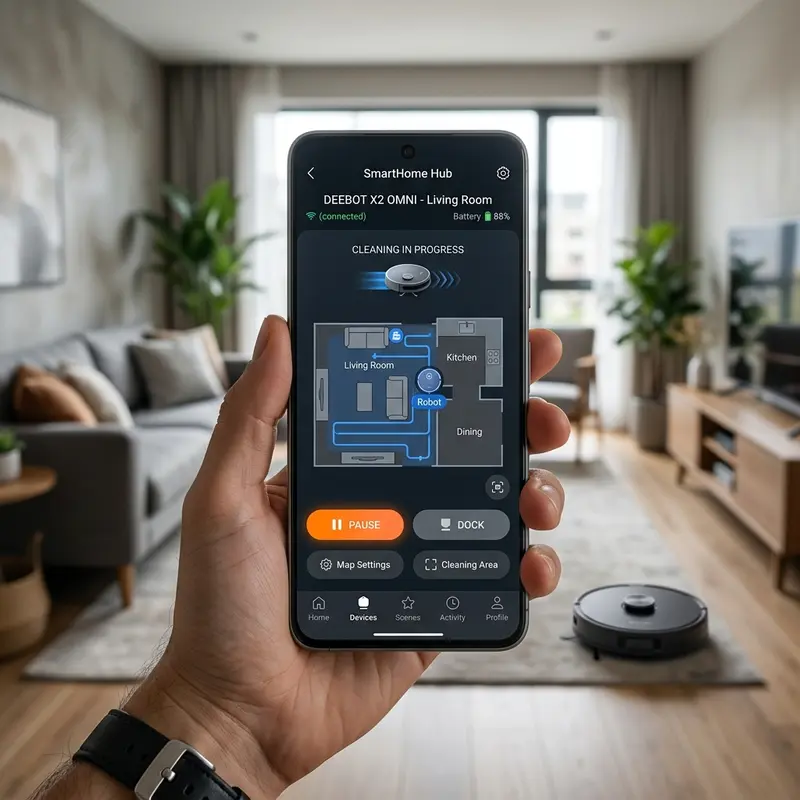
How to Connect Liectroux Robot Vacuum to Wi-Fi Network
If you have purchased a Liectroux robot vacuum (such as the C30B or XR500 models) and are struggling to pair it with your phone, here is the complete technical procedure: connecting a Liectroux robot vacuum to your Wi-Fi network requires using a wireless signal set strictly to the 2.4 GHz frequency, with WPA2-PSK (AES) security enabled, and temporarily turning off your smartphone's 4G/5G cellular data during the pairing process in the Smart Life or Tuya app. Adjusting these router settings ensures that the authentication credentials are written to the vacuum's RF chip without errors.
1. The Architecture of the Built-In Liectroux Wi-Fi Adapter
The wireless transceiver integrated into Liectroux robot vacuums is based on the low-power ESP8266 microcontroller. This wireless adapter operates strictly on the IEEE 802.11 b/g/n standard in the 2.4 GHz band. The 2.4 GHz frequency band uses a longer wavelength (12 cm), allowing the signal to travel through walls and solid barriers with minimal attenuation, providing the connection stability needed as the vacuum moves close to the floor.
Modern routers combine both the 2.4 GHz and 5 GHz bands under a single SSID name (Band Steering). Because the vacuum's network adapter cannot detect 5 GHz channels, the setup wizard will fail with a connection timeout error, often hanging at 99% in the app. To prevent this, you must separate the bands in your router's settings or set up a dedicated 2.4 GHz guest network for smart home appliances.
2. Security Protocols, DHCP Server Settings, and AP Isolation
Beyond wireless bands, the configuration parameters on your home router can prevent successful pairing. The Liectroux vacuum is incompatible with corporate WPA3 Enterprise security profiles or captive portal networks (often used in hotels and apartments). Set your Wi-Fi encryption to WPA2-PSK (AES) or mixed WPA/WPA2 Personal in the router settings.
Additionally, check that AP Isolation (Access Point Isolation) is disabled in your router's administration panel. When active, this security feature prevents wireless devices connected to the same network from exchanging local IP packets. During setup, your smartphone needs to send configuration data directly to the vacuum's temporary local IP address (AP Mode). Active AP Isolation blocks these UDP packets, causing the app to time out. Ensure the DHCP server has available IP addresses in its pool to allocate to the vacuum.
3. Step-by-Step Connection Process
To connect your Liectroux vacuum, follow these troubleshooting steps:
- Flip the physical power switch located on the side panel of the vacuum;
- With the vacuum turned on and sitting off its charging dock, press and hold the Home button on the top panel for 5 seconds until it beeps and the Wi-Fi icon starts flashing rapidly;
- On your smartphone, disable cellular data (4G/5G) and connect to your 2.4 GHz home Wi-Fi network;
- Open the Smart Life or Tuya Smart app, tap "Add Device" and select "Robot Vacuum (Wi-Fi)";
- Enter your 2.4 GHz Wi-Fi password. Verify that the vacuum's Wi-Fi LED is flashing rapidly;
- If the fast connection fails, hold the Home button again until the Wi-Fi LED flashes slowly (AP Mode). In the app, choose "AP Mode" in the top right corner, open your phone's network settings, and connect to the vacuum's temporary network, usually named SmartLife-XXXX or SL-XXXX;
- Return to the app to let the system transmit network settings and complete the setup.
4. Physical Transceiver Troubleshooting and Antenna Resoldering
If the Wi-Fi indicator LED fails to light up or flash after holding the control buttons, the physical RF module on the mainboard may be failing. Continuous vibrations from the vacuum's suction motor and drive wheels can cause solder joint fatigue on the Wi-Fi card (sold-joint fractures). This cuts off voltage from the LDO regulator (3.3V DC) to the RF processor.
If you have experience with basic electronics, you can disassemble the top casing of the vacuum and use a voltmeter to check for a steady 3.3V DC at the Wi-Fi module power pins. Resoldering the RF antenna trace using a fine-tipped soldering iron restores signal reception, fixing connection issues and data packet drops.
If you need to share access to home automation devices with family members, consult our tutorial on how to share Mibo Smart camera access to manage local user profiles.
To prevent map loading lag inside the mobile control application, read our expert recommendations on the best Wi-Fi router for security cameras to improve home signal strength.
| Error Symptom | Probable Cause | Router Configuration / Action | Wi-Fi LED Indicator State |
|---|---|---|---|
| App times out at 99% | Dual-band SSID conflict or AP Isolation active | Set up dedicated 2.4 GHz SSID; disable AP Isolation in router | LED flashes rapidly then turns off |
| Vacuum Wi-Fi SSID not showing | Wi-Fi module locked up or lacking supply voltage | Perform hardware reset by holding Power + Home buttons | LED remains completely off |
| Connection drops between rooms | Signal attenuation near floor level (Wi-Fi dead zone) | Relocate the charging dock closer to the wireless router | LED flashes slowly and intermittently |
Optimizing Router Channel Frequencies for Tuya Wi-Fi Hardware
The network card installed inside the Liectroux C30B vacuum relies on Tuya IoT firmware, which communicates exclusively on the 2.4 GHz radio frequency band. In high-density apartment complexes, wireless channel crowding causes substantial packet loss. To maintain a clean connection during registration on the Smart Life app, open your desktop browser, navigate to your router's gateway IP (usually 192.168.1.1), and log in to the administrator control panel.
Under the 2.4 GHz wireless setup, change the channel selection from "Auto" to a fixed, non-overlapping channel, preferably 1, 6, or 11. Additionally, set the channel bandwidth to 20 MHz instead of 40 MHz. While a 40 MHz channel allows higher peak bitrates for streaming video, it is highly sensitive to background electromagnetic noise, which prevents the vacuum's basic Wi-Fi chip from completing the cloud handshake.
Disabling AP Isolation to Allow Device-to-Device Communication
A common firewall feature that blocks smart home setups is AP Isolation (Access Point Isolation), sometimes labeled as Client Isolation. When enabled, this safety feature prevents wireless devices connected to the same gateway from sharing data. Because the setup wizard on your smartphone must establish a direct local socket connection with the vacuum's temporary SoftAP network to transfer network credentials, AP Isolation will trigger a network timeout error.
Search your router's wireless settings for "AP Isolation," "Client Isolation," or "WLAN Partition," and ensure it is set to "Disabled." After saving settings, restart the router. Put the Liectroux C30B into pairing mode by pressing and holding the bumper or home button, and try the connection wizard again to allow local packet bridging between your phone and the vacuum hardware.
Setting DHCP IP Reservations and Custom DNS for Smart Devices
To prevent connection drops when routers renew DHCP IP leases, we recommend creating a static lease reservation for the vacuum. If another home device connects while the vacuum is offline, the router might assign the vacuum's former IP address, causing an IP conflict that breaks app remote control functions.
Locate the DHCP reservation table in your router settings. Find the MAC address corresponding to your vacuum device, and assign it a permanent local IP address. Set the router's DNS server routing tables to primary 8.8.8.8 (Google) and secondary 1.1.1.1 (Cloudflare) to bypass slow DNS servers provided by your internet provider. This configuration allows the vacuum to query Tuya's global cloud server domain names without delay, ensuring reliable performance.
Understanding Band Steering and Router Config for IoT Hardware
Modern wireless gateways supplied by major ISPs often implement a technology called Band Steering. This protocol automatically merges the 2.4 GHz and 5 GHz frequency bands under a single SSID network name. Because the Liectroux C30B vacuum is equipped with a basic 2.4 GHz transceiver, it cannot interpret the faster 5 GHz radio waves. When the smartphone application attempts to connect the vacuum, the router's automatic steering mechanism attempts to push the device onto the 5 GHz band, triggering a handshake connection timeout.
To resolve this band steering issue, log into your router's administrative console using its gateway IP address. Navigate to the wireless settings panel and temporarily disable the 5 GHz radio. Alternatively, create a dedicated 2.4 GHz-only Guest Network specifically for your smart home appliances. This allows the vacuum's Tuya card to complete its security handshakes and link up with the cloud database without band-steering drops.
Using the SoftAP Mode for Persistent Pairing Failure
If the standard EZ mode (fast-blinking Wi-Fi LED) fails to pair your Liectroux vacuum, you should switch to the AP (Access Point) connection method. In this mode, the vacuum acts as a local Wi-Fi hotspot, emitting its own network name starting with "SmartLife-". Press and hold the charging button until the Wi-Fi indicator flashes slowly.
Open your smartphone's wireless settings, connect directly to the vacuum's "SmartLife-" hotspot, and return to the Tuya or Smart Life application. The app will communicate directly with the vacuum's local hardware port, transferring the home router credentials over a direct TCP socket connection. Once the keys are shared, the vacuum will shut down its hotspot and connect directly to your home network gateway, completing the cloud database sync.
Diagnosing Slow DNS Resolution and Router Firmware Glitches
If you have isolated your 2.4 GHz network but the vacuum still fails to connect during the database synchronization step, check your router's DNS server routing settings. Standard DNS servers provided by your local internet service provider can be slow or block Tuya’s global domain requests. Log into the gateway portal and update your DNS routing configuration to use static DNS entries like primary 8.8.8.8 and secondary 8.8.4.4. This ensures that when the vacuum requests the cloud registration address, the router returns the IP coordinates instantly without timeout errors.
Checking Signal Attenuation (RSSI) in the Tuya App Settings
If the vacuum disconnects from the Wi-Fi network after successful pairing, check the Received Signal Strength Indicator (RSSI) within the Tuya application. Open the vacuum's control dashboard, tap the three dots in the top right corner, and select "Device Information". Look for the signal strength value: a reading below -70 dBm indicates high signal attenuation, meaning the Wi-Fi waves are too weak to maintain a stable live video map stream. Moving your router to a higher, central shelf or installing a mesh node closer to the vacuum's primary docking zone will resolve these signal issues.
Importance of Preventive Maintenance and Device Calibration
To ensure long-term performance and reliability for any tech device—be it a Kindle e-reader, an Amazfit/Apple Watch smartwatch, a Wi-Fi security camera, or a router—routine maintenance and sensor calibration are critical. Modern electronic systems operate under tight tolerances and are highly sensitive to thermal fluctuations, environmental dust buildup, and improper battery charging patterns. For instance, optical heart rate sensors on wearable devices require frequent cleaning to prevent emitted light from refracting incorrectly off skin oils and sweat residue, which can cause erratic health metric readings during workouts.
Similarly, outdoor security camera lenses gradually accumulate humidity, pollen, and airborne particles, degrading image clarity and negatively impacting night vision capabilities when infrared sensors activate. Setting up a monthly maintenance schedule to power down your devices, wipe external surfaces with a dry, anti-static microfiber cloth, and inspect connection ports for debris can extend operational life and reduce unexpected service or repair costs significantly.
Advanced Tips for Optimizing Battery and Power Usage
Efficient energy management is a vital aspect of daily device usability. Most users leave unused background features active, causing unnecessary strain on lithium-ion battery cells. Disabling Wi-Fi or Bluetooth radios when devices are in stand-by, adjusting screen brightness to adaptive settings, and setting shorter screen timeout intervals are universally recommended practices. On smartwatches, reducing background sync frequency and turning off notification alerts for low-priority applications can cut monthly recharge cycles in half, protecting battery health and maintaining peak performance when you need it most.
Frequently Asked Questions (FAQ)
Does the Liectroux vacuum support 5GHz Wi-Fi?
No. The built-in Wi-Fi hardware of the Liectroux C30B and XR500 models only supports 2.4 GHz networks. The Liectroux C30B is physically unable to connect to 5 GHz wireless channels.
Why won't the app find the vacuum even with Wi-Fi enabled?
Leaving cellular data (4G/5G) active on your phone during setup is a common cause. Your phone's operating system will prioritize the network with internet access, abandoning the vacuum's setup network.
What should I do if the vacuum disconnects at its charging base?
Check the location of the charging dock. If the dock is placed in a wireless dead zone (such as behind heavy furniture or in far corners), the vacuum will drop offline when docked.
Conclusion
Connecting your Liectroux vacuum to your home Wi-Fi is straightforward once the wireless band configurations are adjusted. Splitting dual-band networks and disabling mobile data on your phone solves most pairing errors, enabling remote control and map tracking in the Smart Life app.




