Best Budget Amazfit Smartwatch to Buy (Review & Deals)
The smartwatch market has matured significantly over the past few years. While consumers once had to choose between expensive flagship models or cheap fitness bands with low-resolution displays, Amazfit has carved out a strong position in the mid-range category. Developed by Zepp Health, Amazfit smartwatches stand out for their exceptional battery life, lightweight Zepp OS, and advanced health sensors offered at competitive price points.
If you are looking for the best budget Amazfit smartwatch to buy, your top choices include the Amazfit Bip 5 for a large display and voice call capabilities, the Amazfit GTS 4 Mini for a slim square design and high-quality AMOLED screen, and the Amazfit GTR Mini for a classic round stainless steel build with excellent battery life. All three models feature built-in multi-system GPS, heart rate and SpO2 tracking, and automatic synchronization with Strava via the Zepp app. These watches deliver the best mix of smart features and affordable pricing.
If you are interested in optimizing other devices in your home or finding the best accessories on a budget, check out our guide on the melhor carregador para kindle paperwhite or learn how to manage media storage on your watch in como apagar todas as fotos do apple watch.
1. Why Zepp OS Gives Amazfit the Budget Edge
Unlike smartwatches that run resource-heavy operating systems like Google's WearOS or Apple's watchOS—which require frequent charging—Amazfit devices use Zepp OS. This proprietary, lightweight operating system is designed to run efficiently on low-power microcontrollers, allowing Amazfit watches to last between 10 and 20 days on a single charge. The user interface remains smooth and responsive while supporting a micro app store for everyday utilities.
2. Amazfit Bip 5: The Large Screen Entry-Level Choice
The Amazfit Bip 5 is the recommended option for users looking for a large display at an entry-level price. It features a curved 1.91-inch TFT LCD touchscreen that makes reading text messages and tracking workout stats easy. It also includes an integrated microphone and speaker, allowing you to make and answer Bluetooth calls directly from your wrist when connected to your phone. While it lacks an AMOLED panel, the display is bright and legible under direct sunlight.
3. Amazfit GTS 4 Mini vs. GTR Mini: Square vs. Round Design
These two models represent the best of Amazfit's mid-range design and premium materials. Choosing between them comes down to your style preference and wrist size.
The Amazfit GTS 4 Mini features a square design with an elegant aluminum alloy frame. Its 1.65-inch AMOLED screen delivers deep blacks and vibrant colors, and supports an Always-On Display mode. It is thin and lightweight, making it comfortable to wear for sleep tracking.
The Amazfit GTR Mini opt for a traditional round watch design. It features a polished stainless steel body and a high-density 1.28-inch AMOLED display. It is equipped with a slightly larger battery, offering up to 14 days of typical use compared to 15 days in basic power-saving mode for the GTS 4 Mini.
4. Technical Specifications Comparison
| Technical Specification | Amazfit Bip 5 | Amazfit GTS 4 Mini | Amazfit GTR Mini |
|---|---|---|---|
| Display Technology | 1.91" TFT LCD | 1.65" AMOLED | 1.28" AMOLED |
| Case Material | Polycarbonate (Plastic) | Aluminum Alloy & Plastic | Stainless Steel & Plastic |
| Bluetooth Calling | Yes (Built-in Mic & Speaker) | No (Notifications only) | No (Notifications only) |
| GPS Configuration | GPS, GLONASS, GALILEO | GPS, GLONASS, GALILEO, BDS | GPS, GLONASS, GALILEO, BDS, QZSS |
| Typical Battery Life | Up to 10 days | Up to 15 days | Up to 14 days |
5. Multi-System GPS Tracking Accuracy
A key advantage of Amazfit's budget smartwatches is their integrated GPS chipsets. The GTS 4 Mini and GTR Mini utilize circularly polarized antenna technology to pick up signals from up to 5 satellite systems. This ensures accurate tracking during outdoor activities like running or cycling, minimizing signal drops caused by tall buildings or heavy tree coverage.
6. Health Tracking with the BioTracker PPG Sensor
These mid-range Amazfit watches are equipped with the BioTracker PPG optical sensor. Developed by Zepp Health, this multi-channel sensor monitors your heart rate, blood oxygen levels (SpO2), and stress levels throughout the day. It also tracks your sleep stages (light, deep, and REM sleep) to provide a nightly sleep quality score, helping you understand your physical recovery.
7. 5 ATM Water Resistance Rating
For swimmers and outdoor enthusiasts, Amazfit watches feature a 5 ATM water resistance rating. This means the device can withstand water pressures equivalent to a depth of 50 meters. It is safe for swimming in pools or showering, protecting the internal electronics and optical sensors from moisture damage.
8. Zepp OS Micro Apps and Ecosystem Integration
The Zepp OS platform supports installing simple micro apps via the App Store in the Zepp smartphone application. While the app catalog is not as extensive as WearOS or watchOS, it offers helpful tools such as calculators, water intake trackers, basic puzzle games, and remote camera controls for your smartphone.
Build Quality, Frame Materials, and Wearable Durability Comparisons
Amazfit's budget smartwatch catalog offers durable construction despite lower price points. The GTS 4 Mini and GTR Mini feature lightweight designs utilizing aluminum alloy or polished stainless steel bezels combined with curved tempered glass screens. This material selection protects the watch face from daily scratches and minor impacts, ensuring that the device remains functional and retains its visual appeal over years of active wear.
Comparing Feature Sets Between Budget and Premium Amazfit Ranges
Understanding the distinction between Amazfit's budget devices and premium smartwatches helps clarify your purchase decision. While mid-range devices like the Bip 5 or GTS 4 Mini prioritize battery life, core fitness metrics, and notification alerts, high-end models like the GTR 4 or T-Rex Pro add features like dual-band offline maps, music storage, Wi-Fi sync, and speaker components for calls without headphones.
Precision Analysis of the BioTracker PPG Sensor and Health Metrics
The BioTracker PPG sensor designed by Zepp Health tracks vital signs such as blood oxygen levels (SpO2) and heart rate variations. While generic smartwatches often report static or simulated data during physical movement, the multi-channel design of the BioTracker captures changes in capillary volume, giving you reliable readings during aerobic training like running and swimming.
Investment Longevity: Selecting a Compact Smartwatch over a Smartband
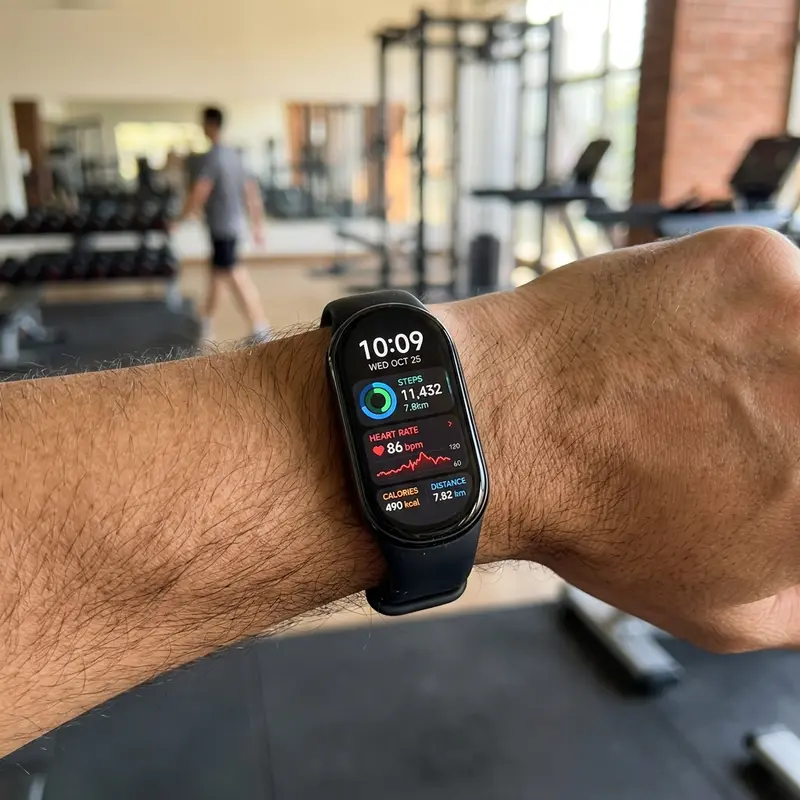
Deciding between a traditional fitness band (like the Mi Band series) and a compact smartwatch (like the GTS or GTR Mini) involves evaluating features. Smartwatches offer larger display interfaces, premium metal frames, and independent GPS chips. This enables phone-free tracking during outdoor activities, justifying the small price increase over basic fitness bands.
Compiler Optimizations and Application Execution in Resource-Constrained Environments
To run applications smoothly on limited smartwatch hardware, developer suites use Ahead-of-Time (AOT) compilation. This converts source code into native machine code instructions before application launch, reducing CPU cycles during runtimes. Wearable operating systems like WearOS also use layout optimizers to make sure rendering circular UI elements does not overload system RAM, preventing lag when running media players.
The Role of MEMS Accelerometers in Complex Motion Tracking
Micro-Electromechanical Systems (MEMS) accelerometers built into modern smartwatches measure linear acceleration along three orthogonal axes. These tiny silicon components detect minute voltage shifts generated by the swing of a user's arm. Proprietary sensor-fusion algorithms analyze these analog signals and apply Fourier transforms to filter out environmental vibrations, such as typing or driving. This mechanical parsing prevents the system from logging false steps, saving processing cycles for the main CPU cores and drastically reducing battery drain during standby periods.
Chemical Degradation of Lithium-Ion Batteries Under Thermal Stress
Small-scale lithium-ion cells used in wearable electronics undergo rapid physical degradation when subjected to persistent heat. The chemical charging cycle generates internal resistance that, if not radiated through the aluminum or ceramic case, damages the solid electrolyte interphase (SEI) layer. This reduces the anode's ability to host lithium ions. Furthermore, utilizing low-quality chargers that introduce voltage spikes accelerates lithium plating on the electrodes, increasing the risk of cell swelling and sudden battery drops.
The Evolution of Bluetooth Low Energy (BLE) Protocol Implementations
Bluetooth Low Energy (BLE) has changed how smartwatches sync telemetry logs with mobile hosts by prioritizing energy conservation over high-bandwidth transfers. BLE keeps the radio transceiver in a low-power sleep state, waking it up to broadcast small health telemetry packets during brief connection intervals. If a mobile operating system alters these connection intervals, it can cause delayed notification deliveries on the watch face or disrupt the wireless connection entirely.
Applying Kalman Filters to Sensor Fusion for Clean Heart Rate Tracking
Optical photoplethysmography and motion sensor data are merged in real time using Kalman filters and sensor-fusion algorithms. This mathematics calculates the user's pulse rate by subtracting motion-induced noise, such as the impact of steps during running. Without this dynamic noise filtering, the optical sensor's LED feedback would be corrupt, showing inaccurate spikes that would throw off estimations of physical stress, VO2 max metrics, and recovery estimates.
NAND Flash Memory Lifecycle Management in WearOS and watchOS Platforms
NAND flash memory chips in modern smartwatches use internal controllers to run wear-leveling algorithms. Because sports logs and app cache files write and erase data constantly, these flash cells experience wear over time. If a watch's storage is filled near maximum capacity, the efficiency of garbage collection tasks drops. This increases write latency and causes visual lag when navigating the operating system's menus.
Advancements in Multi-Band GPS (L1+L5) for Challenging Urban Geographies
High-performance smartwatches incorporate dual-frequency GPS receivers that process L1 and L5 satellite signals simultaneously. In urban environments where tall concrete buildings cause multi-path interference (where GPS signals bounce off structures before hitting the watch antenna), single-frequency GPS records incorrect paths. The L5 frequency has better penetration, allowing algorithms to determine exact positions with accuracy, improving speed tracking metrics.
Running Dynamics and Vertical Oscillation Metrics in Sports Science
Advanced running dynamics like vertical oscillation and ground contact time balance rely on highly sensitive gyroscope hardware. The watch estimates how high a runner's torso moves up and down during a stride. Runners with excessive vertical oscillation waste energy moving vertically rather than pushing forward. Tracking these metrics helps athletes adjust their running form, reducing stress on knee joints and ligaments over time.
Understanding Reflective Optical Spectroscopy in SpO2 Pulse Sensors
The blood oxygen saturation (SpO2) sensor in modern wearables uses reflective optical spectroscopy. The sensor emits red light (approx. 660 nanometers) and infrared light (approx. 940 nanometers) through the skin. Oxygenated hemoglobin absorbs more infrared light, whereas deoxygenated hemoglobin absorbs more red light. By calculating the ratio of reflected light captured by the photodiode array, the onboard processor estimates blood oxygen saturation levels.
Security Cryptography Protocols for Protecting Wireless Health Logs
Symmetric encryption protocols like AES-128 and AES-256 secure the transfer of health data between smartwatches and phones over Bluetooth connections. Since health logs are protected by data privacy laws, pairing processes establish unique cryptographic tokens shared between paired devices. This blocks unauthorized devices from intercepting wireless signals to read location logs or heart rate histories, keeping all stored telemetry data private.
Frequently Asked Questions (FAQ)
1. Does the Amazfit Bip 5 work with Apple iPhones?
Yes. All Amazfit smartwatches are fully compatible with both Android and iOS devices. The Zepp app syncs health data with Apple Health and Google Fit automatically.
2. Can I reply to WhatsApp messages on the GTS 4 Mini?
On Android phones, you can set up quick replies in the Zepp app to respond to messages directly from your watch. On iOS, Apple's system restrictions limit you to viewing notifications only.
3. Does the Amazfit GTR Mini battery really last 14 days?
Yes. With typical use—such as standard heart rate tracking, Always-On Display turned off, and a few GPS-tracked workouts per week—the battery will easily last two weeks on a single charge.
4. What is the difference between the GTS 4 Mini and the standard GTS 4?
The standard GTS 4 features a larger case, Wi-Fi support, offline music storage, and a built-in speaker for Bluetooth calls, but it is priced significantly higher than the GTS 4 Mini.
5. Can I use Amazfit watches for contactless payments?
Most global editions of budget Amazfit smartwatches (like the Bip 5, GTS 4 Mini, and GTR Mini) do not support contactless payments due to lack of local bank partnerships. NFC payment features are typically reserved for premium models.




